
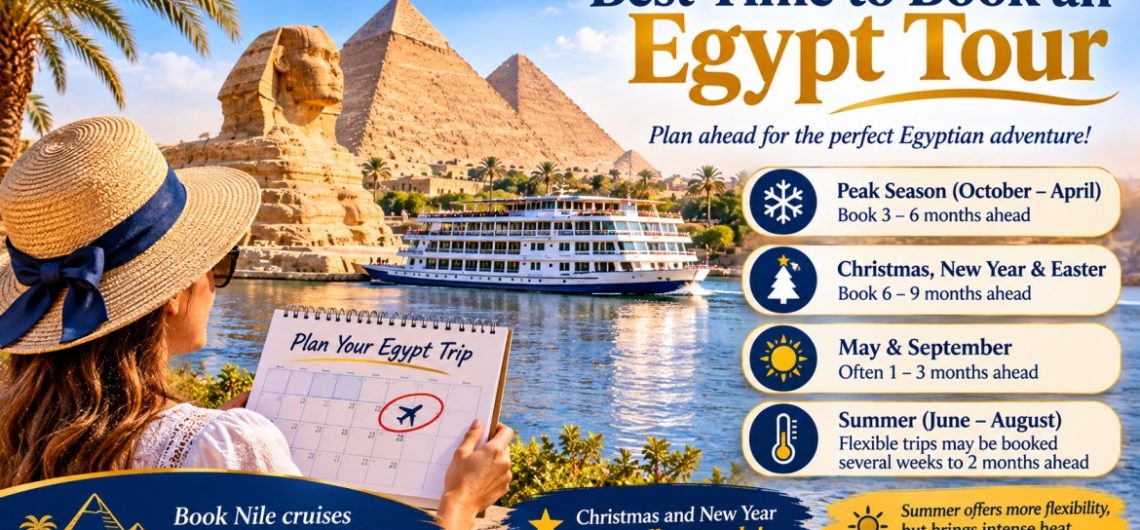
Knowing the best time to book an Egypt tour can make the difference between a smooth, memorable journey and a stressful, overpriced, overcrowded experience. Egypt is one of the world’s most rewarding travel destinations, but it is also a country with strong seasonal patterns, limited availability at popular sites, high-demand holiday periods, and logistical details that require planning. The pyramids, temples, tombs, Nile cruises, Red Sea resorts, domestic flights, licensed guides, and special access tickets all behave differently depending on the time of year.
Many travelers assume they can book an Egypt tour a few weeks before departure and still get the best hotels, the best guides, the best Nile cruise cabin, and the best flight connections. That may work in low season, but it rarely works during peak months such as December, January, February, March, October, and November. If you are traveling around Christmas, New Year, Easter, school holidays, or a popular wedding or honeymoon season, early planning becomes even more important.
This guide explains when to book an Egypt tour, how far in advance you should plan, which travel styles require earlier booking, how seasons affect prices and crowds, and how to build a realistic timeline for flights, hotels, Nile cruises, private guides, domestic transfers, tomb access, and special experiences. Whether you are planning a classic Cairo-Luxor-Aswan itinerary, a luxury Nile cruise, a family holiday, a Red Sea beach extension, a honeymoon, a solo trip, or a deep historical journey through temples and tombs, this article will help you choose the right booking moment and avoid common planning mistakes.
If you are reading this in November 2026 and dreaming about a Christmas or New Year trip, the message is simple: plan quickly. If you are thinking ahead to 2027, you are in a much stronger position. The best Egypt tours are not always the most expensive ones. They are the ones booked with enough time to secure the right guide, the right cabin, the right hotel location, the right flight schedule, and the right pace.
The best time to book an Egypt tour is not only about finding a cheap price. It is about securing the right season, the right guide, the right accommodation, and the right rhythm for your journey.
Quick Answer: When Should You Book an Egypt Tour?
The best time to book an Egypt tour depends on your travel dates and style. For peak-season travel such as Christmas, New Year, Easter, spring, autumn, and school holidays, book 4 to 9 months in advance. For luxury Nile cruises, private guides, honeymoon itineraries, family trips, and Red Sea resort extensions during busy months, book 6 to 12 months ahead when possible. For moderate-season trips, 2 to 4 months in advance is often enough. For low-season or flexible travel, 4 to 8 weeks may work, but availability can still change quickly for popular guides, specific hotels, and Nile cruise cabins. The safest rule is simple: the more fixed your dates, the more specific your hotel or cruise preferences, and the more people in your group, the earlier you should book.
Why the Best Time to Book an Egypt Tour Matters
Egypt is not a destination where every part of the trip can be improvised comfortably. The country has a strong tourism calendar, and certain periods become extremely busy. Flights between Cairo, Luxor, Aswan, Hurghada, Sharm El Sheikh, and Abu Simbel can fill quickly. Nile cruise cabins in high season sell out months in advance. The best licensed guides are booked early. Hotels near major sites, especially those with good reviews, family rooms, Nile views, pool access, or convenient locations, can become limited. Special tomb entries, conservation closures, and site regulations can also affect your plans.
Booking timing matters because Egypt travel is a chain of connected decisions. Your international flight affects your arrival day. Your arrival day affects your Cairo hotel. Your Cairo schedule affects your domestic flight to Luxor. Your Luxor stay affects your Nile cruise or Aswan transfer. Your Aswan plans affect whether you can visit the Temples of Abu Simbel. Your Red Sea extension depends on flight connections, resort availability, and transfer logistics. A small delay in booking can create a domino effect that reduces choice, increases price, or forces you into a less comfortable itinerary.
Another reason timing matters is quality. Egypt’s greatest sites deserve thoughtful guiding. A knowledgeable guide can transform the Giza Pyramids Complex, Karnak Temple, the Valley of the Kings, and Luxor Temple from a collection of ancient stones into a vivid historical narrative. The best guides are not always the most expensive, but they are often booked early, especially during peak season. If you wait too long, you may receive a guide who is competent but less specialized, or you may be placed in a larger group tour with less flexibility.
Finally, booking timing affects your budget. Egypt can be excellent value, but peak-season pricing is real. Hotels, cruises, resorts, and internal flights often increase rates around Christmas, New Year, Easter, and major school holiday periods. Booking early does not always guarantee the lowest price, but it usually gives you more choice, better cabin categories, more suitable hotel locations, and clearer cancellation terms. Waiting until the last minute can mean accepting higher prices, less convenient schedules, or compromised comfort.
Egypt Travel Seasons: The Foundation of Smart Booking
To understand the best time to book an Egypt tour, you first need to understand Egypt’s travel seasons. The country has a climate that makes winter and spring especially popular, while summer is hotter and quieter in inland cultural sites. However, the Red Sea coast, Nile cruises, Cairo museums, and Upper Egypt temples all have slightly different demand patterns.
| Season | Months | Travel Conditions | Booking Advice |
|---|---|---|---|
| Peak winter season | December, January, February | Mild weather, excellent sightseeing, high demand, festive atmosphere, crowded major sites. | Book 5 to 9 months ahead; Christmas and New Year require earlier planning. |
| Spring shoulder/high season | March, April, early May | Warm days, pleasant evenings, strong demand around Easter and school breaks. | Book 4 to 8 months ahead, especially for Easter and family travel. |
| Summer low season | June, July, August | Hot in Cairo, Luxor, and Aswan; better value; fewer crowds at cultural sites; Red Sea remains popular. | Book 1 to 3 months ahead for cultural trips; Red Sea resorts may need earlier booking in August. |
| Autumn shoulder/high season | September, October, November | Weather improves through October and November; demand rises sharply after summer. | Book 3 to 7 months ahead; November and pre-Christmas dates fill quickly. |
The most comfortable sightseeing months are usually October through April. During this period, daytime temperatures are pleasant in Cairo, Luxor, and Aswan, and evenings are cool enough for comfortable hotel stays and Nile walks. This is why Egypt’s high season overlaps with the Northern Hemisphere winter. Travelers escaping cold weather, holidaymakers seeking sunshine, and history lovers wanting optimal temple conditions all converge during these months.
Summer is not impossible, but it requires a different strategy. Luxor and Aswan can be very hot, especially from June to August. Sightseeing is best done early in the morning, followed by pool time, museum visits, air-conditioned transfers, and late afternoon exploration. Cairo can also feel hot, though museums, malls, hotels, and indoor attractions provide relief. The Red Sea coast is popular in summer because beach resorts, pools, water sports, and diving remain attractive, although sea temperatures are warmer and humidity can be higher.
Best Time to Book by Type of Egypt Tour
There is no single answer for every traveler. The best time to book an Egypt tour depends on the type of trip you want. A flexible solo backpacker, a family with children, a luxury honeymoon couple, and a history-focused traveler all have different booking needs.
1. Classic Egypt Tour: Cairo, Luxor, Aswan
A classic Egypt tour usually includes Cairo, the Giza Pyramids, the Egyptian Museum or Grand Egyptian Museum, Luxor temples, the Valley of the Kings, Aswan, Philae Temple, and sometimes Abu Simbel. This is the most common itinerary for first-time visitors, and it is also the most affected by seasonal demand.
For travel between December and March, book 4 to 8 months in advance. For Christmas and New Year, aim for 6 to 9 months. For Easter, book 5 to 8 months ahead. For October and November, 3 to 6 months is usually safer. If you want a specific guide, a particular hotel category, Nile-view rooms, family rooms, or convenient flight timings, earlier is better.
Classic tours are also affected by domestic flight availability. Cairo to Luxor, Luxor to Aswan, and Aswan to Cairo flights can fill quickly during high season. If your itinerary includes Abu Simbel, the Aswan to Abu Simbel flight is especially important to secure early, because morning flights are popular and capacity is limited.
2. Nile Cruise Vacation
A Nile cruise itinerary is one of the most comfortable ways to travel between Luxor and Aswan, but it is also one of the most booking-sensitive parts of an Egypt trip. Cruise cabins are limited, deck categories sell out first, family cabins are scarce, and holiday supplements apply around Christmas, New Year, and Easter.
For a standard Nile cruise outside peak dates, book 3 to 6 months ahead. For high-season travel, book 6 to 10 months ahead. For Christmas or New Year cruises, book as early as possible, ideally 8 to 12 months in advance. If you want a balcony cabin, suite, family cabin, specific ship, or particular dining arrangement, early booking is strongly recommended.
Nile cruises also require attention to embarkation and disembarkation days. Some ships depart on fixed schedules, and changing your flight dates to match the cruise can create extra hotel nights or awkward arrival times. Booking the cruise first, then building flights and hotels around it, is often the smartest approach.
3. Family Egypt Tour
Family trips need more planning because comfort, timing, room configuration, pool access, meal preferences, and pace all matter. Children may enjoy the pyramids, tombs, boats, beaches, and hotel pools, but long museum visits and hot outdoor sites can become tiring if not balanced properly.
For family travel during school holidays, Christmas, Easter, or summer beach extensions, book 5 to 9 months ahead. You may need connecting rooms, family suites, early check-in, late check-out, child-friendly hotels, private transfers, and guides who know how to explain ancient Egypt in engaging ways.
Families should also book domestic flights and airport transfers early. Traveling with children after a long international flight is easier when your driver is waiting, your hotel is confirmed, and your itinerary is not overly packed. For broader planning, see our guide to Egypt with kids.
4. Honeymoon and Romantic Egypt Tour
Honeymoon travelers often want privacy, beautiful hotels, Nile views, private guiding, romantic dinners, felucca sunsets, luxury cruise cabins, and Red Sea resort time. These preferences reduce flexibility, which means booking earlier is usually better.
For a honeymoon in high season, book 6 to 12 months ahead. For shoulder season, 4 to 8 months is sensible. If you want a specific suite, private boat, sunset experience, spa hotel, or romantic dinner location, do not leave it to the last minute. Egypt’s most atmospheric experiences are often limited by space, timing, and season.
A well-planned honeymoon route might combine Cairo for pyramids, Luxor for temples, Aswan for Nile scenery, and Hurghada, El Gouna, Marsa Alam, or Sharm El Sheikh for beach relaxation. For ideas, see our Egypt honeymoon itinerary guide.
5. Luxury Egypt Tour
Luxury travel in Egypt is about more than expensive hotels. It is about private access, expert guides, seamless transfers, premium Nile cruise suites, carefully timed site visits, gourmet dining, spa breaks, and minimal waiting. The best luxury experiences are limited by availability, so early booking is essential.
For luxury Egypt tours, book 6 to 12 months ahead, especially if traveling between December and March. If you want private pyramid photography sessions, special tomb access where permitted, high-end cruise suites, private felucca experiences, luxury Red Sea villas, or bespoke guiding, begin planning even earlier.
Luxury travelers also benefit from early booking because the best guides and drivers are often reserved months in advance. In high season, a luxury hotel is not enough if the logistics around it are poorly managed. A smooth private itinerary depends on people, vehicles, timing, and trusted coordination.
6. Budget Egypt Tour
Budget travelers have more flexibility, but they should not assume Egypt is always cheap at the last minute. During peak season, low-cost options can disappear quickly. Budget hotels, standard Nile cruise cabins, shared tours, and economical domestic flights may sell out or increase in price.
For budget travel in high season, book 3 to 6 months ahead. For low season, 4 to 8 weeks may be enough. To save money, avoid Christmas, New Year, Easter, and major school holidays. Travel in late January, February, September, or summer if you can tolerate heat. Compare package tours with independent planning, but be careful with prices that seem too low to include proper guiding, transfers, and entry tickets.
For cost planning, see our article on Egypt travel costs.
7. Red Sea Beach Vacation
Red Sea resorts in Hurghada, Sharm El Sheikh, Marsa Alam, and El Gouna have their own booking patterns. Families, divers, honeymooners, and all-inclusive resort guests often travel during school holidays, Christmas, Easter, and summer.
For Red Sea Christmas and New Year stays, book 6 to 10 months ahead. For Easter, 4 to 8 months. For summer family holidays, 3 to 6 months. For quieter periods such as late January, February, or November outside holiday weeks, 1 to 3 months may be enough.
If you are combining the Red Sea with cultural Egypt travel, book the whole route together. The hardest part is often not the resort itself, but the domestic flight or transfer connecting Luxor, Aswan, Cairo, and the coast.
8. Diving and Snorkeling Tours
Divers traveling to the Red Sea should consider water temperature, boat availability, liveaboard schedules, marine life seasons, and resort proximity to dive sites. Liveaboards in particular have limited cabins and popular dates, especially around holidays and summer vacation periods.
For liveaboard diving, book 4 to 9 months ahead. For resort-based diving during peak season, book 3 to 6 months ahead. If you want a specific boat, cabin, dive package, or remote location, earlier is better. Water conditions are generally excellent through much of the year, but winter winds and cooler water may affect comfort and exposure suits.
9. Historical, Archaeological, and Special Interest Tours
Travelers interested in deep history, Egyptology, temple symbolism, royal women, ancient art, or funerary belief often want specialist guides. These guides are not always easy to find at short notice, especially during high season.
For specialist tours, book 4 to 9 months ahead. If you want a guide focused on topics such as Hatshepsut, Queen Nefertiti, Queen Nefertari, King Khufu, symbols of ancient Egypt, or Egyptian gods, plan early. Specialist guiding is one of the easiest parts of an Egypt trip to compromise if booked too late.
How Far in Advance Should You Book Each Part of the Trip?
An Egypt tour is made up of many moving parts. Some can be booked late, while others should be secured early. The table below gives a practical planning framework.
| Trip Element | Recommended Booking Window | Why It Matters |
|---|---|---|
| International flights | 3 to 8 months ahead | Prices and direct flight availability vary widely during peak season. |
| Cairo hotels | 2 to 6 months ahead | Good locations, family rooms, Nile views, and festive periods fill early. |
| Luxor and Aswan hotels | 2 to 6 months ahead | West Bank gardens, Nile-view rooms, and convenient bases are limited. |
| Nile cruise | 4 to 10 months ahead | Cabins, deck categories, family rooms, and holiday departures sell out quickly. |
| Private guide | 2 to 6 months ahead | The best guides, especially specialists, are booked early in high season. |
| Domestic flights | 2 to 6 months ahead | Cairo-Luxor, Aswan-Cairo, and Abu Simbel flights can fill during peak months. |
| Abu Simbel flight or convoy | 2 to 6 months ahead | Morning flights and organized travel options have limited capacity. |
| Red Sea resort | 2 to 8 months ahead | Family resorts, all-inclusive packages, and holiday weeks require early planning. |
| Airport transfers | 1 to 3 months ahead | Pre-booking reduces arrival stress, especially for families and late flights. |
| Special experiences | 1 to 6 months ahead | Hot air balloons, private feluccas, photography sessions, and special dinners depend on availability. |
Month-by-Month Guide to Booking an Egypt Tour
The following month-by-month guide helps you understand not only when to travel, but when to book for each travel month. This is especially useful if you are flexible and want to choose a period that balances weather, crowds, and value.
January
January is one of the best months for sightseeing in Cairo, Luxor, and Aswan. Weather is mild, crowds are still high after the holiday period, and Nile cruises remain popular. Coptic Christmas on January 7 adds cultural significance. If you want to travel in January, book by the previous spring or early summer. For Coptic Christmas week, book even earlier.
February
February is excellent for temple visits, desert excursions, and Nile travel. Days are pleasant, evenings are cool, and crowds can be slightly lighter than late December and early January. It is one of the best months for value if you avoid holiday weeks. Book 3 to 6 months ahead for private tours and cruises.
March
March brings warmer spring weather and strong demand, especially around Easter and school breaks. Luxor and Aswan are comfortable, though occasional wind can be noticeable. If you plan to travel in March, especially around Easter, book 5 to 8 months ahead.
April
April is still popular, but heat begins to increase in southern Egypt. Easter travelers and spring break visitors create demand. Book 4 to 7 months ahead. If you are heat-sensitive, focus on early morning site visits, museums, Nile cruise comfort, and Red Sea relaxation.
May
May is a shoulder month. Early May can still be pleasant, but temperatures rise as the month progresses. It can offer good value for flexible travelers. Book 2 to 5 months ahead, especially if you want a specific guide or cruise cabin.
June
June marks the beginning of summer. Cairo, Luxor, and Aswan become hot, but the Red Sea is popular. Cultural itineraries should be paced carefully. Book 1 to 3 months ahead for inland Egypt, and 2 to 4 months ahead for Red Sea family resorts.
July
July is hot and lower demand for temple-heavy itineraries, but family travel and beach holidays remain active. If you visit Luxor or Aswan, plan early mornings, long midday breaks, and air-conditioned transfers. Book 1 to 3 months ahead, or earlier for family resorts.
August
August is one of the hottest months, but also a major family holiday period in many countries. Red Sea resorts can be busy despite the heat. Inland Egypt requires careful pacing. Book 2 to 4 months ahead for beach holidays, and 1 to 3 months ahead for cultural trips if you are flexible.
September
September begins hot but gradually improves, especially later in the month. It can be a good value transition period. Book 2 to 5 months ahead if you want better cruise or hotel choices. Avoid scheduling too many outdoor activities early in the month.
October
October is one of the best months to visit Egypt. Weather becomes excellent, demand rises, and Nile cruises fill quickly. Book 4 to 7 months ahead, especially for late October travel.
November
November is highly recommended for sightseeing. Temperatures are comfortable, crowds are manageable before the Christmas rush, and prices can be better than late December. Book 3 to 6 months ahead. Early November may offer excellent value compared with late November.
December
December is peak season, especially from mid-month onward. Christmas and New Year are among the most expensive and busiest periods. If you want to travel in December, book 6 to 10 months ahead. If you are reading this in November 2026 and planning Christmas 2026, you need to act immediately and be flexible with hotels, cruises, and flight times.
Peak Dates That Require Extra-Early Booking
Some dates in Egypt are more competitive than others. Even within a good season, specific weeks can become extremely busy. If your trip includes any of the following periods, plan earlier than usual.
Christmas and New Year
Christmas and New Year are among the most popular times for international travelers to visit Egypt. The weather is excellent, hotels and cruises offer festive programs, and many travelers seek winter sun. This creates high demand for flights, Nile cruises, Cairo hotels, Luxor properties, Aswan resorts, and Red Sea all-inclusive packages.
For Christmas and New Year travel, book 6 to 12 months ahead when possible. Many hotels and cruises require minimum stays, gala dinner supplements, or full-payment packages. If you want a specific ship, suite, family cabin, or New Year’s Eve venue, early booking is essential.
Coptic Christmas
Coptic Christmas, celebrated on January 7, is an important religious holiday in Egypt. It may not create the same international tourism surge as December 25, but it can affect domestic travel, church visits, local atmosphere, and availability in some areas. Travelers interested in cultural and religious experiences should plan respectfully and confirm local arrangements in advance.
Easter
Easter is a major travel period for many European, North American, and Australian families. School holidays and spring weather combine to increase demand. If you plan to travel around Easter, book 5 to 8 months ahead. Nile cruises, family hotels, and guides with strong storytelling skills are especially affected.
School Holidays
School holiday periods create family demand even outside Christmas and Easter. Summer holidays, October breaks, February half-term, and spring breaks can affect flight prices, resort availability, and guide scheduling. If you are traveling with children during school holidays, book earlier than you think necessary.
Ramadan
Ramadan changes the rhythm of daily life in Egypt. Many Muslims fast during daylight hours, and the atmosphere shifts toward evening meals, family gatherings, and nighttime activity. Tourism does not stop, but some services, restaurant hours, and local energy levels may differ. Ramadan is not inherently bad for travel, but it requires cultural awareness and realistic planning.
Booking during Ramadan can offer lower prices and fewer crowds, but you should confirm meal arrangements, guide availability, site access, and iftar options. If you want a luxury or highly customized itinerary, discuss Ramadan-specific logistics early. If you are interested in cultural sensitivity, respectful planning, and local experiences, Ramadan can be meaningful.
Early Booking vs Last-Minute Booking: Which Is Better?
The decision between early booking and last-minute booking depends on your flexibility, budget, travel style, and travel dates. Neither approach is universally better. Each has advantages and risks.
Advantages of Booking Early
- More choice of hotels, cruise cabins, guides, and flight times.
- Better chance of securing family rooms, Nile views, balconies, or suites.
- More time to compare itineraries and avoid rushed decisions.
- Clearer cancellation terms and payment schedules.
- Less stress around peak dates such as Christmas, New Year, and Easter.
- Better opportunity to request specialist guides or custom experiences.
- More realistic planning for domestic flights and airport transfers.
Disadvantages of Booking Early
- You must commit to dates before plans are fully certain.
- Cancellation policies may be strict for cruises and luxury hotels.
- Prices can sometimes fluctuate, though last-minute peak-season prices are often worse.
- Itinerary details may change due to site closures, flight schedules, or local conditions.
Advantages of Last-Minute Booking
- Possible discounts in low season or unsold inventory.
- Useful for flexible solo travelers or couples without fixed dates.
- Can work for short Cairo-only trips outside peak periods.
- May suit Red Sea stays in less busy weeks.
Disadvantages of Last-Minute Booking
- Limited choice of guides, hotels, cabins, and flight times.
- Higher risk of poor-value packages or overcrowded itineraries.
- Difficult for families, older travelers, luxury trips, and fixed holiday dates.
- Nile cruises and Abu Simbel flights may be unavailable.
- Less time to arrange visas, insurance, vaccinations if needed, and travel documents.
A practical rule: book early when your trip has fixed emotional or logistical anchors. If you want Christmas by the pyramids, a honeymoon suite in Aswan, a family Nile cruise cabin, a specialist guide for Hatshepsut’s temple, or a specific Red Sea resort, early booking protects your vision. If you are flexible, traveling alone, and not tied to a date, last-minute planning can sometimes work.
How to Build a Realistic Egypt Tour Booking Timeline
The best booking timeline is not only about dates. It is about sequence. Some decisions should be made before others. For example, choosing your travel month affects flight prices. Choosing a Nile cruise affects hotel nights. Choosing Abu Simbel affects your Aswan schedule. Choosing a Red Sea extension affects your departure airport.
Step 1: Choose Your Travel Style
Decide whether you want a cultural trip, beach holiday, Nile cruise, luxury journey, family vacation, honeymoon, solo adventure, or combination. This determines which elements need earliest booking.
Step 2: Select Your Season
Choose between peak weather and lower crowds. October to April is best for sightseeing. May to September can be better for value and Red Sea travel, but inland heat must be managed.
Step 3: Fix Your Major Anchor
Pick the part of the trip that is hardest to change. For many travelers, this is the Nile cruise, Christmas hotel, family resort, or Abu Simbel flight. Once the anchor is fixed, build the rest of the itinerary around it.
Step 4: Book International Flights
After choosing dates, secure international flights. Consider arriving into Cairo and departing from another city if it saves backtracking. For example, fly into Cairo and out of Hurghada, or into Luxor and out of Aswan, depending on your route.
Step 5: Arrange Domestic Transport
Book domestic flights, trains, private drivers, or cruise transfers. For comfort and time savings, domestic flights are often best. For scenic travel, trains can work, but they require more buffer time.
Step 6: Confirm Guides and Site Access
Choose your guide early, especially if you want historical depth. Confirm which tombs, museums, temples, and special entries are included. Some sites have separate tickets, limited access, or conservation rules.
Step 7: Add Rest and Flexibility
Do not fill every hour. Egypt is physically engaging, and travel days can be longer than expected. Build in pool time, café breaks, hotel downtime, and flexible evenings. A well-paced itinerary is often more memorable than an overpacked one.
Best Time to Book for Specific Egypt Experiences
Giza Pyramids and Sphinx
The Giza Pyramids Complex can be visited year-round, but early morning access is most valuable during peak season. If you want a private sunrise experience, photography session, or guide who can explain Khufu, Khafre, Menkaure, the Sphinx, and the workers’ settlement in depth, book 1 to 3 months ahead in moderate season and 3 to 6 months ahead in high season.
Grand Egyptian Museum and Egyptian Museum
Museum visits are especially useful during hot weather or rainy days. The Grand Egyptian Museum and Egyptian Museum can be visited with tickets and guided timing. During peak season, book museum entries and guides early to avoid long waits and schedule conflicts.
Valley of the Kings
The Valley of the Kings has changing tomb access, conservation limits, and separate tickets for special tombs. If you want to see specific tombs, especially those of famous pharaohs or queens, confirm availability early. In high season, book 2 to 5 months ahead and ask your guide or operator about current tomb openings.
Hatshepsut Temple and West Bank Luxor
The Mortuary Temple of Hatshepsut at Deir el-Bahari is best visited early because of sun exposure and crowd flow. If you are interested in Hatshepsut, her divine birth reliefs, Punt expedition, and architectural genius, a knowledgeable guide is valuable. Book 1 to 4 months ahead depending on season.
Karnak Temple and Luxor Temple
Karnak Temple is vast and best explored with a guide. Luxor Temple is especially atmospheric in the evening. For private or early-access experiences, book 1 to 3 months ahead in high season.
Abu Simbel
Abu Simbel is one of the most logistically sensitive experiences in Egypt. Morning flights from Aswan are popular, and overland convoys require timing and security coordination. If Abu Simbel is important to your trip, book 2 to 6 months ahead. Do not leave it for the final week unless you are highly flexible.
Philae Temple and Nubian Villages
Aswan’s Philae Temple and Nubian village experiences are best arranged with private boats and guides. During high season, book 1 to 3 months ahead to secure better timing and avoid crowded group schedules.
Hot Air Balloon Rides in Luxor
Hot air balloon rides over Luxor are weather-dependent and operate early in the morning. They are popular with photographers, couples, and history lovers. Book 1 to 3 months ahead in high season, and allow flexibility in case of cancellation due to wind.
Red Sea Diving and Liveaboards
Liveaboard cabins are limited, and popular dive seasons fill early. For Christmas, Easter, summer, and school holidays, book 4 to 9 months ahead. For resort diving, book 2 to 5 months ahead depending on destination and package type.
How Seasonal Prices Work in Egypt
Egypt tourism pricing follows demand. The highest prices usually appear during the most comfortable weather and the biggest holiday periods. However, price is not the only factor. Value comes from the balance of cost, comfort, crowd level, guide quality, and itinerary flow.
When Prices Are Highest
- Mid-December to early January.
- Easter period.
- October and November weekends.
- School holiday weeks.
- New Year’s Eve packages.
- Popular Nile cruise departure dates.
- High-end Red Sea resorts during family holiday weeks.
When Prices May Be Better
- Late January after Coptic Christmas.
- February outside holiday weeks.
- Early May before summer heat.
- September, especially early September.
- Weekdays outside major festivals.
- Lower-category Nile cruise cabins in shoulder season.
- Red Sea resorts outside European school holidays.
If you are budget-conscious but still want good weather, November and February are often excellent choices. They avoid the most intense Christmas and New Year pricing while still offering comfortable sightseeing. March can also be good, but Easter may raise prices.
Booking Flights: International and Domestic
Flights are one of the most important booking elements in an Egypt tour. International flights determine your arrival and departure dates, while domestic flights determine how efficiently you move between regions. Poor flight planning can waste entire days.
International Flight Strategy
For most first-time visitors, flying into Cairo is the simplest option. It gives access to the pyramids, museums, and domestic connections. However, open-jaw flights can be smarter. For example, fly into Cairo and out of Hurghada, Luxor, Aswan, or Sharm El Sheikh. This can reduce backtracking and save time.
During peak season, book international flights 3 to 8 months ahead. If you need direct flights, morning arrivals, specific baggage allowances, or family seating, book earlier. For Christmas and New Year, even earlier is safer.
Domestic Flight Strategy
Domestic flights are useful for Cairo to Luxor, Luxor to Aswan, Aswan to Abu Simbel, Cairo to Hurghada, Cairo to Sharm El Sheikh, and Aswan to Cairo. They save time and reduce road fatigue. However, schedules can change, and peak-season flights fill quickly.
Allow buffer time between connecting flights. If you arrive internationally and connect domestically, do not make the connection too tight. Immigration, baggage claim, terminal transfers, and traffic can cause delays. For families and older travelers, comfort and buffer time are more important than saving one hour.
For airport planning, see our guide to airports in Egypt.
Booking Hotels: Location Matters More Than Star Rating
When planning an Egypt tour, hotel location is often more important than star rating. A slightly smaller hotel in a convenient location can save time, reduce traffic stress, and improve your daily rhythm. A luxury hotel in the wrong area may still require long transfers.
Cairo Hotel Planning
In Cairo, consider staying near Giza if the pyramids are your main focus, near downtown or Tahrir if you want museum and city access, near Zamalek or Maadi for a quieter atmosphere, or near the Nile for views and evening comfort. Traffic is a major factor, so choose based on your first and last day plans.
Luxor Hotel Planning
Luxor hotels fall mainly on the East Bank and West Bank. East Bank hotels are closer to Karnak, Luxor Temple, restaurants, and the city. West Bank hotels are quieter, often garden-based, and closer to the Valley of the Kings, Hatshepsut Temple, and Medinet Habu. If you love sunrise over the Theban hills and a calm atmosphere, the West Bank can be wonderful.
Aswan Hotel Planning
Aswan is one of Egypt’s most scenic cities. Hotels along the Nile offer views of feluccas, granite rocks, and the river. Some are close to the city center, while others are on Elephantine Island or farther south. Choose based on whether you want walkability, island calm, or luxury riverfront atmosphere.
Red Sea Hotel Planning
Red Sea resorts vary widely. Some are close to airport transfers, others are far along the coast. Some are family-focused, others are adult-oriented, luxury, diving-centered, or budget all-inclusive. Always check transfer distance, beach type, reef access, kids facilities, meal plans, and review patterns before booking.
Why Nile Cruises Need the Earliest Booking
Nile cruises are among the most popular ways to experience Egypt, but they are also one of the most constrained parts of the travel chain. Ships have a fixed number of cabins. Deck categories, family cabins, suites, and balcony rooms sell out first. Holiday departures are especially competitive.
A Nile cruise is not just accommodation. It includes meals, guided excursions, entertainment, transport between Luxor and Aswan, and often a structured social rhythm. This makes it attractive for families, couples, older travelers, and first-time visitors. But that same convenience means demand is high.
If you want a specific ship, choose early. If you only care about the general experience, you may have more flexibility. But even then, high-season cabins can disappear months in advance. For Christmas, New Year, Easter, and February school breaks, book as early as possible.
Also check what is included. Some cruises include meals, excursions, and transfers; others charge extras. Holiday dinners may have supplements. Cabin categories may differ in price even when the ship is the same. Read the itinerary carefully, especially departure times, port stops, and temple visits.
The Value of Booking a Private Guide Early
A guide can make or break an Egypt tour. Egypt’s monuments are not self-explanatory. A temple column, tomb wall, statue, hieroglyph, or relief can look impressive but remain confusing without context. A good guide turns stone into story.
The best guides are not always the loudest or the most expensive. They are knowledgeable, patient, culturally aware, good at pacing, and able to adapt to your interests. Some specialize in art history, others in religion, others in family-friendly storytelling, and others in Egyptology-level detail.
During peak season, excellent guides are booked early. If you wait until the last minute, you may still get a guide, but you may not get the right guide for your style. For families, this matters because children need engagement, not lectures. For history lovers, it matters because deep questions deserve informed answers. For couples and solo travelers, it matters because pacing and comfort shape the emotional experience.
When booking a guide, share your interests. Tell them whether you want concise highlights or deep historical detail. Mention mobility needs, heat sensitivity, children’s ages, photography interests, and favorite topics such as Hatshepsut, Nefertiti, Nefertari, Ramesses II, Tutankhamun, the pyramids, or ancient symbols.
Booking Around Weather: What Travelers Often Forget
Many travelers book Egypt tours based only on calendar convenience, then discover that weather affects daily rhythm more than expected. Egypt is not uniformly hot or mild. Cairo, Luxor, Aswan, the Red Sea, Alexandria, and desert regions each have different conditions.
In winter, days are pleasant but evenings can be cool. Nile cruise decks, open-air temples, and desert camps require layers. In spring, wind can occasionally affect comfort, especially in Upper Egypt. In summer, heat becomes the main planning factor. Early starts, midday breaks, hydration, and air-conditioned transport are essential.
If you are booking a tour in summer, avoid planning too many outdoor activities in one day. A good summer itinerary might include early morning pyramids or temples, late morning museum time, afternoon pool rest, and evening Nile walks. If you are booking in winter, you can be more ambitious, but still respect travel distances and shorter daylight hours.
For seasonal advice, see our guides to best time of year to visit Egypt and climate and weather in Egypt.
Booking for Different Travelers: Practical Recommendations
First-Time Visitors
First-time visitors should book earlier than they think. Egypt can feel overwhelming because the highlights are so famous. The pyramids, Luxor temples, Valley of the Kings, and Nile cruise are not just attractions; they are emotional expectations. Booking early helps secure good guides, convenient hotels, and realistic pacing.
A good first-time route is Cairo for two or three nights, Luxor for two nights, Aswan for one or two nights, and optionally a Red Sea extension. For planning, see our Egypt itinerary guide.
Returning Travelers
Returning visitors may be more flexible and can explore deeper sites such as Abydos, Dendera, Kom Ombo, Edfu, Saqqara, Dahshur, Memphis, Amarna, or Nubian landscapes. However, specialist guides and niche itineraries still require early booking. If you want a focused trip on royal women, Old Kingdom pyramids, or temple symbolism, plan ahead.
Older Travelers and Travelers with Mobility Needs
Older travelers and wheelchair users should book early to confirm vehicle access, hotel accessibility, tomb access limitations, museum routes, and guide pacing. Egypt’s ancient sites often involve uneven ground, steps, sand, heat, and long walking distances. A well-planned private itinerary can make travel far more comfortable.
For accessibility advice, see our guide on whether Egypt is wheelchair friendly.
Solo Female Travelers
Solo female travelers can enjoy Egypt greatly, but planning should prioritize trusted accommodation, private transfers, reputable guides, and realistic nighttime movement. Booking early helps secure well-reviewed hotels and dependable drivers. It also reduces stress at arrival and departure.
For practical advice, see our solo female travel Egypt guide.
Photographers
Photographers should book early if they want golden-hour access, private site visits, sunrise balloon rides, Nile felucca sessions, or low-crowd pyramid photography. Light in Egypt is dramatic, but timing is everything. Midday can be harsh, while early morning and late afternoon produce the best atmosphere.
Common Mistakes When Booking an Egypt Tour
One common mistake is booking only the hotel and assuming the rest of the itinerary can be arranged locally. Egypt’s internal travel is more structured than many visitors expect. Domestic flights, guides, Nile cruises, and tomb access can fill quickly.
Another mistake is choosing the cheapest package without checking inclusions. A low price may exclude entry tickets, meals, transfers, tips, special tombs, or quality guiding. Always compare what is included, not only the headline cost.
Many travelers also overpack their itinerary. Seeing too much in too little time can lead to fatigue, missed details, and frustration. Egypt rewards slow looking. A few well-guided sites are often more memorable than a rushed list.
Some visitors ignore flight timing. A late-night arrival followed by an early pyramid visit is rarely comfortable. Build rest into your first and last days.
Another mistake is failing to consider seasonality. A summer trip to Luxor and Aswan requires different pacing from a winter trip. A Christmas Nile cruise requires different planning from a February cultural tour.
Finally, many travelers do not ask enough questions before booking. Good questions include: Which tombs are included? Is the guide licensed? What hotels are exactly included? Are airport transfers private? What is the cancellation policy? Are holiday supplements included? How much free time is built into each day?
Sample Booking Timelines for Different Egypt Trips
Timeline 1: 7-Day Classic Egypt Tour
- 6 months before: Choose dates, research itinerary, check passport validity, compare flight options.
- 5 months before: Book international flights and select hotels or cruise.
- 4 months before: Confirm domestic flights, guides, transfers, and tomb tickets where applicable.
- 2 months before: Review itinerary pacing, packing list, visa requirements, insurance.
- 2 weeks before: Confirm all transfers, hotel check-ins, guide meetings, and flight times.
Timeline 2: 10-Day Egypt Tour with Nile Cruise
- 8 months before: Choose travel season, compare cruise ships, set budget.
- 6 months before: Book cruise cabin, international flights, Cairo and Aswan hotels if needed.
- 4 months before: Confirm guides, transfers, Abu Simbel flight if included, special requests.
- 1 month before: Review cabin category, meal needs, excursion options, packing list.
- 1 week before: Reconfirm embarkation time, luggage rules, flight buffers, and hotel pickups.
Timeline 3: Family Christmas Egypt Tour
- 9 to 12 months before: Begin planning, choose family-friendly cruise or hotel route, monitor flights.
- 6 to 8 months before: Book international flights, cruise cabin, family hotel rooms, Christmas dinner packages.
- 4 months before: Confirm private transfers, child-friendly guides, domestic flights, Red Sea extension if included.
- 1 month before: Prepare children with stories, packing, medications, snacks, and realistic daily pacing.
- Final week: Confirm all bookings, print documents, check weather, prepare layering plan.
Timeline 4: Luxury Honeymoon Egypt Tour
- 10 to 12 months before: Define style, choose luxury ships, hotels, private guiding, and romantic experiences.
- 8 months before: Secure suite, private guide, special dinners, felucca sunset, balloon ride, Red Sea villa.
- 4 months before: Confirm transfers, spa bookings, dietary requests, photography timing.
- 1 month before: Review final itinerary, ensure rest days, confirm celebration arrangements.
How to Decide Your Ideal Egypt Travel Month
Choosing when to book starts with choosing when to travel. The ideal month depends on your priorities.
Choose December to February if you want:
- Mild sightseeing weather.
- Festive atmosphere around Christmas and New Year.
- Comfortable Nile cruise conditions.
- Good Red Sea resort weather, though breezy.
- The best temple and tomb walking conditions.
Choose March to May if you want:
- Spring warmth.
- Good weather before peak summer heat.
- Family travel around Easter, if booked early.
- A balance of culture and beach time.
Choose June to August if you want:
- Lower cultural-season crowds.
- Red Sea beach holidays.
- Potential value in hotels and some packages.
- A heat-managed itinerary with pools, museums, and early starts.
Choose September to November if you want:
- Improving weather after summer.
- Strong sightseeing conditions by October and November.
- Possible value before the Christmas rush.
- Excellent photography light.
What to Ask Before Booking an Egypt Tour
Before confirming any Egypt tour, ask detailed questions. The best tour is not always the one with the most attractions. It is the one with the clearest logistics, honest pricing, suitable pacing, and qualified guiding.
- Which hotels are included, and what room category will I receive?
- Are airport transfers private or shared?
- Is the guide licensed, and what is their specialty?
- Which entry tickets are included, and which are optional extras?
- How many tombs are included in the Valley of the Kings?
- Are special tomb tickets included or purchased locally?
- What is the cancellation policy?
- Are meals included, and what type of dining is provided?
- How much free time is built into each day?
- What happens if a site, tomb, or museum is closed?
- Are domestic flights included, and what baggage allowance applies?
- Is the Nile cruise ship category clearly stated?
- Are holiday supplements included for Christmas, New Year, or Easter?
- Can the itinerary be customized for mobility, heat sensitivity, or children?
How Egypt Via Travel Can Help You Book at the Right Time
Planning an Egypt tour is easier when you work with a travel company that understands seasonality, internal logistics, guide quality, hotel locations, Nile cruise categories, and site access. A good planner does not simply sell a package. They help you choose the right dates, the right pace, and the right combination of culture, comfort, and relaxation.
At Egypt Via Travel, we can help you design a private itinerary based on your travel style, budget, and interests. Whether you want a short Cairo pyramid break, a 7-day classic route, a 10-day cultural journey, a Nile cruise honeymoon, a family Christmas vacation, a Red Sea extension, or a specialist historical tour focused on queens, pharaohs, temples, and symbols, early planning gives you the best chance of securing the experience you imagine.
The right booking time is the one that protects your priorities. If your priority is price, flexibility may help. If your priority is comfort, guidance, timing, and memorable moments, book earlier and plan carefully.
Frequently Asked Questions About the Best Time to Book an Egypt Tour
How far in advance should I book an Egypt tour?
For peak-season travel, book 4 to 9 months in advance. For Christmas, New Year, Easter, luxury Nile cruises, family trips, and honeymoon itineraries, book 6 to 12 months ahead when possible. For shoulder season, 2 to 5 months may be enough. For low season and flexible travel, 4 to 8 weeks can work, but availability for guides and cruises may still be limited.
Is Egypt expensive to book at Christmas?
Egypt can be more expensive at Christmas because it is peak season. Hotels, Nile cruises, resorts, and domestic flights often apply holiday rates. However, early booking can still offer good value. If you want lower prices, consider late January, February, November, or early December before the holiday rush.
Can I book an Egypt tour last minute?
Yes, but it depends on the season and your flexibility. Last-minute booking can work in low season or for simple Cairo-only trips. It is risky during Christmas, New Year, Easter, summer family holidays, and peak Nile cruise periods. Last-minute travelers may face higher prices, limited guides, fewer hotel choices, and unavailable cruise cabins.
What is the best month to book an Egypt tour for good weather?
The best months for weather are usually October, November, December, January, February, and March. If you want comfortable sightseeing without the deepest peak-season crowds, consider November, late January, or February. Book these periods 3 to 7 months ahead depending on your itinerary.
Do Nile cruises need to be booked early?
Yes. Nile cruises should be booked early, especially during high season. Cabins, deck categories, family rooms, suites, and holiday departures sell out quickly. For Christmas, New Year, and Easter, book 6 to 12 months ahead when possible.
Is summer a bad time to visit Egypt?
Summer is not bad, but it requires careful planning. Luxor and Aswan can be very hot, so itineraries should include early starts, midday breaks, air-conditioned transfers, museums, pools, and relaxed evenings. The Red Sea remains popular in summer, and lower cultural-season crowds can be an advantage for flexible travelers.
When should families book an Egypt tour?
Families should book 5 to 9 months ahead for school holidays, Christmas, Easter, and summer Red Sea trips. Family travel needs connecting rooms, private transfers, child-friendly guides, pool time, and realistic pacing. Early booking helps secure comfort and reduces stress.
When should couples book a honeymoon Egypt tour?
Couples should book 6 to 12 months ahead for high-season honeymoons, luxury Nile cruises, private guides, romantic hotels, felucca sunsets, and Red Sea villa stays. Honeymoons often depend on specific suites, private experiences, and carefully timed itineraries, so early planning is wise.
Is it better to book a package tour or customize my Egypt trip?
Both options can work. Package tours are convenient and may offer value, especially for first-time visitors. Customized private tours provide better pacing, guide selection, hotel choice, and flexibility. If you have specific interests, mobility needs, children, or a special occasion, customization is often worth it.
What parts of an Egypt trip should be booked first?
Book the hardest-to-change elements first: international flights during peak season, Nile cruise cabins, Christmas or New Year hotels, family rooms, specialist guides, Abu Simbel flights, and Red Sea resorts during school holidays. After that, arrange domestic transfers, museum tickets, special experiences, and daily pacing.
Can I visit Abu Simbel without booking early?
It is possible in low season, but risky in high season. Abu Simbel morning flights from Aswan have limited capacity and are popular with cruise passengers and tour groups. If Abu Simbel is important to your trip, book 2 to 6 months ahead.
How early should I book domestic flights in Egypt?
Book domestic flights 2 to 6 months ahead during peak season. Cairo to Luxor, Aswan to Cairo, Cairo to Hurghada, and Aswan to Abu Simbel routes can fill quickly. Early booking also helps you choose better departure times and avoid inconvenient connections.
Is Ramadan a good time to book an Egypt tour?
Ramadan can be a meaningful and lower-crowd time to visit, but it requires cultural awareness and planning. Some daily rhythms change, and meal arrangements may need confirmation. It can offer value, but if you want luxury services, private guides, or festive dining, discuss Ramadan logistics early.
What is the best value time to visit Egypt?
Late January, February, early May, September, and November often provide good value. These periods can offer comfortable weather, fewer crowds than Christmas or Easter, and better pricing. The exact best value depends on your tolerance for heat, crowd levels, and whether you need school-holiday dates.
Should I book guided tours or independent visits in Egypt?
For major sites such as the pyramids, Luxor temples, Valley of the Kings, and Abu Simbel, guided tours are highly recommended. Independent travel can work for museums, cafés, Nile walks, and some city exploration, but guides add historical context, logistical ease, and safer navigation during busy periods.
How many days should I plan for an Egypt tour?
Three to four days is enough for Cairo and Giza. Five to seven days allows Cairo and Luxor or a short Nile cruise. Ten to fourteen days is ideal for Cairo, Luxor, Aswan, Abu Simbel, and a Red Sea extension. The right length depends on your pace, budget, and interests.
What should I do if I am booking Egypt very late?
If you are booking late, be flexible with dates, hotels, cruise ships, and flight times. Focus on essential experiences, use private transfers, book guides immediately, and avoid overpacking the itinerary. If peak-season options are limited, consider a shorter Cairo-Luxor trip or a Red Sea-focused holiday with selective cultural visits.
Related Topics and Internal Links
If you are researching the best time to book an Egypt tour, these related guides can help you refine your dates, choose your route, understand seasonal weather, plan budgets, and build a complete itinerary.
- Best Time to Book an Egypt Tour for the main planning guide
- Best Time of Year to Visit Egypt for seasonal comparison
- Climate and Weather in Egypt for month-by-month conditions
- Egypt itinerary guide for route planning
- 7 days in Egypt itinerary for classic short trips
- 10 day Egypt itinerary for relaxed cultural routes
- Nile cruise itinerary for cruise planning
- Cairo for capital city travel
- Giza Pyramids Complex for pyramid visits
- Grand Egyptian Museum for museum planning
- Egyptian Museum for Cairo museum visits
- Luxor for temples and tombs
- Karnak Temple for Luxor attraction planning
- Luxor Temple for evening visits
- Valley of the Kings for west bank tombs
- Hatshepsut for Luxor historical focus
- Aswan for southern Egypt travel
- Temple of Philae for Aswan attractions
- Temples of Abu Simbel for southern monument planning
- Hurghada for Red Sea resort planning
- Sharm El Sheikh for beach and diving travel
- Marsa Alam for quieter Red Sea holidays
- El Gouna for polished resort experiences
- Airports in Egypt for flight and transfer planning
- Egypt travel costs for budget planning
- Egypt travel tips for practical preparation
- What to pack when traveling to Egypt for seasonal packing advice
- Is it safe to travel to Egypt for safety guidance
- Tourist scams in Egypt for avoiding common hassles
- Egypt with kids for family travel planning
- Solo female travel Egypt guide for independent travelers
- Egypt honeymoon itinerary for romantic travel planning
- Top museums in Egypt for museum-focused visits
- Symbols of Ancient Egypt for cultural depth
- Egyptian Gods Family Tree for religious context
- Eye of Ra Symbol Meaning for solar symbolism
- Scarab Beetle Meaning for rebirth symbolism
Final Thoughts: Book with Confidence, Travel with Comfort
The best time to book an Egypt tour is not a single date on the calendar. It is the moment when you have enough clarity about your season, budget, travel style, and must-see experiences to secure the right pieces of the journey. Egypt rewards travelers who plan thoughtfully, but it also rewards those who leave space for wonder. The ideal trip is organized without being rigid, ambitious without being exhausting, and festive without being overcrowded.
If you want to see the pyramids at sunrise, cruise between Luxor and Aswan, stand before Hatshepsut’s temple, explore the Valley of the Kings, watch feluccas glide past Aswan’s granite rocks, or finish your journey on the Red Sea, the planning stage matters. The earlier you begin, the more control you have over guides, hotels, flights, cabins, timing, and comfort.
Egypt is not a destination to rush into blindly. It is a country of distances, seasons, history, and sensory intensity. But when booked well, it becomes one of the most smooth, rewarding, and unforgettable journeys a traveler can take. The right timing does not remove the adventure. It protects it.
The best Egypt tours are not simply booked early. They are planned with intention: the right season, the right guide, the right pace, and enough space to let ancient wonder unfold.
Ready to Plan Your Egypt Tour at the Right Time?
Let Egypt Via Travel help you choose the best season, secure the right guide, arrange comfortable transfers, select the ideal hotel or Nile cruise, and design a private Egypt itinerary tailored to your dates, budget, and travel style.