
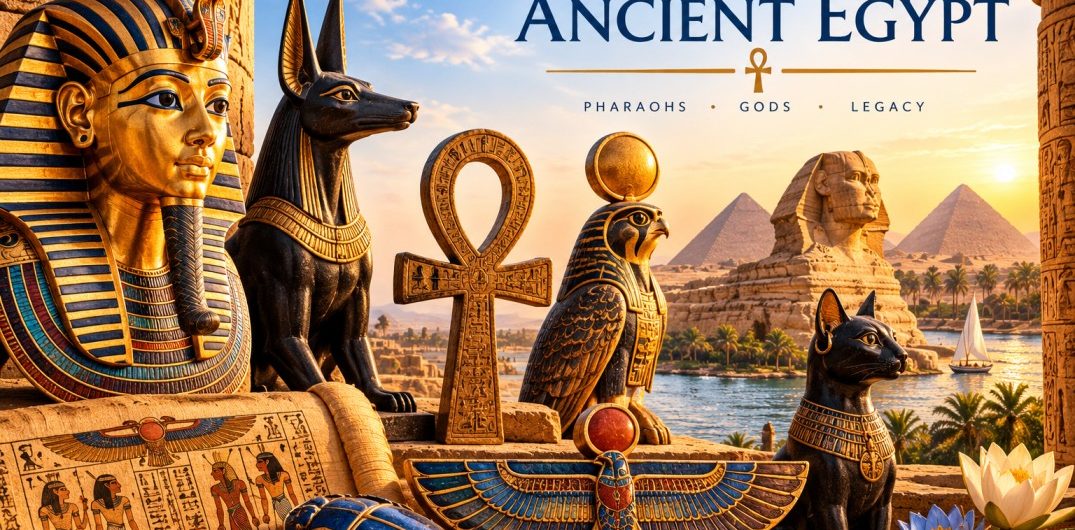
The symbols of ancient Egypt are among the most recognizable images in world history. The Ankh, the Eye of Horus, the Scarab, the Djed pillar, the Lotus, the Uraeus cobra, the Cartouche, and the Feather of Ma’at appear in museums, temples, tombs, jewelry, books, tattoos, and modern design. But these images were never simply decoration. In ancient Egypt, symbols were a visual language of power, protection, religion, kingship, rebirth, and cosmic order.
To understand ancient Egyptian symbols is to understand how the Egyptians saw the world. They believed that writing, images, names, gestures, animals, colors, and objects could carry spiritual force. A symbol could protect a king, heal a body, guide a soul, honor a god, or declare the unity of Upper and Lower Egypt. Even a simple loop of rope, a bird, a cobra, or a lotus flower could communicate profound ideas about life, death, and divine order.
For travelers visiting Egypt, learning the main symbols makes the journey richer. When you stand before the Giza Pyramids Complex, walk through Karnak Temple, enter the Valley of the Kings, or study artifacts in the Grand Egyptian Museum, you begin to notice repeated signs: wings, eyes, sun disks, cobras, crooks, flails, feathers, knots, plants, and royal names enclosed in cartouches. These are not random motifs. They are part of a symbolic system that connected the human world with the divine.
This guide is written for first-time visitors, returning travelers, students, history lovers, families, couples, solo explorers, and anyone who wants to understand the meanings behind ancient Egyptian symbols. We will explore the most important symbols, their religious and royal meanings, where to see them in Egypt today, how to interpret them responsibly, and how to include museum and temple visits in a wider Egypt itinerary.
Whether you are planning a trip to Cairo, Luxor, Aswan, Saqqara, or Memphis, this guide will help you read Egypt’s ancient imagery with more confidence, curiosity, and respect.
In ancient Egypt, a symbol was never just a picture. It was a vessel of meaning, a tool of protection, and a bridge between the visible world and the divine.
Quick Answer: What Are the Symbols of Ancient Egypt?
The symbols of ancient Egypt are sacred and royal images used in temples, tombs, amulets, jewelry, papyri, statues, and hieroglyphic writing. Major symbols include the Ankh, representing life; the Eye of Horus, representing protection and healing; the Scarab, representing rebirth; the Djed pillar, representing stability; the Tyet, representing divine protection; the Lotus and Papyrus, representing creation and unity; the Uraeus cobra, representing royal authority; the Feather of Ma’at, representing truth and cosmic order; and the Cartouche, representing the protected name of a king. These symbols helped ancient Egyptians express religious belief, royal power, magical protection, and the promise of eternal life.
Why Ancient Egyptian Symbols Matter
Ancient Egyptian symbols matter because they reveal how the Egyptians understood life, death, kingship, and the universe. Modern viewers often see them as beautiful designs, but to ancient Egyptians they were active signs with spiritual purpose. A symbol could be carved into a temple wall to honor a god, painted inside a tomb to guide the deceased, worn as an amulet to protect the body, or placed beside a royal name to affirm the king’s divine authority.
Egyptian symbols are also connected to hieroglyphs. Hieroglyphic writing used pictures not only as sounds but also as ideas. Some signs represented words, some represented sounds, and some carried symbolic meaning. This is why Egyptian art often feels layered: a figure may be both a depiction and a statement, both an image and a spell.
For travelers, understanding symbols changes the way you experience Egypt. Instead of seeing only statues and walls, you begin to notice patterns. You may recognize the wings of a protective goddess above a royal figure, the loop of an Ankh offered by a god to a king, the scarab placed over a heart in burial, or the cartouche enclosing a pharaoh’s name. These details make temples, museums, and tombs feel more alive.
Symbols also connect ancient Egypt to the wider world. Many Egyptian images influenced later art, jewelry, religious symbolism, and modern popular culture. The Eye of Horus, the Ankh, and the Scarab are now known globally, but their original meanings were deeply rooted in Egyptian religion, royal ideology, and beliefs about the afterlife.
To read Egyptian symbols is to read the mindset of one of history’s most enduring civilizations.
How to Interpret Egyptian Symbols Correctly
One of the most important things to understand is that ancient Egyptian symbols do not always have one fixed meaning. Their interpretation depends on context: where the symbol appears, who holds it, what material it is made from, what scene surrounds it, and what period it belongs to.
For example, the Eye of Horus can represent protection, healing, restoration, and royal legitimacy. But the Eye of Ra is often associated with solar power, destruction, and divine vengeance. They may look similar to modern viewers, but their meanings are not identical.
Similarly, the Lotus can represent rebirth because the water lily closes at night and reopens at sunrise. But it can also be connected to creation, Upper Egypt, or ritual purification depending on the scene. The Scarab represents transformation and sunrise, but it can also appear in amulets, seals, jewelry, and funerary contexts.
A responsible approach to Egyptian symbols is to avoid oversimplifying them. They are not merely “good luck charms.” They are part of a complex religious and political language. When visiting museums such as the Egyptian Museum or the Grand Egyptian Museum, ask your guide to explain the context of each symbol rather than giving only a modern interpretation.
The same symbol can mean life in one scene, protection in another, and royal power in a third. Context is the key.
The Most Important Symbols of Ancient Egypt
Below is a guide to the most famous and meaningful ancient Egyptian symbols. These appear repeatedly in temples, tombs, statues, papyri, jewelry, amulets, and museum collections.
| Symbol | Main Meaning | Where You May See It |
|---|---|---|
| Ankh | Life, eternal life, divine breath | Temple reliefs, statues, tomb paintings, amulets, museum displays |
| Eye of Horus | Protection, healing, restoration, royal legitimacy | Amulets, jewelry, tomb scenes, temple walls, medical or magical objects |
| Eye of Ra | Solar power, divine wrath, protection through force | Mythological scenes, solar imagery, temple reliefs |
| Scarab | Rebirth, transformation, sunrise, creation | Seals, jewelry, amulets, heart scarabs, funerary objects |
| Djed Pillar | Stability, endurance, resurrection, the backbone of Osiris | Osiris-related scenes, royal rituals, amulets, temple reliefs |
| Tyet / Isis Knot | Protection, magic, divine feminine power | Jewelry, amulets, funerary contexts, goddess imagery |
| Lotus | Rebirth, purity, creation, Upper Egypt symbolism | Temple columns, reliefs, papyri, perfume and ritual scenes |
| Papyrus | Lower Egypt, growth, creation, marshland fertility | Unity scenes, temple reliefs, royal iconography |
| Uraeus Cobra | Royal authority, divine protection, sovereignty | Pharaoh’s crown, statues, temple entrances, royal reliefs |
| Crook and Flail | Kingship, guidance, discipline, royal responsibility | Royal statues, mummy masks, temple reliefs, funerary art |
| Was Scepter | Dominion, power, protection | Gods and kings holding staffs, temple scenes, ritual objects |
| Shen Ring | Eternity, protection, cyclical time | Royal jubilee scenes, cartouches, protective imagery |
| Feather of Ma’at | Truth, justice, cosmic order, balance | Weighing of the heart scenes, afterlife books, goddess imagery |
| Cartouche | Royal name, identity, divine protection | Temple walls, tombs, stelae, obelisks, royal statues |
| Vulture and Cobra | The Two Ladies, protection of Upper and Lower Egypt | Royal crowns, throne names, temple reliefs, mummy masks |
| Sun Disk | Ra, divine light, creation, eternal cycles | Temple ceilings, solar barques, royal iconography, Aten scenes |
| Obelisk | Petrified sun ray, solar connection, royal monument | Temple entrances, Heliopolitan symbolism, royal dedications |
| Pyramid | Resurrection, primordial mound, royal ascent, solar rays | Giza, Saqqara, Dahshur, funerary architecture, tomb models |
| Sphinx | Guardianship, royal strength, solar protection | Giza, temple avenues, processional routes, royal necropolises |
Ancient Egyptian symbols formed a visual vocabulary: life, protection, rebirth, kingship, truth, and eternity were carved into stone and worn close to the body.
1. The Ankh: Symbol of Life and Eternal Existence
The Ankh is one of the most recognizable ancient Egyptian symbols. It looks like a cross with a loop at the top and is often called the “key of life,” though this modern nickname can oversimplify its meaning. In ancient Egypt, the Ankh primarily represented life, vitality, and eternal existence.
In temple reliefs and tomb paintings, gods are often shown holding the Ankh or offering it to the king. This gesture communicates divine blessing: the god grants life, legitimacy, and eternal sustenance to the ruler. The Ankh may also appear in scenes involving the afterlife, where it expresses the hope that the deceased will live forever in the presence of the gods.
The exact origin of the Ankh is debated. Some scholars suggest it may derive from a sandal strap, a looped cord, or another everyday object that became ritualized. What matters most is not its original physical form but its symbolic power: the Ankh became the sign of life itself.
If you visit the Egyptian Museum or the Grand Egyptian Museum, you will see Ankhs in jewelry, statuettes, ritual objects, and temple reliefs. They are often made of gold, faience, wood, stone, or painted materials, depending on their function and owner.
The Ankh is not only a symbol of life. It is a declaration that life can be granted, protected, and extended beyond death.
2. The Eye of Horus: Protection, Healing, and Restoration
The Eye of Horus, also known as the Wedjat Eye, is one of the most famous symbols of ancient Egypt. It is usually depicted as a stylized human eye with distinctive markings beneath it. In Egyptian mythology, Horus was a falcon god associated with kingship, protection, and the legitimate rule of the pharaoh.
The Wedjat Eye is connected to myths in which Horus’s eye is injured, healed, or restored. Because of this story, the symbol became associated with healing, protection, wholeness, and the restoration of order. It was used in amulets, medical contexts, funerary objects, and temple reliefs.
The Eye of Horus also had mathematical associations in hieroglyphic usage. Different parts of the eye were linked to fractional values in ancient Egyptian measurement systems. Over time, these parts were sometimes connected to the senses or to ideas of completeness, though modern interpretations should be handled carefully.
For travelers, the Eye of Horus appears everywhere: in souvenir shops, jewelry, museum displays, temple walls, and tomb scenes. But its original meaning was not decorative. It was a powerful sign of divine protection and restoration.
The Eye of Horus watched over the living, protected the king, and helped guide the deceased toward restoration in the afterlife.
3. The Eye of Ra: Solar Power and Divine Force
The Eye of Ra is often confused with the Eye of Horus, but the two symbols have different meanings. Ra was the sun god, one of the most important deities in ancient Egypt. The Eye of Ra represents the active power of the sun: creative, protective, and sometimes destructive.
In Egyptian mythology, the Eye of Ra could be sent out as a force of divine punishment. It was sometimes associated with fierce goddesses such as Sekhmet, who embodied the sun’s burning power. At the same time, the Eye of Ra could protect Ra during his nightly journey through the underworld.
While the Eye of Horus is often linked to healing and restoration, the Eye of Ra is more closely connected to solar authority, cosmic conflict, and divine vengeance. Both symbols involve protection, but their emotional and mythological tones are different.
When visiting temples such as Karnak Temple or reading about solar barques and the journey of Ra, the Eye of Ra becomes especially meaningful. It reminds us that the Egyptian sun was not only a source of light but also a force of cosmic power.
The Eye of Ra is the sun as weapon, protector, and judge: brilliant, dangerous, and divine.
4. The Scarab: Rebirth, Transformation, and the Rising Sun
The Scarab beetle is one of the most beloved symbols of ancient Egypt. It is connected to Khepri, a manifestation of the sun god Ra associated with the morning sun, creation, and transformation. The Egyptians observed dung beetles rolling balls of earth and emerging from them, which inspired a symbolic connection with rebirth and the sun’s daily renewal.
Scarabs appeared as amulets, seals, jewelry, commemorative objects, and funerary items. Some were small and worn for protection. Others were large “heart scarabs” placed in tombs to help the deceased in the afterlife, especially during the weighing of the heart scene.
Scarabs could also carry inscriptions, including royal names, prayers, magical formulas, or commemorative texts. This makes them valuable to historians because they reveal information about kings, administration, trade, religion, and daily life.
In museums across Egypt, scarabs are among the most frequently displayed objects. They may be carved from stone, faience, steatite, lapis lazuli, carnelian, or other materials. Their beauty lies not only in craftsmanship but in their deep symbolic connection to transformation and eternal renewal.
The scarab taught the Egyptians that life could emerge from apparent decay, and that the sun could rise again through transformation.
5. The Djed Pillar: Stability, Endurance, and Osiris
The Djed pillar is a symbol of stability, endurance, and resurrection. It is often described as the backbone of Osiris, the god of the afterlife, rebirth, and regeneration. The Djed appears in temple reliefs, amulets, funerary objects, and royal rituals.
In some scenes, the king is shown raising the Djed pillar. This act symbolized the stabilization of the land, the strengthening of royal authority, and the renewal of cosmic order. The Djed was not only a religious sign; it was also a political one, connecting the pharaoh’s rule with divine stability.
The shape of the Djed, with its broad base and segmented upper portion, may have been inspired by a bundle of reeds, a column, or a ritual object. Whatever its physical origin, its symbolic meaning became clear: permanence, support, and resurrection.
If you visit Osirian scenes or study funerary belief, the Djed pillar becomes especially important. It expresses the hope that the dead may be made stable, whole, and eternal, just as Osiris was restored.
The Djed pillar is Egypt’s symbol of what cannot be shaken: stability, resurrection, and divine endurance.
6. The Tyet: The Knot of Isis and Protective Magic
The Tyet, often called the Knot of Isis, resembles the Ankh but has arms that curve downward. It is associated with Isis, the great goddess of magic, motherhood, healing, and protection. The Tyet appears in amulets, jewelry, funerary contexts, and temple scenes.
Like the Ankh, the Tyet is connected to life and protection, but its emphasis is often more specifically tied to magical safeguarding. In funerary texts, the Tyet could be invoked as a protective symbol for the deceased. Its association with Isis gave it a feminine divine power connected to healing, binding, and rescue.
The Tyet is sometimes linked to the idea of Isis’s magical knot, a symbol of binding protection. In Egyptian thought, knots could hold power, secure blessings, or prevent harm. This makes the Tyet a subtle but important symbol in the wider language of Egyptian amulets.
You may see Tyet amulets in museum collections, especially among jewelry and funerary objects. They are often made of red materials such as carnelian, jasper, or red glass, colors associated with life, blood, vitality, and protection.
The Tyet is a quiet symbol of magical protection: the knot of Isis binding danger away and preserving life.
7. The Lotus and Papyrus: Creation, Unity, and the Land of Egypt
Plants were deeply symbolic in ancient Egypt. The lotus and papyrus are two of the most important botanical symbols. The blue lotus, or water lily, was associated with rebirth because it closes at night and reopens at sunrise. It also connects to creation myths, where the lotus emerged from the primordial waters and gave birth to the sun.
The papyrus plant, growing in the marshes of the Nile Delta, was associated with Lower Egypt, fertility, growth, and the marshland of creation. Together, the lotus and papyrus can symbolize the unity of Upper and Lower Egypt, the two lands joined under one king.
In temple reliefs, you may see the sema-tawy motif, where plants and other symbols are tied together to represent the unification of Egypt. This is one of the most politically important symbolic themes in Egyptian art: the king’s duty to maintain unity, balance, and order.
Lotus columns, lotus capitals, papyrus bundles, and floral patterns appear in temples such as Karnak Temple and Luxor Temple. These are not merely decorative. They transform the temple into a symbolic landscape of creation, fertility, and divine order.
The lotus and papyrus taught Egypt that the land itself was sacred: born from water, renewed by sun, and unified under kingship.
8. The Uraeus Cobra: Royal Authority and Divine Protection
The Uraeus is the rearing cobra often shown on the forehead of the pharaoh. It represents the goddess Wadjet, protector of Lower Egypt and guardian of royal power. The Uraeus was not simply a decorative emblem; it was a sign that the king carried divine authority and supernatural protection.
In Egyptian belief, the cobra could strike against the king’s enemies. Its venom became a symbol of destructive protection. At the same time, the Uraeus connected the pharaoh to the sun god Ra, because cobras were associated with solar power and guardianship.
You can see the Uraeus on royal statues, mummy masks, temple reliefs, crowns, and museum objects. It is especially striking on funerary masks, where it declares that the deceased king remains under divine protection even in death.
The Uraeus is also part of the “Two Ladies” symbolism, paired with the vulture goddess Nekhbet. Together, they represent the protection of both Upper and Lower Egypt.
The Uraeus cobra was the king’s living warning: divine power sits upon this brow, and enemies will not pass unnoticed.
9. The Crook and Flail: Kingship, Guidance, and Discipline
The crook and flail are two of the most important royal symbols of ancient Egypt. The crook, shaped like a shepherd’s staff, represents guidance and care. The flail, a beaded whip-like object, represents discipline, authority, and the power to correct.
Together, they express the ideal role of the pharaoh as shepherd of Egypt. The king was expected to guide his people, maintain order, protect the weak, punish wrongdoing, and sustain the land. These were not abstract political ideas; they were religious duties connected to Ma’at, the concept of truth, justice, and cosmic balance.
The crook and flail often appear crossed on the chest of royal mummies, statues, and funerary masks. This placement emphasizes that kingship continues into the afterlife. The dead king remains a ruler, a protector, and a participant in divine order.
If you visit royal statues in the Egyptian Museum or the Grand Egyptian Museum, look for these objects in the hands or chests of pharaohs. They are subtle but powerful signs of royal responsibility.
The crook and flail remind us that Egyptian kingship was not only power. It was care, correction, and sacred duty.
10. The Was Scepter and Shen Ring: Dominion and Eternity
The Was scepter is a staff-like symbol often held by gods and kings. It has a forked base and an animal-headed top, sometimes resembling a canine or desert animal. The Was represents dominion, power, and protection. It is a sign of control over chaos and the ability to maintain order.
The Shen ring, by contrast, is a circular rope-like symbol representing eternity, protection, and cyclical time. It often appears around royal names or in jubilee scenes. The Shen ring is closely connected to the idea of endless duration, especially the king’s wish to renew his strength and legitimacy through ritual.
Together, the Was scepter and Shen ring express two essential dimensions of divine kingship: power in the present and permanence across time. The king must rule with authority, but he must also be sustained by ritual, protection, and cosmic order.
These symbols appear in temple reliefs, royal statues, ritual scenes, and museum objects. They are especially important when studying Sed festivals, royal jubilees, and divine investiture scenes.
The Was scepter commands the present. The Shen ring protects eternity.
11. The Feather of Ma’at: Truth, Justice, and Cosmic Order
The Feather of Ma’at is one of the most morally significant symbols of ancient Egypt. Ma’at was the goddess and concept of truth, justice, balance, righteousness, and cosmic order. Her feather appears in the famous weighing of the heart scene in the afterlife.
In Egyptian funerary belief, the heart of the deceased was weighed against the feather of Ma’at. If the heart was light and balanced, the person had lived rightly. If it was heavy with wrongdoing, the soul faced destruction or denial of eternal life. This scene reveals how central morality was to Egyptian religion.
The Feather of Ma’at is not only a symbol of judgment. It also represents the order that the king was responsible for maintaining on earth. Pharaohs often claimed to rule according to Ma’at, defeating chaos and preserving balance.
You can see weighing-of-the-heart scenes in tomb paintings, papyri, Book of the Dead manuscripts, and museum collections. These images are among the most powerful in ancient Egyptian art because they connect daily behavior with eternal consequence.
The feather of Ma’at weighed more than gold. It measured the truth of a human heart.
12. The Cartouche: The Protected Name of the King
The cartouche is an oval loop with a horizontal line at the bottom, enclosing the name of a pharaoh. It derives from the Shen ring and symbolizes protection, eternity, and royal identity. In Egyptian belief, a person’s name was essential to existence. To erase a name was to threaten memory and afterlife. To enclose a king’s name in a cartouche was to protect it.
Cartouches appear on temple walls, obelisks, stelae, tombs, statues, seals, and royal monuments. They are among the most useful tools for historians because they help identify rulers, dynasties, building projects, and political claims.
When visiting Karnak Temple, Luxor Temple, Valley of the Kings, or Abu Simbel, look for cartouches. They are not just labels. They are declarations that the king’s name is eternal, protected, and divinely sanctioned.
Modern travelers often see cartouche-shaped souvenirs in markets. While these can be lovely keepsakes, it is important to remember that in ancient Egypt the cartouche was a sacred royal symbol, not merely a decorative frame.
A cartouche is a name made eternal: the king enclosed in protection, memory, and divine order.
13. The Two Ladies: Nekhbet and Wadjet
The “Two Ladies” are the vulture goddess Nekhbet and the cobra goddess Wadjet. Nekhbet represented Upper Egypt, while Wadjet represented Lower Egypt. Together, they symbolized the unity and protection of the entire country.
The vulture was associated with motherhood, nourishment, and protection. Its wings could shelter the king and the deceased. The cobra, as the Uraeus, represented sovereign power, divine danger, and guardianship.
The Two Ladies often appear in royal titulary, especially in the “Nebty” name, one of the five names of the pharaoh. They also appear on crowns, mummy masks, temple reliefs, and royal statues. Their message is clear: the king rules over a unified land and is protected by its oldest divine powers.
For travelers, recognizing the Two Ladies adds depth to royal imagery. When you see a vulture and cobra together, you are seeing the symbolic unification of Egypt itself.
The Two Ladies were Egypt’s twin guardians: one winged, one coiled, both protecting the unity of the land.
14. The Sun Disk, Obelisk, and Pyramid: Solar Symbols of Eternity
Solar symbols are central to ancient Egyptian religion. The sun represented creation, daily renewal, divine visibility, and the journey of the soul. The sun disk, often associated with Ra, appears in temple ceilings, royal iconography, hymns, and funerary texts.
The obelisk is another powerful solar symbol. Its shape may represent a petrified ray of sunlight. Obelisks were often placed at temple entrances and dedicated to Ra. They connected the king, the temple, and the sun in a vertical statement of divine ascent.
The pyramid also has solar meaning. It may represent the primordial mound from which creation emerged, the stairway by which the king ascended to the stars, or the rays of the sun solidified in stone. The Great Pyramid of Cheops and the wider Giza Pyramids Complex are among the most monumental expressions of this solar and funerary symbolism.
Earlier still, the Step Pyramid of Zoser at Saqqara represents the beginning of colossal stone pyramid architecture. Together, Saqqara, Dahshur, and Giza show the evolution of the pyramid as a symbol of royal resurrection.
The sun disk, obelisk, and pyramid all point upward: they are Egypt’s stone language of light, ascent, and eternity.
15. The Sphinx: Guardian of Kingship and Sacred Space
The Sphinx combines the body of a lion with the head of a human, usually a king. It represents strength, guardianship, royal authority, and sometimes solar power. The most famous example is the Great Sphinx of Giza, which watches over the Giza Plateau and is commonly associated with the pyramid complex of Khafre.
Sphinxes were not only monumental sculptures. They also lined temple avenues, guarded sacred spaces, and expressed the idea that royal power protects the boundary between the human and divine worlds. The lion body conveys force; the human head conveys intelligence and kingship.
The Great Sphinx is especially powerful because it is ancient, damaged, and still watchful. Its missing nose and weathered surface remind visitors that even the most enduring symbols are touched by time.
Smaller sphinxes appear in museums, temple processional ways, and royal contexts. They often carry the same symbolic message: protection through strength, wisdom, and divine kingship.
The Sphinx does not merely stand. It guards, remembers, and challenges every visitor to look back.
16. Sacred Animals as Symbols of Divine Power
Many ancient Egyptian symbols are connected to animals. Animals were not seen as inferior to humans; they could manifest divine qualities. Gods were often depicted with animal heads or associated with specific creatures.
Important Animal Symbols
- Falcon: Associated with Horus, kingship, sky, and divine protection.
- Ibis: Associated with Thoth, wisdom, writing, and measurement.
- Cat: Associated with Bastet, home, fertility, protection, and grace.
- Cow: Associated with Hathor, motherhood, music, joy, and nourishment.
- Ram: Associated with Khnum, creation, the Nile source, and sometimes Amun.
- Crocodile: Associated with Sobek, power, fertility, and the dangerous waters of creation.
- Jackal: Associated with Anubis, embalming, cemeteries, and guidance of the dead.
- Vulture: Associated with Nekhbet, protection, and Upper Egypt.
- Cobra: Associated with Wadjet, royal authority, and divine defense.
When visiting temples such as Philae Temple, Karnak, or Luxor Temple, animal symbolism becomes especially visible. Gods appear in falcon, ibis, jackal, cow, and ram forms. These images teach that divinity could be present in nature, not separate from it.
In ancient Egypt, the animal was not the opposite of the divine. It could be the face of the divine.
Color Symbolism in Ancient Egypt
Colors were also symbolic in ancient Egyptian art. They were not chosen only for beauty; they carried meaning. Understanding color helps travelers interpret statues, reliefs, tombs, and museum objects more deeply.
Common Egyptian Color Meanings
- Gold: Flesh of the gods, eternity, divine radiance, incorruptibility.
- Blue: Sky, water, creation, divinity, and the cosmic realm.
- Green: Vegetation, fertility, regeneration, and new life.
- Red: Life, blood, power, danger, chaos, and protection through force.
- Black: Fertile Nile soil, the underworld, regeneration, and potential.
- White: Purity, holiness, ritual cleanliness, and sacred spaces.
For example, a green skin may indicate rebirth or vegetation power. A gold mask suggests divine eternity. A red crown or red desert landscape may evoke danger, chaos, or protective force. Black imagery can be positive because it recalls the fertile soil of the Nile and the possibility of regeneration.
When you visit tomb paintings or museum displays, pay attention to color. Even when pigments have faded, the original symbolic logic can still be felt.
Egyptian color was never decorative alone. Gold was eternity, green was rebirth, black was fertile darkness, and blue was the sky of the gods.
Where to See Authentic Symbols of Ancient Egypt in Egypt
If you want to see authentic ancient Egyptian symbols, Egypt offers museums, temples, tombs, obelisks, statues, amulets, and funerary objects in extraordinary abundance. The best experience comes from combining museum study with on-site viewing.
1. Egyptian Museum in Cairo
The Egyptian Museum in Tahrir Square is one of the best places to study symbols up close. Its collections include royal statues, jewelry, amulets, papyri, sarcophagi, and objects connected to Tutankhamun and other pharaohs. Here you can see Ankhs, Eyes of Horus, scarabs, cartouches, funerary texts, and divine figures in detail.
2. Grand Egyptian Museum
The Grand Egyptian Museum near Giza offers a modern setting for ancient symbols. Its monumental statues, galleries, conservation spaces, and Tutankhamun collections allow visitors to experience Egyptian imagery with clarity and scale. It is especially useful before or after visiting the pyramids.
3. Giza Pyramids Complex and Great Sphinx
The Giza Pyramids Complex is the ultimate outdoor expression of pyramid symbolism. The Great Sphinx of Giza adds the guardian dimension of royal and solar power. Seeing these monuments in person helps you understand scale, orientation, and the sacred landscape of the necropolis.
4. Saqqara and Memphis
Saqqara contains the Step Pyramid of Zoser, the beginning of colossal stone pyramid architecture. The nearby Ancient City of Memphis features the fallen colossus of Ramesses II and the alabaster sphinx. These sites help visitors understand the origins of royal symbolism and Memphite power.
5. Karnak Temple and Luxor Temple
Karnak Temple and Luxor Temple are open-air libraries of Egyptian symbols. You will find cartouches, solar disks, lotus columns, papyrus bundles, divine figures, royal rituals, protective deities, and processional imagery. A guide can help you identify symbols that are easy to miss when walking quickly.
6. Valley of the Kings
The Valley of the Kings is one of the most important places to understand funerary symbols. Tomb walls contain afterlife journeys, gods, demons, solar barques, the weighing of the heart, protective spells, and royal resurrection imagery. Access and lighting conditions vary, so plan carefully and consider a guide.
7. Abu Simbel
The Temples of Abu Simbel are monumental expressions of Ramesses II’s royal power, solar connection, and divine kingship. The colossal statues, temple facades, and internal reliefs communicate strength, protection, and eternal rule.
8. Philae Temple
The Temple of Philae, dedicated to Isis, is especially meaningful for understanding protective and feminine divine symbols. Isis was associated with magic, healing, motherhood, and resurrection. Philae’s setting on the Nile also adds to its symbolic beauty.
To understand Egyptian symbols, visit both museum cases and temple walls. One preserves the object; the other restores the sacred setting.
Egyptian Symbols in Daily Life, Magic, and the Afterlife
Ancient Egyptian symbols were not limited to temples and royal monuments. They appeared in daily life through amulets, jewelry, household objects, seals, cosmetics, clothing, and ritual tools. Ordinary people wore protective signs, used scarab seals, and invoked divine symbols for health, fertility, travel, childbirth, and safety.
Magic, known as heka, was an important part of Egyptian religion. Symbols could activate spoken spells, protect the body, or guide the soul. This is why amulets were placed on mummies, inside wrappings, or near the deceased. They were not mere ornaments; they were spiritual tools.
In the afterlife, symbols became even more critical. Tomb walls and funerary texts used images to help the deceased navigate dangerous regions, speak correctly to gods, receive offerings, and achieve resurrection. The Eye of Horus, Ankh, Djed, scarab, Feather of Ma’at, and solar barque all appear in funerary contexts.
For modern travelers, this means that Egyptian symbols cannot be separated from belief. They are part of a worldview in which image, word, ritual, and material object worked together to sustain life and defeat chaos.
An Egyptian amulet was not just worn. It was activated by belief, crafted with intention, and meant to work across life and death.
How to Include Egyptian Symbols in Your Egypt Itinerary
If you are planning a trip to Egypt and want to focus on symbols, museums, temples, and tombs, a well-paced itinerary is essential. You do not need to be an Egyptologist to enjoy this theme. You simply need curiosity, a good guide, and enough time to look closely.
Cairo Symbol Day
Begin in Cairo with the Egyptian Museum or Grand Egyptian Museum. Ask your guide to point out Ankhs, Eyes of Horus, scarabs, cartouches, divine animals, and royal regalia. In the afternoon, visit the Citadel of Saladin for a contrast between ancient and medieval Cairo.
Giza and Saqqara Symbol Route
Visit the Giza Pyramids Complex and Great Sphinx to understand pyramid and guardian symbolism. Then continue to Saqqara and Memphis to see the origins of stone monumentality. For a combined route, see our day tour to Memphis and Saqqara.
Luxor Temple Symbol Day
In Luxor, focus on Karnak and Luxor Temple. Look for cartouches, solar disks, lotus columns, papyrus bundles, divine falcons, and royal ritual scenes. If you visit in the evening, Luxor Temple becomes especially atmospheric, with illumination highlighting inscriptions and symbolic reliefs.
Valley of the Kings Afterlife Symbols
The Valley of the Kings is ideal for afterlife symbolism. The weighing of the heart, solar barques, protective deities, underworld gates, and resurrection scenes appear on tomb walls. Because access can be limited and heat intense, plan early and use a knowledgeable guide.
Aswan and Philae: Isis, Protection, and Sacred Landscape
Aswan offers a gentler pace and strong symbolic connections to Isis, the Nile, and Nubian culture. Philae Temple is especially meaningful for viewers interested in protective and feminine divine imagery. A felucca ride at sunset can also help you understand why the Nile itself was sacred.
For broader planning, see our Egypt itinerary guide, 3-day Egypt itinerary, 7 days in Egypt itinerary, and 10 day Egypt itinerary.
A symbol-focused Egypt itinerary is not slower because it is less important. It is slower because it asks you to look twice.
Buying Egyptian Symbol Souvenirs: What to Know
Many travelers want to bring home a symbol such as the Eye of Horus, Ankh, scarab, or cartouche. Souvenirs are common in Cairo, Luxor, Aswan, Hurghada, Sharm El Sheikh, and airport shops. They can be lovely reminders of your trip, but it is important to buy responsibly.
Tips for Buying Symbol Souvenirs
- Buy replicas, not authentic antiquities. Removing ancient artifacts illegally is harmful and unlawful.
- Ask about materials: faience, alabaster, brass, silver, copper, glass, resin, and stone have different qualities and prices.
- Compare prices before buying, especially in tourist markets.
- Negotiate politely, but do not insult the seller with unrealistic offers.
- If buying jewelry, check clasps, stone setting, and metal quality.
- Remember that many symbols have religious meaning; treat them with respect even when used as modern fashion.
- For higher-quality shopping, consider reputable hotel shops, museum gift areas, or established jewelers.
A souvenir symbol can be a meaningful travel memory, but it should never come at the expense of Egypt’s heritage. Authentic antiquities belong in museums, conservation programs, and protected archaeological contexts.
Bring home the memory, not the artifact. A replica can honor ancient Egypt without harming it.
Common Mistakes When Understanding Egyptian Symbols
One common mistake is treating all Egyptian symbols as “good luck” signs. While some amulets offered protection, others represented judgment, royal violence, divine danger, or cosmic struggle. Egyptian symbolism is not always gentle.
Another mistake is confusing the Eye of Horus and Eye of Ra. They are related in visual language but differ in mythological meaning. Horus is connected to kingship, healing, and restoration; Ra is connected to the sun, creative power, and destructive force.
Travelers also sometimes assume that every symbol has one fixed meaning. In reality, meaning changes according to context, material, color, placement, and the figures surrounding it.
A further mistake is overinterpreting modern esoteric meanings as ancient facts. Many contemporary spiritual interpretations are interesting, but they should not be confused with documented Egyptian religion unless supported by evidence.
Finally, visitors sometimes rush through temples and tombs without pausing to notice repeated signs. A symbol-focused visit requires slowing down. The best details are often small: a cartouche, a feather, a knot, a cobra, a lotus bud, or a winged disk.
Egyptian symbols reward patience. The smallest carved sign can carry the largest idea.
Respectful Travel and Cultural Sensitivity
Ancient Egyptian symbols are part of a living national heritage. Egypt is not only an open-air museum; it is a modern country with communities, religious traditions, laws, and cultural pride. Respectful travel matters.
When visiting archaeological sites, follow posted rules, do not touch reliefs unless permitted, do not climb on ancient stones, and avoid removing fragments. If you photograph local people, ask permission. If you buy souvenirs, choose legal replicas and support responsible artisans.
Dress modestly, especially when combining ancient sites with mosques, churches, or conservative neighborhoods. Egypt is generally welcoming to tourists, but cultural respect helps you move more smoothly and positively through the country.
For practical preparation, see our guides to Egypt travel tips and what to pack when traveling to Egypt.
Respect for Egyptian symbols begins with respect for Egypt: its people, its laws, its landscapes, and its ancient memory.
Frequently Asked Questions About Symbols of Ancient Egypt
What are the most famous symbols of ancient Egypt?
The most famous symbols of ancient Egypt include the Ankh, Eye of Horus, Scarab, Djed pillar, Tyet, Lotus, Papyrus, Uraeus cobra, Crook and Flail, Feather of Ma’at, Cartouche, Sun Disk, Obelisk, Pyramid, and Sphinx. These symbols represented life, protection, rebirth, kingship, truth, stability, and divine power.
What does the Ankh mean?
The Ankh is the ancient Egyptian symbol of life, eternal life, and divine vitality. It is often shown held by gods or offered to the king, representing the gift of life and the promise of existence beyond death.
What is the difference between the Eye of Horus and the Eye of Ra?
The Eye of Horus is usually associated with protection, healing, restoration, and royal legitimacy. The Eye of Ra is associated with solar power, divine wrath, and the destructive or protective force of the sun god. They can look similar, but their mythological meanings are not identical.
What does the Scarab symbolize?
The Scarab symbolizes rebirth, transformation, creation, and the rising sun. It is connected to Khepri, a manifestation of the sun god Ra. Scarabs were used as amulets, seals, jewelry, and funerary objects, including heart scarabs placed in tombs.
What does the Djed pillar mean?
The Djed pillar represents stability, endurance, resurrection, and the backbone of Osiris. It appears in royal rituals, funerary contexts, and temple scenes. The raising of the Djed symbolized the strengthening of order and the renewal of life.
What is the Tyet or Knot of Isis?
The Tyet is a protective amulet associated with Isis. It resembles the Ankh but has downward-curving sides. It symbolizes magical protection, divine feminine power, healing, and safeguarding, especially in funerary contexts.
Why is the Lotus important in ancient Egypt?
The Lotus, especially the blue water lily, symbolizes rebirth, purity, creation, and renewal because it closes at night and reopens at sunrise. It also connects to Upper Egypt and the unification symbolism when paired with papyrus.
What does the Uraeus cobra represent?
The Uraeus cobra represents royal authority, divine protection, and the goddess Wadjet. It appears on the pharaoh’s crown and symbolizes the king’s supernatural defense against enemies and chaos.
What is the meaning of the Feather of Ma’at?
The Feather of Ma’at represents truth, justice, balance, and cosmic order. It appears in the weighing of the heart scene, where the deceased’s heart is judged against the feather to determine worthiness for the afterlife.
What is a cartouche in ancient Egypt?
A cartouche is an oval enclosure containing the name of a pharaoh. It symbolizes protection, eternity, and royal identity. Cartouches appear on temple walls, tombs, stelae, obelisks, and royal monuments.
Where can I see authentic Egyptian symbols?
You can see authentic ancient Egyptian symbols in the Egyptian Museum, Grand Egyptian Museum, Giza Pyramids Complex, Saqqara, Memphis, Karnak Temple, Luxor Temple, Valley of the Kings, Abu Simbel, and Philae Temple. Museums are best for close study, while temples and tombs show symbols in their original sacred settings.
Are ancient Egyptian symbols religious?
Many ancient Egyptian symbols are religious, but not all are exclusively religious. Some represent kingship, unity, protection, magic, daily life, or funerary belief. Their meaning depends on context, material, placement, and the figures surrounding them.
Can I buy Egyptian symbol jewelry in Egypt?
Yes, you can buy modern Egyptian symbol jewelry such as Ankh pendants, Eye of Horus rings, scarab bracelets, and cartouche necklaces. Always buy legal replicas, compare prices, ask about materials, and avoid purchasing authentic antiquities.
Do I need a guide to understand Egyptian symbols?
A guide is not mandatory, but it is highly recommended. Egyptian symbols can be subtle, repeated, and context-dependent. A knowledgeable guide can help you identify meanings, avoid misconceptions, and connect symbols to temples, tombs, and museum objects.
Related Words and Topics Around Symbols of Ancient Egypt
If you are researching symbols of ancient Egypt, you may also be searching for terms such as ancient Egyptian symbols meanings, Egyptian symbols list, Ankh symbol, Eye of Horus meaning, Eye of Ra, Scarab beetle Egypt, Djed pillar, Tyet knot, Lotus symbol Egypt, Papyrus symbol, Uraeus cobra, Crook and Flail, Feather of Ma’at, Cartouche meaning, Egyptian amulets, hieroglyphic symbols, sacred animals of ancient Egypt, Egyptian temple symbols, tomb symbols Egypt, and best museums for Egyptian symbols. These topics all connect to the same experience: learning to read the visual language of one of the world’s greatest civilizations.
- Symbols of Ancient Egypt for the main guide
- Egyptian Museum for close study of artifacts
- Grand Egyptian Museum for modern museum context
- Giza Pyramids Complex for pyramid symbolism
- Great Sphinx of Giza for guardian symbolism
- Step Pyramid of Zoser for early pyramid architecture
- Ancient City of Memphis for royal capital context
- Karnak Temple for temple symbols
- Luxor Temple for royal and divine imagery
- Valley of the Kings for afterlife symbols
- Temples of Abu Simbel for monumental royal symbolism
- Temple of Philae for Isis-related imagery
- Top museums in Egypt for museum planning
- Egypt itinerary guide for trip planning
Final Thoughts: Why the Symbols of Ancient Egypt Still Speak to Us
The symbols of ancient Egypt continue to fascinate us because they express ideas that remain deeply human: the desire for life, protection, justice, stability, love, memory, and meaning beyond death. The Ankh asks for life. The Eye of Horus asks for healing. The Scarab asks for transformation. The Feather of Ma’at asks for truth. The Cartouche asks that a name not be forgotten.
When you travel through Egypt and learn to recognize these signs, the country becomes more than a collection of famous monuments. It becomes a language. Temples speak through columns and reliefs. Tombs speak through spells and scenes. Museums speak through small amulets, worn stones, gold, faience, and painted wood. Even the landscape speaks: the Nile, the desert, the sun, the lotus, the papyrus, and the horizon all shaped Egyptian thought.
You do not need to memorize every symbol to enjoy Egypt. But knowing the main ones can change your experience. It helps you slow down, look closely, and ask better questions. It helps you understand why the ancient Egyptians carved eyes, wings, serpents, birds, flowers, circles, and names into stone with such care.
The symbols of ancient Egypt are not dead images. They are messages from a civilization that believed meaning could be made permanent. And after thousands of years, they still succeed.
The symbols of ancient Egypt endure because they were never only decoration. They were prayers, protections, royal claims, and promises that life could outlast stone.
Ready to Explore the Symbols of Ancient Egypt in Person?
Let Egypt Via Travel help you plan a meaningful Egypt journey through museums, temples, tombs, pyramids, and sacred landscapes, with private guides, comfortable transport, and itineraries designed to help you read ancient Egypt with clarity and wonder.
Contact Egypt Via Travel to Plan Your Symbol-Focused Egypt Trip