
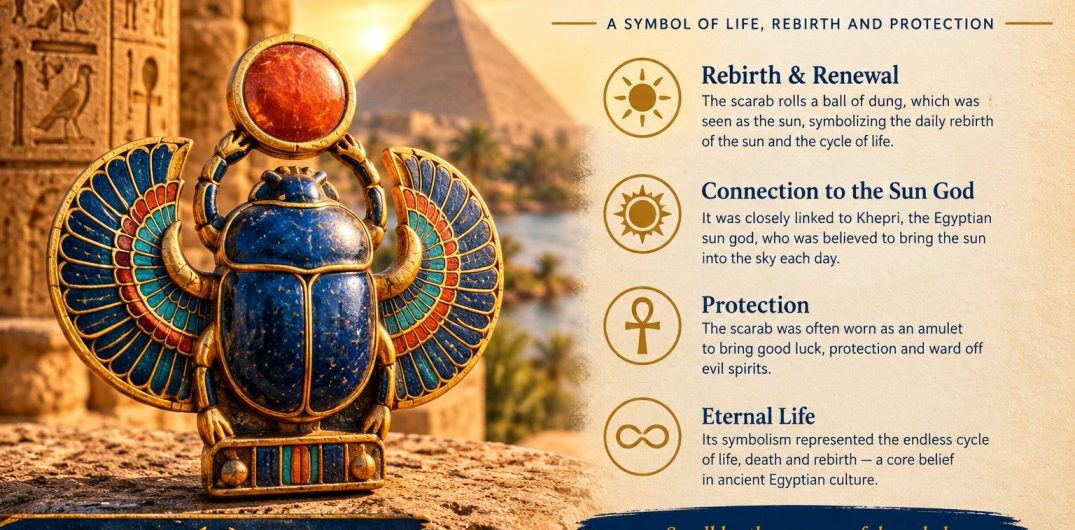
The scarab beetle meaning is one of the most fascinating topics in ancient Egyptian symbolism. To modern eyes, a scarab may look like a small beetle carved into stone, faience, or jewelry. But in ancient Egypt, the scarab was far more than an insect image. It was a powerful symbol of rebirth, transformation, creation, protection, and the daily rising of the sun.
The scarab beetle is closely connected to Khepri, a manifestation of the sun god Ra associated with the morning sun, renewal, and creation. Ancient Egyptians observed dung beetles rolling balls of earth, laying eggs inside them, and watching new life emerge from what appeared to be a dead or inert mass. This natural behavior inspired a profound spiritual idea: life could arise from apparent death, and the sun could be reborn every morning just as the beetle emerged from its ball.
For travelers visiting Egypt, understanding the scarab beetle meaning helps you read temple walls, museum displays, amulets, jewelry, seals, and funerary objects with greater clarity. When you see a scarab in the Egyptian Museum, the Grand Egyptian Museum, or a temple such as Karnak Temple, you are not looking at a decorative motif alone. You are encountering a visual language of eternity.
This guide explores the full meaning of the scarab beetle in ancient Egypt, its connection to Khepri and Ra, its role in protection and the afterlife, the different types of scarab objects, where to see authentic examples, and how to include scarab symbolism in a wider Egypt itinerary. Whether you are a first-time visitor, a history lover, a jewelry enthusiast, or someone planning a trip through Cairo, Luxor, Aswan, Saqqara, or Giza, this article will help you understand why the scarab remains one of the most enduring symbols of ancient Egypt.
The scarab beetle taught ancient Egypt that life can emerge from darkness, transformation is sacred, and the sun can rise again.
Quick Answer: What Is the Scarab Beetle Meaning?
The scarab beetle meaning in ancient Egypt is primarily connected to rebirth, transformation, creation, protection, and the rising sun. The scarab was associated with Khepri, a form of the sun god Ra linked to morning renewal. Egyptians saw the dung beetle rolling earth, creating life, and emerging from it as a symbol of resurrection and divine power. Scarabs were used as amulets, seals, jewelry, commemorative objects, and funerary pieces, including heart scarabs placed in tombs to help the deceased in the afterlife.
Why the Scarab Beetle Matters in Ancient Egypt
The scarab matters because it expresses one of the central beliefs of Egyptian civilization: life does not end in death. Ancient Egypt was a culture deeply concerned with resurrection, continuity, and the triumph of order over chaos. The scarab became a natural symbol of this belief because of the beetle’s behavior and its mysterious appearance of new life from earth.
Unlike many modern symbols that are purely decorative, the Egyptian scarab had active spiritual meaning. It could protect the wearer, seal documents, commemorate royal events, support the deceased in the afterlife, and connect the king to the creative power of the sun. A scarab was not simply “lucky.” It was a vessel of divine transformation.
For travelers, the scarab is especially important because it appears in many forms across Egypt. You may see tiny faience scarabs in museum cases, large stone scarabs in temple contexts, golden scarabs in royal jewelry, heart scarabs in funerary displays, and scarab seals used in administrative life. Understanding the scarab beetle symbolism helps you connect these objects to a single powerful idea: renewal.
The scarab is ancient Egypt’s quiet reminder that transformation is not accidental. It is divine.
What Is a Scarab Beetle?
A scarab beetle is a type of dung beetle. In Egypt, the most commonly referenced species is associated with the genus Scarabaeus. These beetles roll balls of dung, bury them, and use them as a place to lay eggs. When new beetles emerge from the ball, ancient observers saw something astonishing: life appearing from what seemed like waste or dead matter.
This natural behavior became a spiritual metaphor. The ball of earth resembled the sun moving across the sky. The emergence of new life from the buried ball suggested resurrection. The beetle’s daily activity connected it to the cycles of creation, renewal, and the sun’s journey.
In ancient Egyptian thought, nature was not separate from the divine. Animals, insects, plants, rivers, and celestial movements all revealed the power of the gods. The scarab was therefore not just an insect. It was a living sign of creation.
To the ancient Egyptians, the scarab was a small creature carrying a cosmic message: life can rise again.
Khepri and the Scarab: The Morning Sun
The scarab is most closely connected to Khepri, a god or divine manifestation associated with the rising sun, creation, and transformation. Khepri was often depicted as a man with a scarab head or as a scarab pushing a sun disk. The name is linked to the Egyptian verb “kheper,” meaning to become, to come into being, or to manifest.
In Egyptian solar theology, the sun had different forms during its journey. Ra represented the noon sun, Atum the evening sun, and Khepri the morning sun. Each form expressed a stage of creation, power, aging, and renewal. Khepri was the sun as it emerged, the beginning of a new day, the daily resurrection of light.
This is why the scarab became so powerful. It was not only a symbol of insect life. It was a symbol of the sun’s self-creation. The beetle rolling the sun-like ball across the earth mirrored Khepri rolling the sun across the sky.
When you see a scarab in a temple or museum, ask yourself whether it is connected to Khepri, solar renewal, protection, or funerary transformation. The scarab beetle meaning changes slightly depending on context, but rebirth remains at the center.
Khepri is the scarab’s divine face: the morning sun, the creative force, and the promise that life begins again.
Main Meanings of the Scarab Beetle in Ancient Egypt
The scarab beetle has several layers of meaning. It is not a single symbol with one fixed interpretation. Its meaning depends on where it appears, what material it is made from, who uses it, and what scene surrounds it. Below are the main meanings associated with the Egyptian scarab.
| Meaning | Explanation | Where It Appears |
|---|---|---|
| Rebirth | The scarab represents new life emerging from earth, just as the sun rises each morning. | Tombs, amulets, funerary texts, museum objects |
| Transformation | It symbolizes change, becoming, and the movement from one state to another. | Khepri scenes, magical objects, jewelry |
| Creation | The scarab is linked to Khepri as a creative force that brings life into being. | Temple reliefs, solar theology, royal iconography |
| Protection | Scarab amulets were worn to guard the body, soul, and daily life. | Amulets, mummy wrappings, personal jewelry |
| Healing | Because of its connection to restoration and renewal, the scarab could appear in healing contexts. | Magical objects, amulets, ritual items |
| Royal Power | Commemorative scarabs recorded royal achievements and affirmed the king’s authority. | Royal inscriptions, seals, palace contexts |
| Afterlife Support | Heart scarabs helped the deceased during judgment and resurrection. | Tombs, mummies, funerary equipment |
| Eternity | The scarab expresses the endless cycle of death and renewal. | Solar barques, tomb paintings, temple ceilings |
The scarab beetle meaning is not one idea alone. It is rebirth, protection, creation, royal memory, and eternal renewal woven into a single image.
Types of Egyptian Scarabs
Not all scarabs had the same function. Ancient Egyptians created many kinds of scarab objects, each with a different purpose. Understanding these types helps you interpret the scarab beetle symbolism more accurately when visiting museums or archaeological sites.
1. Scarab Amulets
Scarab amulets were among the most common forms. They were worn for protection, healing, good fortune, and spiritual support. Some were placed on mummies or inside wrappings to assist the deceased in the afterlife. These amulets could be made of faience, stone, glazed ceramic, gold, silver, carnelian, lapis lazuli, or other materials.
2. Scarab Seals
Many scarabs were used as administrative or personal seals. The flat underside could be engraved with names, titles, symbols, prayers, or official marks. Scarab seals were pressed into clay to authenticate documents, goods, letters, and containers. This makes them valuable to historians because they reveal information about administration, trade, and royal authority.
3. Commemorative Scarabs
Commemorative scarabs were large royal objects created to record important events. They could celebrate victories, building projects, royal marriages, hunting expeditions, or gifts to the king. These scarabs functioned like official announcements, spreading royal propaganda through a sacred symbol of power and renewal.
4. Heart Scarabs
Heart scarabs are among the most famous funerary scarabs. They were placed over or near the heart of the deceased and often inscribed with spells from the Book of the Dead. Their purpose was connected to the weighing of the heart ceremony, where the heart was judged against the feather of Ma’at. The scarab could help prevent the heart from testifying against the deceased.
5. Jewelry Scarabs
Scarabs were set into rings, pendants, bracelets, and necklaces. In life, they served as protective adornments. In death, they could accompany the deceased into eternity. Jewelry scarabs often combine beauty with spiritual meaning, showing how Egyptian art merged craftsmanship and belief.
6. Scaraboids
A scaraboid is a simplified scarab-like object, often without detailed legs or underside engraving. These pieces may have been used as amulets, pendants, or symbolic ornaments. They are less complex than full scarabs but still carry the same associations of protection and rebirth.
From tiny amulets to royal commemorative stones, the scarab moved through every level of Egyptian life: personal, administrative, religious, and funerary.
Scarab Beetle Meaning in the Afterlife
The afterlife is one of the most important contexts for the scarab. Egyptian funerary belief centered on resurrection, judgment, and eternal survival. The deceased had to pass through dangerous spiritual regions, speak correctly to divine beings, and prove worthiness before Osiris and other gods.
The scarab helped in this journey because it symbolized transformation. Just as the beetle emerged from earth, the deceased hoped to emerge from death. Just as Khepri renewed the sun each morning, the soul hoped to be renewed in the afterlife.
Heart scarabs are especially powerful in this context. Placed near the heart, they could invoke magical protection during the weighing of the heart. The heart was considered the seat of memory, emotion, and moral responsibility. A scarab inscription might ask the heart not to oppose the deceased during judgment.
In tomb paintings and funerary papyri, scarabs may appear alongside solar barques, Osirian scenes, and symbols of resurrection. They remind the viewer that death is not the end. It is a passage into renewed existence.
In the afterlife, the scarab became more than a symbol. It became a spiritual helper, guiding the soul from death toward rebirth.
Scarab Beetle Meaning in Daily Life and Magic
The scarab was not reserved only for kings and tombs. Ordinary Egyptians also used scarab imagery in daily life. Amulets protected travelers, mothers, children, workers, and the sick. Scarab seals authenticated goods and documents. Jewelry carried both beauty and spiritual power.
Magic, known as heka, was an important part of Egyptian religion. Objects could be charged with meaning through materials, inscriptions, rituals, and spoken words. A scarab amulet was not merely a piece of stone. It was a tool of protection, healing, and transformation.
This everyday use explains why so many scarabs survive in museum collections. They were made in large numbers, worn by many classes of society, and placed in tombs across centuries. The scarab was one of Egypt’s most democratic sacred symbols: powerful enough for kings, practical enough for ordinary people.
The scarab belonged to everyone: the pharaoh who issued commemorative stones, the scribe who used a seal, the mother who wore an amulet, and the deceased who hoped for resurrection.
Materials, Colors, and the Symbolism of Scarabs
The material and color of a scarab can add meaning to its symbolism. Ancient Egyptians believed that substances carried spiritual qualities. Gold, for example, was associated with the flesh of the gods and eternity. Blue-green faience was connected with renewal and fertility. Red stones could evoke life, blood, protection, and danger.
Common Scarab Materials
- Faience: A glazed ceramic material often blue or green, associated with rebirth and protection.
- Stone: Including steatite, limestone, quartzite, and other carved materials.
- Gold: Connected with divinity, eternity, and royal power.
- Lapis Lazuli: A blue stone associated with the sky, gods, and cosmic order.
- Carnelian and Jasper: Red stones associated with life, vitality, and protective power.
- Glass and Paste: Used in jewelry and amulets, sometimes imitating precious stones.
Color Symbolism
- Green: Vegetation, fertility, regeneration, and new life.
- Blue: Sky, water, creation, and divine presence.
- Gold: Eternity, incorruptibility, and the body of the gods.
- Red: Life force, protection, danger, and magical power.
- Black: Fertile soil, the underworld, and potential rebirth.
When you examine a scarab in a museum, look beyond its shape. The material and color can deepen the scarab beetle meaning. A blue faience scarab may emphasize renewal. A gold scarab may suggest divine eternity. A red stone scarab may emphasize protection or vital force.
A scarab carved in faience, stone, or gold was never only beautiful. Its material was part of its message.
Where to See Authentic Scarabs in Egypt
If you want to understand the scarab beetle meaning in person, Egypt offers some of the best places in the world to see authentic examples. Museums allow close study, while temples and tombs show scarabs in their original sacred or royal contexts.
1. Egyptian Museum in Cairo
The Egyptian Museum is one of the best places to study scarabs up close. Its collections include amulets, jewelry, seals, funerary objects, and royal artifacts. Here you can see how small and varied scarab objects could be, from simple faience pieces to elaborate gold settings.
2. Grand Egyptian Museum
The Grand Egyptian Museum near Giza offers a modern setting for ancient symbols. Its galleries, royal statues, Tutankhamun-related collections, and conservation displays help visitors understand scarabs within the broader world of Egyptian art and belief.
3. Giza Pyramids Complex
The Giza Pyramids Complex is not primarily a scarab museum, but it is essential for understanding solar and funerary symbolism. The pyramids, temples, and surrounding necropolis express the same ideas of resurrection and ascent that the scarab represents in miniature.
4. Saqqara and Memphis
Saqqara, home to the Step Pyramid of Zoser, and the nearby Ancient City of Memphis provide context for early royal power and Memphite funerary culture. Scarabs appear across these landscapes as part of Egypt’s long tradition of resurrection symbolism.
5. Karnak Temple and Luxor Temple
At Karnak Temple and Luxor Temple, scarab imagery may appear in temple reliefs, royal scenes, and symbolic decoration. A guide can help you identify Khepri-related imagery and understand how solar renewal connects to kingship and divine order.
6. Valley of the Kings
The Valley of the Kings is one of the most powerful places to understand funerary symbolism. Tomb walls depict the journey of the sun through the underworld, resurrection scenes, judgment imagery, and protective deities. The scarab fits naturally into this world of afterlife transformation.
7. Abu Simbel
The Temples of Abu Simbel express monumental royal power and solar connection. While scarabs may not be the first object visitors notice, the temple’s solar alignment and royal imagery resonate with the same themes of renewal, divine kingship, and eternal order.
To understand the scarab, visit both museum cases and sacred landscapes. One shows the object; the other shows the belief.
Scarab Beetle Meaning in Jewelry and Modern Culture
Today, scarab jewelry is popular around the world. Rings, pendants, bracelets, earrings, and necklaces often feature stylized scarabs. Many people wear them as symbols of transformation, protection, resilience, or personal rebirth. This modern use is meaningful, but it is important to distinguish contemporary interpretations from ancient Egyptian context.
In ancient Egypt, a scarab was not simply a fashion accessory. It was a spiritual object connected to Khepri, resurrection, magic, and divine protection. A scarab ring worn today may symbolize personal change, but in ancient contexts it could have been intended to guard the wearer, seal a document, or support the deceased in the afterlife.
The same applies to tattoos. Many people choose scarab tattoos to represent rebirth, strength, or overcoming hardship. These meanings are inspired by Egyptian symbolism, but they are modern adaptations. When traveling in Egypt, it is helpful to respect the original religious and cultural depth of the symbol.
A modern scarab may speak of personal transformation. An ancient Egyptian scarab spoke of the sun, the gods, and the soul’s journey beyond death.
How to Buy Scarab Souvenirs Responsibly
Many travelers want to bring home a scarab pendant, ring, statue, or amulet as a reminder of Egypt. This can be a beautiful choice, but it should be done responsibly. Authentic ancient artifacts are part of Egypt’s heritage and should not be illegally bought, sold, or exported.
Tips for Buying Scarab Souvenirs
- Buy legal replicas, not authentic antiquities.
- Ask about materials: faience, alabaster, brass, silver, copper, resin, glass, or stone.
- Compare prices in markets such as Khan el-Khalili, but negotiate politely.
- Check jewelry clasps, stone settings, and metal quality before buying.
- Avoid sellers who claim an object is ancient without proper documentation.
- Support reputable artisans, museum shops, or established jewelers when possible.
- Remember that the scarab is a sacred symbol, not only a decorative motif.
A replica scarab can be a meaningful souvenir if purchased ethically. It allows you to carry home the symbolism of transformation without harming Egypt’s archaeological heritage.
Bring home the meaning, not the artifact. A replica scarab can honor ancient Egypt without damaging its memory.
Common Misconceptions About the Scarab Beetle Meaning
One common misconception is that the scarab was simply a “good luck charm.” While it did offer protection, its meaning was much deeper. It was connected to creation, solar theology, resurrection, royal power, and magical practice.
Another misunderstanding is that all scarabs are the same. In reality, scarabs could be amulets, seals, commemorative stones, jewelry, heart scarabs, or ritual objects. Their meaning changes depending on use and context.
Some modern interpretations also exaggerate mystical or secret meanings without historical support. The scarab is genuinely powerful in Egyptian religion, but it does not need fantasy to be fascinating. Its documented connections to Khepri, rebirth, and protection are already profound.
A further mistake is confusing the scarab with other Egyptian beetle or insect imagery. Not every beetle-like object carries the same theological weight. Context, inscription, material, and placement matter.
The scarab is not a vague lucky symbol. It is a precise Egyptian image of creation, transformation, and resurrection.
How to Include Scarab Symbolism in Your Egypt Itinerary
If you are planning a trip to Egypt and want to focus on symbols, the scarab is an excellent theme. It connects museums, temples, tombs, jewelry, royal power, and everyday magic. You do not need to be an Egyptologist to enjoy this journey. You only need curiosity, a good guide, and enough time to look closely.
Cairo Scarab Day
Begin in Cairo with the Egyptian Museum or Grand Egyptian Museum. Ask your guide to point out scarab amulets, seals, jewelry, and Khepri-related objects. This is the best way to study the symbol up close before seeing it in temple or tomb contexts.
Giza and Saqqara Symbol Route
Visit the Giza Pyramids Complex to understand solar and funerary symbolism. Then continue to Saqqara and Memphis to explore the early Memphite world of royal resurrection. For a combined route, see our day tour to Memphis and Saqqara.
Luxor Temple and Karnak Scarab Stops
In Luxor, focus on Karnak Temple and Luxor Temple. Look for solar imagery, royal ritual scenes, and symbolic reliefs. A guide can help you connect scarab symbolism to Khepri, Ra, and the theology of renewal.
Valley of the Kings Afterlife Theme
The Valley of the Kings is ideal for understanding funerary scarabs. Tomb walls show the sun’s journey, resurrection scenes, and judgment imagery. The heart scarab becomes especially meaningful in this context.
For broader planning, see our Egypt itinerary guide, 3-day Egypt itinerary, 7 days in Egypt itinerary, and 10 day Egypt itinerary.
A scarab-focused Egypt itinerary is not slower because it is less important. It is slower because it asks you to look twice.
Scarab Beetle Meaning Compared with Other Egyptian Symbols
The scarab is part of a wider system of symbols of ancient Egypt. Comparing it with other signs helps clarify its unique role.
Scarab vs. Ankh
The Ankh represents life and eternal existence. The scarab represents transformation and rebirth. The Ankh is often offered by gods to kings, while the scarab is connected to the creative process of becoming.
Scarab vs. Eye of Horus
The Eye of Horus is associated with protection, healing, and restoration. The scarab shares protective and restorative meanings, but its central theme is rebirth through transformation.
Scarab vs. Djed Pillar
The Djed pillar represents stability, endurance, and Osirian resurrection. The scarab represents dynamic renewal, especially solar rebirth. Together, they express different dimensions of eternal life: stability and transformation.
Scarab vs. Sun Disk
The sun disk represents Ra and solar power. The scarab, through Khepri, represents the morning sun and creative emergence. The sun disk is the celestial body; the scarab is the symbol of its renewing force.
The scarab does not stand alone. It speaks alongside the Ankh, the Eye of Horus, the Djed, and the sun disk in Egypt’s sacred visual language.
Frequently Asked Questions About Scarab Beetle Meaning
What is the scarab beetle meaning in ancient Egypt?
The scarab beetle meaning in ancient Egypt is mainly connected to rebirth, transformation, creation, protection, and the rising sun. It was associated with Khepri, a manifestation of the sun god Ra. Scarabs were used as amulets, seals, jewelry, commemorative objects, and funerary pieces to express renewal and divine power.
Why was the scarab sacred to the ancient Egyptians?
The scarab was sacred because its behavior reminded Egyptians of creation and resurrection. Dung beetles rolled balls of earth, buried them, and new life emerged. This was connected to the sun’s daily renewal and the hope that the dead could be reborn.
What god is associated with the scarab beetle?
The scarab is associated with Khepri, a form of the sun god Ra connected with the morning sun, creation, and transformation. Khepri was often depicted as a scarab or a man with a scarab head pushing a sun disk.
What is a heart scarab?
A heart scarab is a funerary amulet placed with the deceased, often near the heart. It could be inscribed with spells from the Book of the Dead and was connected to the weighing of the heart ceremony in the afterlife.
Did Egyptians wear scarab jewelry?
Yes. Scarabs were set into rings, pendants, bracelets, and necklaces. They served as protective adornments in life and could also be placed with the deceased for spiritual support in the afterlife.
What is the difference between a scarab amulet and a scarab seal?
A scarab amulet was worn for protection, healing, or spiritual support. A scarab seal was used to press impressions into clay for documents, goods, or administrative purposes. Some objects could function as both.
Where can I see authentic scarabs in Egypt?
Authentic scarabs can be seen in the Egyptian Museum, Grand Egyptian Museum, temple sites in Luxor, funerary contexts connected to the Valley of the Kings, and archaeological collections related to Memphis and Saqqara. Museums are best for close study, while temples and tombs show symbolic context.
Can I buy a scarab souvenir in Egypt?
Yes, but buy legal replicas rather than authentic antiquities. Scarab jewelry, statues, and amulets are common souvenirs. Ask about materials, compare prices, and purchase from reputable sellers.
Is the scarab a good luck symbol?
The scarab could offer protection, but calling it only a good luck symbol is too simple. In ancient Egypt, it represented creation, rebirth, solar renewal, magical protection, and afterlife transformation.
Do I need a guide to understand scarab symbolism?
A guide is not mandatory, but it is highly recommended. Scarabs can be small, repeated, and context-dependent. A knowledgeable guide can help you distinguish amulets, seals, heart scarabs, commemorative scarabs, and solar imagery.
Related Words and Topics Around Scarab Beetle Meaning
If you are researching scarab beetle meaning, you may also be searching for terms such as Egyptian scarab meaning, scarab beetle symbolism, Khepri scarab, ancient Egyptian scarab amulet, heart scarab, scarab seal, scarab jewelry, dung beetle Egypt, scarab rebirth symbol, Egyptian beetle symbol, scarab artifact meaning, and where to see scarabs in Egypt. These topics all connect to the same idea: the scarab was one of ancient Egypt’s most powerful images of transformation and eternal life.
- Scarab Beetle Meaning for the main guide
- Symbols of Ancient Egypt for wider symbolic context
- Egyptian Museum for close study of scarab objects
- Grand Egyptian Museum for modern museum context
- Giza Pyramids Complex for solar and funerary symbolism
- Step Pyramid of Zoser for early resurrection architecture
- Ancient City of Memphis for royal capital context
- Karnak Temple for temple symbolism
- Luxor Temple for royal and divine imagery
- Valley of the Kings for afterlife symbolism
- Egypt itinerary guide for trip planning
- Egypt travel tips for practical preparation
Final Thoughts: Why the Scarab Beetle Still Speaks to Us
The scarab beetle meaning endures because it touches something universal. Human beings understand loss, change, fear, hope, and the desire to begin again. The ancient Egyptians saw these truths in a small insect and transformed it into a symbol of cosmic power.
When you stand before a scarab in a museum case, it may look simple. But inside that small carved form is a whole worldview: the sun rises, life emerges, death is not final, and transformation is sacred. The scarab connects the ordinary world of nature with the eternal world of the gods.
For travelers, learning the scarab’s meaning makes Egypt richer. It helps you see beyond souvenirs and photographs. It invites you to slow down, ask better questions, and recognize that ancient Egypt was not only a civilization of monumental stone. It was also a civilization of subtle signs, where a beetle could carry the promise of resurrection.
The scarab beetle is small, but its meaning is vast: it is Egypt’s ancient reminder that life can rise again.
Ready to Explore Egyptian Symbols in Person?
Let Egypt Via Travel help you plan a meaningful journey through Egypt’s museums, temples, tombs, and sacred landscapes, with private guides and itineraries designed to help you understand symbols like the scarab beetle in their original context.
Contact Egypt Via Travel to Plan Your Symbol-Focused Egypt Trip