
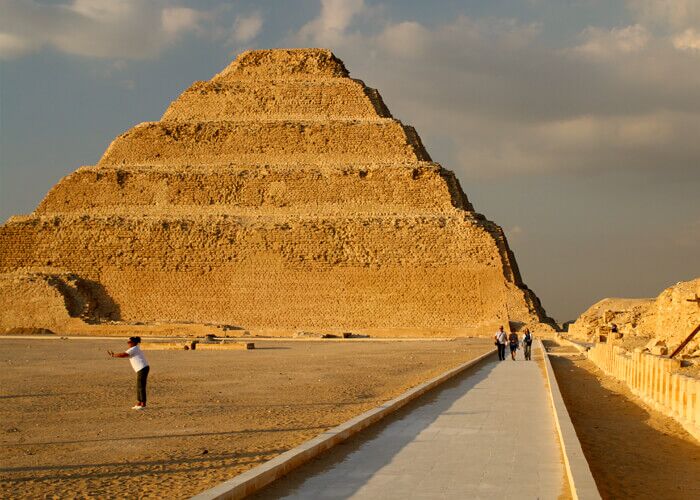
The Step Pyramid of Zoser is one of the most important monuments in the history of architecture. It is not only Egypt’s first pyramid; it is the earliest colossal stone building in the world and one of the most revolutionary structures ever created by human hands. Before the Step Pyramid, Egyptian royal tombs were built mainly as flat-roofed mudbrick mastabas. After it, the idea of stone eternity changed forever. The Step Pyramid of Zoser marks the moment when ancient Egypt began to build not just for burial, but for permanence.
Located at Saqqara, near the ancient capital of Memphis and south of modern Cairo, the Step Pyramid was built for Pharaoh Djoser, also spelled Zoser, during the Third Dynasty. Its architect, Imhotep, is one of the few ancient builders whose name has survived through history. Together, king and architect created a monument that would influence every pyramid that followed, including the great smooth-sided pyramids of the Giza Pyramids Complex.
Visiting the Step Pyramid of Zoser is unlike visiting the more famous pyramids at Giza. It is less monumental in height, but in many ways more historically important. At Giza, you see the climax of pyramid building. At Saqqara, you see the beginning. The Step Pyramid is where ancient Egypt first learned to turn royal burial into a stone statement of eternity. It is quieter, more intimate, and often more rewarding for travelers who want to understand the evolution of Egyptian civilization rather than simply photograph its most famous icons.
This guide is written for first-time visitors, returning travelers, families, couples, solo explorers, history lovers, students, and anyone who wants to plan a meaningful visit to the Step Pyramid of Zoser. We will explore its history, architecture, location, highlights, best time to visit, practical tips, tickets, transport, safety, photography, packing advice, and how to combine Saqqara with Memphis, Giza, and the wider Cairo region. You will also find links to related guides on this website so you can place the Step Pyramid within a broader Egypt itinerary.
If you are traveling to Egypt and want to understand where the pyramid age truly began, the Step Pyramid of Zoser is essential. It is not the most famous monument in Egypt, but it may be one of the most important. It is the place where stone first became eternity.
The Step Pyramid of Zoser is where ancient Egypt first dared to build forever in stone. Every later pyramid stands in its shadow.
Quick Answer: What Is the Step Pyramid of Zoser?
The Step Pyramid of Zoser, also known as the Step Pyramid of Djoser, is a Third Dynasty royal tomb located at Saqqara, Egypt. Built around the 27th century BCE for Pharaoh Djoser and designed by the architect Imhotep, it is considered the world’s oldest colossal stone building and the first true pyramid structure in ancient Egypt. The monument rises in six stepped tiers and was surrounded by a vast funerary complex containing courtyards, chapels, colonnades, ritual spaces, and symbolic buildings connected to royal rebirth and the Sed festival. Today, visitors can explore the Step Pyramid complex as part of a wider Saqqara, Memphis, and Giza day trip from Cairo. Most travelers spend one to three hours at Saqqara, depending on interest level and itinerary pace.
Why the Step Pyramid of Zoser Matters
The Step Pyramid of Zoser matters because it represents one of the greatest turning points in architectural history. Before Djoser’s reign, elite Egyptian burials were typically housed in mastabas, rectangular structures made of mudbrick or stone. They were important, but they were not monumental in the way the Step Pyramid would become. Djoser’s architects transformed the mastaba into something entirely new: a stacked series of platforms rising toward the sky. This was not just a change in shape. It was a change in ambition.
The Step Pyramid was the first large-scale structure built primarily from cut stone. That fact alone makes it revolutionary. Stone meant durability, permanence, and a new relationship with eternity. Mudbrick could crumble, but stone could outlast generations. By choosing stone on such a massive scale, the Egyptian state declared that the king’s journey into the afterlife was not temporary. It was eternal.
The monument also matters because it introduced the architectural language that would later evolve into the smooth-sided pyramids of the Fourth Dynasty. The great pyramids at Giza did not appear suddenly. They developed through experimentation, refinement, and bold vision. Saqqara is where that process began. The Step Pyramid is the ancestor of every later pyramid, including the Great Pyramid of Cheops.
For travelers, the Step Pyramid is valuable because it gives context to the rest of Egypt. Once you understand Saqqara, the pyramids of Giza feel less isolated. They become part of a longer story of royal power, religious belief, engineering progress, and cultural memory. The Step Pyramid helps you see ancient Egypt not as a collection of famous monuments, but as a civilization that learned to build eternity step by step.
The Step Pyramid is not famous because it is the largest. It is important because it was first.
Who Was Zoser? Understanding Pharaoh Djoser
Zoser, more commonly spelled Djoser today, was a pharaoh of Egypt’s Third Dynasty. He ruled during a period when the Egyptian state was becoming more centralized, more administratively sophisticated, and more capable of organizing large building projects. Djoser’s reign is especially important because it marks the emergence of the classic pyramid age.
Although details of his life are limited, Djoser is remembered as a powerful king whose authority allowed him to commission an unprecedented funerary complex. His name appears in later king lists, and his monument at Saqqara became so influential that it shaped the future of royal burial architecture for centuries.
Djoser’s legacy is not only political. It is also cultural and religious. His pyramid complex expressed new ideas about kingship, resurrection, and the afterlife. The architecture was not simply a tomb. It was a machine for royal transformation, a sacred landscape designed to help the king move safely into eternity.
For modern visitors, understanding Djoser helps humanize the monument. The Step Pyramid was not built by an anonymous ancient culture. It was built for a specific king, by a specific administration, under the direction of a specific architect. That makes the site feel less abstract and more historically alive.
Djoser may not be as famous as Khufu or Ramesses II, but his pyramid changed the course of Egyptian architecture forever.
Imhotep: The Architect Behind the Step Pyramid
One of the most remarkable aspects of the Step Pyramid of Zoser is that its architect is known. His name was Imhotep, a figure of extraordinary importance in Egyptian history. Imhotep served as chancellor to Djoser, high priest, physician, scribe, and master builder. Later Egyptian tradition elevated him almost to divine status, and he became associated with wisdom and healing.
Imhotep’s achievement at Saqqara was not only technical but conceptual. He transformed the traditional mastaba into a stepped monument of stone. This required advanced planning, engineering knowledge, labor organization, and a clear religious vision. The Step Pyramid was not simply a bigger tomb. It was a new architectural idea.
The fact that Imhotep’s name survived gives the site a rare human dimension. Many ancient monuments are anonymous, but the Step Pyramid carries the memory of the mind that conceived it. For travelers interested in architecture, engineering, or intellectual history, Imhotep makes Saqqara especially compelling.
When you stand before the Step Pyramid, you are looking at one of the earliest surviving masterpieces of a named architect. That is a rare experience in the ancient world.
Imhotep did not merely design a tomb. He invented a new way for Egypt to build eternity.
Where Is the Step Pyramid of Zoser Located?
The Step Pyramid of Zoser is located at Saqqara, an ancient necropolis on the west bank of the Nile near Memphis. Saqqara lies south of modern Cairo and northwest of Memphis, making it part of the greater Memphite region. This area was one of the most important royal cemeteries and religious landscapes in ancient Egypt.
Saqqara was not chosen randomly. Its desert edge provided a natural boundary between the land of the living and the land of the dead. The necropolis stretched along the plateau for miles and contained pyramids, mastabas, temples, burials, and ceremonial spaces used for centuries. The Step Pyramid of Djoser stands as the architectural crown of this early royal cemetery.
For travelers, Saqqara is often visited as part of a wider day trip that includes Memphis and sometimes Dahshur or Giza. Its proximity to Cairo makes it accessible, though traffic can affect timing. A private driver or guided tour is usually the most comfortable way to visit, especially if you are combining multiple sites in one day.
If you are interested in the ancient capital that oversaw this necropolis, read our guide to the Ancient City of Memphis. Together, Memphis and Saqqara reveal the relationship between the living capital and the cemetery of kings.
Saqqara is where Memphis buried its kings, and the Step Pyramid is where Egypt first learned to raise them toward the sky.
The Architecture of the Step Pyramid
The Step Pyramid of Zoser rises in six distinct tiers, creating a profile that is unlike the smooth-sided pyramids of Giza. Originally, the structure began as a rectangular mastaba, but it was expanded and stacked into a stepped monument. The final result was a pyramid of stone that reached approximately 60 meters in height, though exact measurements vary depending on erosion and reconstruction.
The pyramid’s base is roughly rectangular, and its stepped form gives it a powerful visual rhythm. Each tier creates a horizontal line that draws the eye upward. Unlike later pyramids, which aim for a single smooth slope toward a point, the Step Pyramid feels architectural in a more layered way. It is not one shape but a sequence of shapes.
The exterior once may have been covered with fine limestone casing, giving the monument a brighter and more polished appearance. Over time, much of this casing was lost, exposing the core structure. Even in its current state, the pyramid retains a striking presence. Its age is visible, but so is its ambition.
Inside and beneath the pyramid is a complex network of galleries and chambers. The substructure was designed for burial and ritual purposes, though the exact details of Djoser’s original interment remain debated. What is clear is that the pyramid was not merely a solid mound. It was part of a carefully planned funerary machine.
The Step Pyramid is not smooth, but it is monumental. Its steps are the visible proof of an idea becoming architecture.
The Funerary Complex of Djoser
The Step Pyramid was only one part of a much larger funerary complex. Djoser’s monument at Saqqara was surrounded by a massive enclosure wall, courtyards, chapels, colonnades, ritual courts, and symbolic structures. This was not a single tomb. It was a sacred city of the afterlife.
The complex was designed to support the king’s eternal needs. It included spaces associated with the Sed festival, a royal jubilee that renewed the king’s strength and legitimacy. Even in death, Djoser’s monument was meant to reactivate royal power and ensure his continued presence among the gods.
Many elements of the complex imitated stone versions of earlier ritual structures. Columns, doorways, chapels, and courts were carved to resemble reed mats, bundles, and other materials used in temporary ceremonial architecture. This translation of perishable forms into stone is one of the most fascinating aspects of the site. It shows how Egypt preserved ritual memory through architecture.
For visitors, the complex is more rewarding than the pyramid alone. The Step Pyramid is impressive, but the surrounding spaces reveal the intellectual and religious sophistication of Djoser’s builders. Saqqara is not just a burial place. It is a theater of eternity.
The Step Pyramid is the symbol, but the funerary complex is the story.
What You Can See at the Step Pyramid of Zoser Today
The Step Pyramid of Zoser is located within the Saqqara archaeological site, and visitors can explore parts of the ancient funerary complex. The experience is more open-air and less polished than Giza, but that is part of its charm. Saqqara feels like a place of discovery, where history is still being uncovered and interpreted.
1. The Step Pyramid Itself
The pyramid is the central landmark of the site. Its six stepped tiers rise above the surrounding desert plateau, creating a powerful silhouette. Visitors can view the monument from outside and appreciate its scale, age, and architectural significance. In some periods, access to certain interior areas may be restricted for conservation reasons, so it is always wise to check current conditions before visiting.
Standing before the Step Pyramid is a humbling experience. It is not as tall or famous as the Great Pyramid, but it is older in concept and equally revolutionary. This is where the pyramid idea began.
2. The Enclosure Wall
The vast enclosure wall surrounding Djoser’s complex is one of the most impressive surviving elements of the site. Built of polished limestone, it once defined the sacred boundary of the funerary landscape. Walking near it gives visitors a sense of how monumental and controlled the complex was.
The wall is not merely decorative. It served a symbolic and practical purpose, separating the ritual world of the king’s afterlife from the ordinary landscape outside.
3. The Colonnaded Entrance
The entrance to the complex includes a colonnade that once guided visitors and priests into the sacred space. The columns are among the earliest examples of stone columnar architecture. Their design echoes earlier bundled reed forms, translated into durable stone.
This area is especially interesting for architecture lovers because it shows how Egyptian builders transformed temporary materials into permanent monuments. The colonnade is not just a gateway. It is a lesson in architectural memory.
4. The Heb-Sed Court
The Heb-Sed Court is one of the most important ritual spaces in the complex. The Sed festival was associated with the renewal of royal power, and the court was designed to allow the king’s spirit to participate in this ceremony eternally.
The court includes small chapels and symbolic structures arranged around an open space. Though ruined in parts, it remains one of the most evocative areas of Saqqara. It helps visitors understand that the pyramid complex was not static. It was designed for ritual movement and divine reenactment.
5. The South Tomb
The South Tomb is a mysterious structure within the complex, possibly connected to the burial of the king’s spirit or ritual objects. Its exact function is debated, but it adds another layer of complexity to the site.
For travelers who enjoy archaeological puzzles, the South Tomb is a reminder that ancient monuments often carry meanings that are not fully resolved. Saqqara is not a place of simple answers.
6. The North Tomb and Serdab Area
Other parts of the complex include chapels, symbolic tombs, and areas associated with the king’s cult. The serdab, a sealed chamber that once held a statue of Djoser, is especially significant. It allowed the king’s spirit to receive offerings while remaining protected.
These spaces may not be as visually dramatic as the pyramid itself, but they are essential to understanding the religious logic of the monument. Djoser’s complex was designed to keep the king present, nourished, and powerful in the afterlife.
7. The Saqqara Museum Area and Surrounding Tombs
Depending on current access and conservation arrangements, visitors may also see nearby mastabas, reliefs, and museum displays connected to Saqqara. The wider necropolis contains tombs of nobles, officials, priests, and later burials that span many centuries of Egyptian history.
Saqqara is not only the Step Pyramid. It is a vast archaeological landscape. If you have time, exploring beyond Djoser’s complex can deepen your understanding of the Memphite region.
The Step Pyramid is the headline, but Saqqara is the full story: a necropolis where Egypt learned to carve memory into stone.
Best Time to Visit the Step Pyramid of Zoser
The best time to visit the Step Pyramid of Zoser is early in the morning, especially if you are combining Saqqara with Memphis or Giza. The site is largely open-air, and the Egyptian sun can become intense by mid-morning. Early arrival gives you cooler temperatures, softer light, and a calmer atmosphere.
Late afternoon can also be pleasant, particularly in cooler months, but you should check current closing times and plan around traffic. Saqqara is not as crowded as Giza, but tour groups and local visitors can still make the site busier during peak hours.
In terms of season, the most comfortable months to visit the Cairo region are generally from October to April. During this period, daytime temperatures are milder and outdoor archaeology is much more enjoyable. If you are planning a wider trip, our guides to Egypt in October, Egypt in November, and Egypt in January can help you choose the right window.
Summer visits are possible, but they require heat management. From June to August, the region can be very hot, and Saqqara offers limited shade. If you travel in summer, start early, carry water, wear sun protection, and plan to finish outdoor visits before the hottest part of the day. For broader seasonal advice, see our guide to the best time of year to visit Egypt and our article on climate and weather in Egypt.
If you are visiting during Ramadan, local rhythms may shift. Days can feel quieter, while evenings become more active. Our guide to Ramadan in Egypt can help you plan respectfully around seasonal changes.
At Saqqara, the best hour is the first. The stones are cooler, the light is gentler, and the ancient complex feels less shared.
How Much Time Do You Need at Saqqara?
For most travelers, one to two hours is enough to see the Step Pyramid of Zoser and the main parts of Djoser’s funerary complex. This allows time to walk the enclosure, view the pyramid, explore the Heb-Sed Court, and absorb the atmosphere without rushing.
If you are a history enthusiast, architecture lover, or photographer, you may want two to three hours or more. Saqqara is a large archaeological area, and some visitors enjoy exploring additional mastabas, reliefs, and nearby monuments.
For families with children, keep the visit focused and short. The Step Pyramid is visually understandable, but heat, walking, and open spaces can tire younger travelers quickly. Bring water, hats, and plan breaks.
If you are combining Saqqara with Memphis, Dahshur, or Giza, plan for a half-day or full-day route. A strong morning might include Memphis first, then Saqqara, with Giza later in the day. A full-day route can include all three, but it will be long and should be planned carefully around traffic and heat.
For structured itineraries, see our day tour to Memphis and Saqqara and our private day tour to the Pyramids of Giza, Dahshur, Memphis, and Saqqara.
One hour gives you the pyramid. Two hours gives you the complex. Three hours gives you a deeper conversation with early Egypt.
Tickets, Entry, and Practical Visitor Information
Entry to Saqqara usually requires a ticket, and prices can vary for international visitors, Egyptian residents, and Arab residents. Some areas within the archaeological site may have separate access rules, and certain monuments or interior spaces may be restricted for conservation reasons. Before visiting, check current opening hours, ticket prices, and access conditions.
Security checks are normal at major archaeological sites in Egypt. Bags may be inspected, and large luggage is usually not permitted inside. If you are visiting with a guide or driver, they can advise you on the best entrance and timing.
Inside the site, follow posted signs and respect barriers. The monuments are ancient and fragile. Do not climb on stones, touch reliefs where prohibited, or remove fragments. If you plan to photograph, be aware of other visitors and any restrictions that may apply.
Because Saqqara is an open-air archaeological area, comfortable shoes and sun protection are essential. The ground can be uneven, sandy, and hot. If you have mobility concerns, plan carefully and consider private transport close to the entrance.
For structured visits, consider a guided option through our Cairo day tours page or our Egypt guided tours section.
A smooth Saqqara visit depends on small preparations: current ticket information, comfortable shoes, water, and realistic timing.
How to Get to the Step Pyramid from Cairo
Most visitors reach Saqqara from Cairo. The site is located south of the city, near the ancient Memphite region. Travel time can vary depending on traffic, your starting point, and whether you are combining stops. In favorable conditions, the journey may take around 45 minutes to over an hour. During busy periods, it can take longer.
Private transport is usually the most comfortable option. A hired car or driver can take you directly to Saqqara and then continue to Memphis, Dahshur, or Giza. This is especially useful if you are traveling with family, older companions, or limited time.
Taxis and ride-hailing apps can also be used, but you should confirm the destination carefully. Because Saqqara is near other archaeological sites and villages, unclear instructions can lead to confusion. If you use an app, check the drop-off point and be ready to communicate with the driver.
Public transport is possible but not always practical for first-time visitors. Microbuses and local routes may require multiple changes and some walking. For a smooth day, a guided tour or private driver is usually better.
For broader Cairo planning, see our Cairo destination guide and our practical Egypt travel tips.
Saqqara is close to Cairo by map, but Egypt is a country where distance is measured not only in kilometers, but in traffic, heat, and time.
Is Saqqara Safe for Tourists?
Saqqara is generally safe for tourists. Security is present at major archaeological sites, and the area is well known to guides, drivers, and visitors. As with any destination, normal awareness is recommended. Keep your belongings secure, stay on official routes, and avoid isolated areas outside designated visiting zones.
The most common issues travelers encounter are not serious safety threats but minor hassles: persistent vendors, unofficial guides, transport confusion, or pressure to buy services. These situations can be managed with politeness, firmness, and preparation. A simple “no thank you” is usually enough.
If you are visiting independently, use reputable transport and confirm ticket information at official entrances. If you are traveling with a guide, choose a licensed and experienced professional. This reduces stress and helps you move smoothly between sites.
For broader safety advice, read our guide on whether it is safe to travel to Egypt. For practical guidance on common tourist pressures, see our article on tourist scams in Egypt.
Saqqara is not a dangerous place, but it is a real place. Respect the site, plan your transport, and keep your attention as steady as your curiosity.
What to Wear and What to Pack for Saqqara
Saqqara is an open-air archaeological site, so comfort and sun protection are essential. Wear lightweight, breathable clothing that covers shoulders and knees, especially if you plan to continue to mosques or conservative areas elsewhere in Egypt. Comfortable walking shoes are important because the ground can be uneven, sandy, and hot.
A sun hat, sunglasses, and high SPF sunscreen are strongly recommended. The Egyptian sun can be intense even in cooler months. Bring a reusable water bottle, tissues, hand sanitizer, and a small backpack. A power bank is useful if you plan to take many photos or use your phone for maps and tickets.
If you are combining Saqqara with Memphis or Giza, plan for a longer day. Bring snacks if you have dietary needs, and do not underestimate the heat. A small umbrella or light scarf can also provide shade.
For a complete checklist, see our guide to what to pack when traveling to Egypt.
At Saqqara, your best accessories are not souvenirs. They are water, shade, comfortable shoes, and patience.
Photography Tips for the Step Pyramid
Photographing the Step Pyramid of Zoser can be very rewarding because the site has dramatic architecture in a relatively open landscape. The stepped pyramid, enclosure wall, colonnades, and ritual courts create strong visual compositions. The best light is usually early morning or late afternoon, when shadows are softer and the limestone glows warmly.
Wide-angle shots work well for the pyramid and enclosure, while closer details can reveal stone textures, column bases, carved edges, and the geometry of the steps. Do not focus only on the pyramid itself. Some of the most evocative photos come from quieter corners: a fragment of wall, a colonnade, or the shadow of the steps at sunrise.
If you are visiting with a guide, ask for help finding angles and explaining context. If you are visiting independently, take your time and be aware of other travelers. Archaeological sites are shared spaces, and respectful photography matters.
Check current rules before using tripods, drones, or professional equipment. Some areas may restrict certain types of photography. Always follow signage and staff guidance.
The best Saqqara photograph is not always the pyramid. Sometimes it is the stone detail that makes the viewer feel the beginning of eternity.
Visiting Saqqara with Kids
Saqqara can be a good stop for families, especially for children who enjoy pyramids, ancient walls, and open spaces. The Step Pyramid is easy to understand visually, and its stepped form can feel more approachable than the smooth giants of Giza.
To make the visit engaging, give children simple observations: count the steps, look for the oldest stone building, imagine how workers carried blocks, or spot the enclosure wall. You do not need to explain every dynasty. A few vivid ideas are enough.
The heat, walking, and open terrain can become tiring, so bring water, hats, sunscreen, and snacks if needed. If your family wants a smoother experience, consider a private guide who knows how to make early Egyptian history accessible for children.
For broader family advice, see our guide to Egypt with kids and our family tours Egypt page.
Children do not need a lecture on the Third Dynasty. They need to see the first pyramid and understand that even giants began with one step.
Solo Travel and Romantic Travel at Saqqara
Solo travelers may find Saqqara surprisingly reflective. The site is quieter than Giza, and the Step Pyramid has a contemplative atmosphere. Standing before the world’s oldest colossal stone building can feel like a personal encounter with the origins of architecture.
If you are traveling alone, plan transport carefully and use trusted drivers or tours. The area is generally safe, but as in any rural or archaeological setting, awareness is important. For broader solo advice, see our guides to tips when traveling to Egypt alone and the solo female travel Egypt guide.
For couples, Saqqara can be romantic in a quiet, intellectual way. Sharing a moment before the Step Pyramid, imagining Imhotep’s genius, or walking the enclosure wall together can create a meaningful experience. Pair the visit with a calm lunch, a Memphis stop, or sunset near Giza for a balanced day.
If you are planning a romantic route through Egypt, our Egypt honeymoon itinerary guide can help you combine culture with comfort.
There is something intimate about standing at the beginning of the pyramid age. Saqqara is not loud, but it is profound.
Budget Tips for Visiting Saqqara
Saqqara can be visited on different budgets. Independent travel with public or app-based transport is usually cheaper, but it requires more planning and confidence. Guided tours cost more but can save time, reduce confusion, and provide historical context.
If you are budget-conscious, consider combining Saqqara with Memphis or Dahshur in one shared tour or private driver arrangement. Booking separate short trips can become inefficient. Also, bring your own water and snacks to avoid paying inflated prices near tourist sites.
If you prefer comfort, private tours with air-conditioned vehicles are often the best value for time and energy. This is especially true if you are traveling in warmer months or with family. For broader pricing guidance, see our article on Egypt travel costs.
For value-focused options, visit our Egypt budget tours page. For higher-end comfort, see our guides to luxury hotels in Egypt and 5-star hotels in Cairo Egypt.
The best budget tip for Saqqara is not to skip it. It is to combine it wisely with nearby sites so your time and money work together.
Common Mistakes to Avoid at Saqqara
One of the most common mistakes is expecting Saqqara to feel like Giza. It is not a giant tourist plaza with camel lines and pyramid panoramas everywhere. Saqqara is more archaeological, more open, and more fragmentary. If you arrive with the wrong expectations, you may leave disappointed. The key is to understand that Saqqara is about historical meaning, not visual spectacle alone.
Another mistake is visiting Saqqara alone without combining it with Memphis or Giza. Because the site is compact in its main highlights, it makes the most sense as part of a broader Memphite route. A standalone trip can feel short unless you are deeply interested in early pyramid architecture.
Travelers also sometimes underestimate traffic and heat. Saqqara is near Cairo, but Cairo traffic can be unpredictable. Start early, plan your route, and do not try to cram too many sites into one afternoon.
Finally, many visitors rush past the enclosure wall, colonnades, and Heb-Sed Court without pausing. These areas are essential. They help you understand that the Step Pyramid was not a lone object but part of a sacred complex.
The biggest mistake at Saqqara is treating it as a quick pyramid photo. It is the birthplace of the pyramid age. It deserves a pause.
Cultural Etiquette and Respectful Travel at Saqqara
Saqqara is an archaeological site, but it is also part of a living landscape. Respectful travel matters. Do not climb on stones, touch reliefs where prohibited, or remove fragments. Follow barriers, signs, and guidance from site staff.
When photographing local workers, vendors, or visitors, ask permission. A friendly gesture and a smile can lead to better interactions than a hidden shot. Remember that the people around the site are not part of the scenery. They are part of the living community near the ancient necropolis.
Dress modestly, especially if you are combining Saqqara with other cultural or religious sites in Egypt. Egypt is generally tolerant of tourists, but showing respect helps you move more comfortably through different spaces.
Tipping may come up for guides, drivers, restroom attendants, or helpers. For clear advice, read our guide to tipping in Egypt.
Respect at Saqqara is simple: do not touch the stones, do not rush the silence, and do not forget that ancient history still shares space with modern lives.
Saqqara and Memphis: City of the Living, Necropolis of the Dead
Saqqara is best understood together with Memphis. Memphis was the ancient capital, while Saqqara was one of its great cemeteries and monument zones. The desert edge near Saqqara became the place where kings, nobles, priests, and officials built tombs, temples, and eternal memorials.
The Step Pyramid of Djoser is the most famous monument in this landscape, but it is not the only one. Saqqara contains numerous mastaba tombs, temple remains, serdabs, reliefs, and burial chambers decorated with scenes of daily life, offering rituals, and religious texts. These tombs show the lives of officials who served the Memphite administration. They remind us that ancient Egypt was not only pharaohs and pyramids. It was also scribes, priests, generals, overseers, artisans, and families.
Visiting Memphis and Saqqara in the same day gives you a fuller picture of the Memphite landscape. Memphis shows you the capital. Saqqara shows you the necropolis. Together, they reveal how ancient Egyptians organized life and death.
For a combined route, see our day tour to Memphis and Saqqara and our Saqqara Egypt tours page.
Memphis was where Egypt ruled. Saqqara was where Egypt prepared to live forever.
Saqqara, Dahshur, and Giza: The Evolution of the Pyramid
The ancient Memphite region includes some of the most important pyramid fields in Egypt. Saqqara, Dahshur, and Giza form a long desert edge where royal power was expressed through monumental tombs. Visiting them in sequence helps you understand how the pyramid evolved.
At Saqqara, the Step Pyramid of Djoser marks the beginning. At Dahshur, kings of the Fourth Dynasty experimented with pyramid forms, including the Bent Pyramid and the Red Pyramid. At Giza, Khufu, Khafre, and Menkaure created the most famous pyramid complex in the world.
This progression is one of the most rewarding themes in Egyptian archaeology. The Step Pyramid is not an isolated curiosity. It is the first great experiment in a long architectural evolution. If you visit Saqqara, Dahshur, and Giza, you can literally watch the pyramid age grow.
For a broader route, consider our private day tour to the Pyramids of Giza, Dahshur, Memphis, and Saqqara or the private day tour to Dahshur, Saqqara, and Memphis.
Giza is the climax, but Saqqara is the beginning. To understand the pyramid, start with the steps.
The Step Pyramid and the Grand Egyptian Museum
The Grand Egyptian Museum is a natural companion to Saqqara. While Saqqara gives you the ancient landscape, the museum provides artifacts, royal statues, contextual displays, and modern interpretive spaces. Together, they create a fuller understanding of the Memphite region and Old Kingdom Egypt.
After walking the hot limestone paths of Saqqara, the museum offers air-conditioned relief, rest areas, and a chance to study objects up close. For many travelers, this combination makes the day more balanced: outdoor monument, indoor context, and then perhaps sunset views back near Giza.
If you are interested in comparing museum experiences, you may also want to visit the classic Egyptian Museum in Tahrir Square. The old museum has historical atmosphere, while the Grand Egyptian Museum offers modern scale and design. Both can enrich your understanding of Saqqara and the Step Pyramid.
For broader museum planning, see our guide to top museums in Egypt.
Saqqara gives you the first pyramid. The museum gives you the pieces that help you understand why it mattered.
Suggested Saqqara Itineraries
Short Half-Day Route: Memphis and Saqqara
This is the most common and practical route. Start early from Cairo, visit Memphis for 30 to 45 minutes, then continue to Saqqara for one to two hours. This route gives you the ancient capital and its necropolis without overloading your day. It is ideal for travelers with limited time or those who want a cultural morning before returning to Cairo.
Full-Day Route: Saqqara, Dahshur, and Memphis
For history lovers, this route is excellent. Saqqara gives you the Step Pyramid, Dahshur gives you experimental pyramids, and Memphis gives you the ancient capital context. The day can be long, so start early, bring water, and arrange private transport. This route is best for travelers who want depth rather than famous landmarks only.
Classic Full-Day Route: Saqqara, Memphis, and Giza
This is one of the best ways to understand the Memphite region. Visit Saqqara early, continue to Memphis, then finish at the Giza Pyramids Complex. If your energy allows, add the Grand Egyptian Museum before or after. This route combines ancient capital, royal necropolis, and world-famous pyramids in one day.
Museum-Focused Route: Saqqara and Grand Egyptian Museum
If you prefer a more comfortable day, visit Saqqara in the morning and spend the afternoon at the Grand Egyptian Museum. This route is excellent for families, older travelers, or anyone who wants to avoid too much outdoor heat. The museum adds context and comfort while keeping the day culturally rich.
The best Saqqara itinerary is not the one with the most sites. It is the one that gives you time to understand why the Step Pyramid mattered.
Guided Tours vs Independent Visits to Saqqara
You can visit Saqqara independently or with a guide. Independent travel gives flexibility and lower cost. Guided visits provide historical context, transport support, and help with logistics. For first-time visitors, a guide is often worth it, especially if you are combining Saqqara with Memphis or Dahshur.
The site itself is not difficult to navigate, but its meaning is deeper than its visible remains. A good guide can explain the founding of the Step Pyramid, the role of Imhotep, the symbolism of the Heb-Sed Court, and the connection to Memphis and Giza. Without interpretation, some visitors may see only stones. With guidance, they see the beginning of the pyramid age.
If you prefer independence, read a short overview before arrival, plan your transport, and allow enough time for traffic. Also, be prepared for vendor approaches near tourist sites. A polite but firm attitude helps.
For structured options, see our Cairo day tours and Egypt guided tours pages.
A guide cannot give you wonder, but it can remove confusion so wonder has room to arrive.
What Saqqara Feels Like: Atmosphere, Silence, and Origins
Saqqara has a different mood from Giza. It is quieter, more open, and more archaeological. The site does not overwhelm you with giant tourist infrastructure or endless camel lines. Instead, it asks you to imagine. The Step Pyramid, the enclosure wall, the colonnades, and the ritual courts create a space where history feels close but incomplete.
This incompleteness can be powerful. Ancient Egypt is often presented through its most famous monuments, but Saqqara reminds us that civilizations also leave fragments, gaps, and silences. The first pyramid does not stand in a pristine museum setting. It stands in the landscape, surrounded by time.
Visitors often describe Saqqara as a place of reflection. It is not the most exciting stop for everyone, but for those who enjoy historical depth, it can be one of the most meaningful. You are not just seeing a pyramid. You are standing at the origin point of pyramid architecture.
If you allow yourself to slow down, the site begins to speak. The stones are not loud, but they are old. The silence is not empty, but full of memory.
Saqqara does not demand attention with spectacle. It earns attention with origins.
Frequently Asked Questions About the Step Pyramid of Zoser
Is the Step Pyramid of Zoser worth visiting?
Yes, especially if you are interested in the origins of ancient Egyptian architecture and want to understand the development of the pyramid form. Saqqara is not as visually dramatic as Giza, but it is historically profound. The Step Pyramid is the world’s oldest colossal stone building and the starting point of the pyramid age. It is best visited as part of a wider route including Memphis, Dahshur, or Giza.
How much time do you need at Saqqara?
Most visitors need one to two hours to see the Step Pyramid and the main parts of Djoser’s funerary complex. If you are a history enthusiast, photographer, or deeply curious traveler, you may want two to three hours or more. Families with children may prefer a shorter visit focused on a few key areas and breaks in shaded or seating spaces.
What is the difference between Saqqara and Giza?
Saqqara contains the Step Pyramid of Djoser, the earliest colossal stone pyramid and the beginning of pyramid architecture. Giza contains the famous smooth-sided pyramids of Khufu, Khafre, and Menkaure, which represent the later climax of pyramid building. Saqqara is quieter and more historically foundational, while Giza is more monumental and internationally iconic.
Can you go inside the Step Pyramid?
Access to interior areas of the Step Pyramid can vary depending on conservation work, safety regulations, and current site management. In many cases, visitors view the pyramid and complex from outside or from limited accessible areas. Always check current conditions before your visit if interior access is important to you.
Is Saqqara safe for tourists?
Yes, Saqqara is generally safe for tourists. Security is present at major archaeological sites, and the area is well known to guides and drivers. As always, use normal awareness, keep belongings secure, and choose reputable transport. Most issues visitors encounter are minor hassles rather than serious safety concerns.
Do I need a guide at Saqqara?
A guide is not mandatory, but it is highly recommended if you want to understand the site’s historical importance. Saqqara is compact, but its meaning is deeper than its visible remains. A good guide can explain the Step Pyramid, Imhotep, the funerary complex, and the connection to Memphis and Giza. If you prefer independence, read a short overview before arrival.
Is Saqqara suitable for children?
Yes, Saqqara can be suitable for children because the Step Pyramid is easy to understand visually and the site is less crowded than Giza. However, the heat and open-air setting mean you should bring water, hats, and sunscreen. Keep the visit short and combine it with a more engaging stop such as Memphis or Giza if possible.
What is the best time of day to visit Saqqara?
Early morning is usually best. The temperature is cooler, the light is softer, and the site feels calmer. Late afternoon can also be pleasant for photography, but check opening hours and plan around traffic. Avoid the hottest part of the day, especially in summer, because the site is largely open-air.
Can you visit Saqqara and the Pyramids of Giza in one day?
Yes, this is a popular and logical full-day route from Cairo. Saqqara offers the Step Pyramid and early pyramid history, while Giza offers the famous smooth-sided pyramids and the Sphinx. The day can be long, so start early, arrange private transport, and prioritize the sites that interest you most.
What should I wear to Saqqara?
Wear lightweight, modest, breathable clothing and comfortable walking shoes. The site is open-air, sandy, and exposed to sun. A hat, sunglasses, and sunscreen are strongly recommended. If you plan to visit mosques or conservative areas afterward, carrying a scarf or light layer is useful.
Can you take photos at Saqqara?
Yes, photography is usually possible, but rules can vary by area and may change over time. Follow signage and staff guidance. Some areas may restrict tripods, drones, or professional equipment. Be respectful of other visitors and avoid touching stones while taking photos.
Why is the Step Pyramid called a step pyramid?
It is called a step pyramid because its structure rises in six distinct tiers rather than a single smooth slope. This stepped form was an early architectural solution that later evolved into the smooth-sided pyramids seen at Dahshur and Giza. The steps are one of the monument’s most recognizable features.
Who built the Step Pyramid of Zoser?
The Step Pyramid was built for Pharaoh Djoser, also spelled Zoser, during Egypt’s Third Dynasty. Its architect was Imhotep, a remarkable figure who served as chancellor, priest, physician, and master builder. Imhotep’s name makes the monument one of the few ancient structures associated with a known designer.
Is Saqqara part of the Memphis necropolis?
Yes. Saqqara is part of the ancient Memphite necropolis, the burial landscape associated with Memphis, one of Egypt’s earliest capitals. UNESCO recognizes Memphis and its Necropolis, which includes the pyramid fields from Giza to Dahshur, as a World Heritage site. Saqqara is one of the most important components of this ancient funerary landscape.
Should I visit Saqqara before or after the pyramids?
Both orders can work. Visiting Saqqara before Giza gives you historical context first, helping you understand how pyramid architecture developed. Visiting after the pyramids can help you reflect on the origins of the form. If you combine sites in one day, a common strategy is to start with Saqqara early, then continue to Memphis or Giza while the weather is manageable.
Related Words and Topics Around the Step Pyramid of Zoser
If you are researching the Step Pyramid of Zoser, you may also be searching for terms such as Step Pyramid of Djoser, Saqqara pyramid, oldest stone pyramid, Imhotep pyramid, Memphis necropolis, Saqqara day trip from Cairo, Step Pyramid history, first pyramid in Egypt, ancient Egyptian architecture, Saqqara tickets, and Egypt pyramids tour. These topics all connect to the same idea: Saqqara is where the pyramid age began.
- Step Pyramid of Zoser for the main monument guide
- Ancient City of Memphis for the nearby capital context
- Giza Pyramids Complex for the later pyramid climax
- Grand Egyptian Museum for artifacts near Giza
- Egyptian Museum for classic Cairo museum context
- Cairo for city planning and nearby attractions
- Cairo day tours for structured sightseeing
- Egypt itinerary guide for planning a wider trip
Final Thoughts: Why the Step Pyramid of Zoser Stays With You
The Step Pyramid of Zoser is not the loudest monument in Egypt. It does not have the global fame of the Great Pyramid or the dramatic silhouette of the Sphinx. But it has something just as important: origin. Saqqara is where ancient Egypt first learned to turn royal burial into monumental stone architecture. It is where the pyramid idea was born.
Visiting Saqqara is an exercise in imagination. You stand among fragments and reconstruct a revolution. You see a stepped pyramid and imagine the first time Egyptian builders dared to stack stone toward the sky. You face the enclosure wall and think of priests, craftsmen, scribes, and kings moving through a sacred landscape that would shape the future of Egyptian civilization.
If you plan your visit well, combine it with Memphis or Giza, arrive early, respect the site, and allow yourself a quiet pause, Saqqara can become one of the most thoughtful stops of your trip. It is not a place that shouts for attention. It waits. And when you slow down enough to listen, it tells you the beginning of the pyramid story.
The Step Pyramid may be ancient, but it is not finished. It still teaches us how Egypt first learned to build eternity.
Ready to Visit Saqqara and Memphis Without Stress?
Let Egypt Via Travel help you plan a smooth Memphite day that combines the Step Pyramid of Zoser, Saqqara, Memphis, Giza, museums, and private transport with comfort, clarity, and expert guidance.