
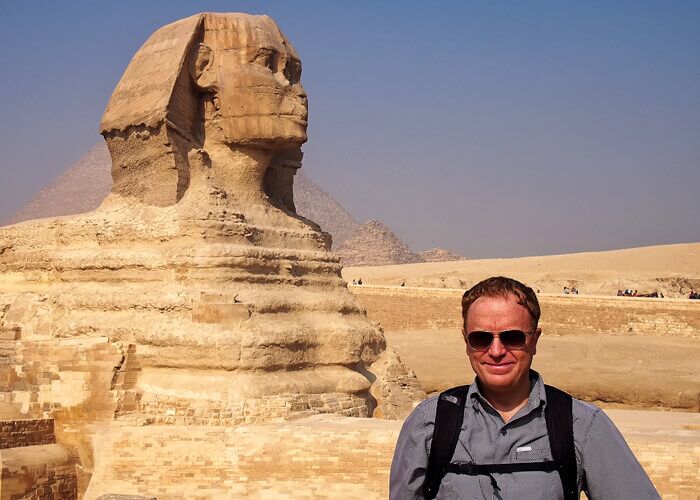
The Great Sphinx of Giza is one of the most recognizable monuments in the world. With the body of a lion and the face of a human, it has watched over the Giza Pyramids Complex for thousands of years. It is ancient, enigmatic, and strangely calm, as if it has seen empires rise and fall and decided to remain silent. For many travelers, the Sphinx is the moment when Egypt stops feeling like a collection of famous images and becomes something more intimate: a monument that seems to look back at you.
Located on the Giza Plateau just outside Cairo, the Great Sphinx is the largest monolithic statue in the world and one of the oldest surviving sculptures of its size. Carved from a single mass of limestone, it stands near the Pyramid of Khafre and is often associated with that pharaoh, though its exact origins continue to be studied and debated. Its lion body suggests strength and protection, while its human face suggests intelligence, royalty, and divine presence. Together, these elements create a symbol that feels both earthly and eternal.
Visiting the Sphinx is unlike visiting any other monument in Egypt. The pyramids impress you with their scale, but the Sphinx draws you in with its expression. It is not only a masterpiece of ancient engineering; it is a face. Standing before it, you may feel that you are looking into the gaze of a king, a god, a guardian, or perhaps the memory of civilization itself. That emotional connection is one of the reasons the Great Sphinx remains one of the most photographed, discussed, and mysterious landmarks on Earth.
This guide is written for first-time visitors, returning travelers, families, couples, solo explorers, history lovers, photographers, and anyone who wants to understand the Great Sphinx beyond the postcard. We will explore its history, symbolism, location, restoration, myths, best visiting times, ticket and access tips, photography advice, safety guidance, and how to combine a Sphinx visit with the pyramids, the Grand Egyptian Museum, Saqqara, Memphis, and the rest of your Cairo itinerary.
Whether you have one day in Cairo or a longer journey through Egypt, the Great Sphinx deserves more than a quick glance. It is a monument that rewards attention, patience, and curiosity. When you slow down and truly look at it, the Sphinx begins to speak without saying a word.
The Great Sphinx does not need to explain itself. It simply watches, and in that watching it makes every visitor feel the weight of time.
Quick Answer: What Is the Great Sphinx of Giza?
The Great Sphinx of Giza is a massive limestone statue with the body of a lion and the head of a human, located on the Giza Plateau near Cairo, Egypt. It is one of the oldest and largest monolithic sculptures in the world and is commonly associated with Pharaoh Khafre of the Old Kingdom. The Sphinx served as a guardian figure connected to royal power, solar symbolism, and the sacred landscape of the Giza necropolis. Today, visitors can view it from designated areas near the Giza Pyramids Complex, often combining the experience with visits to the Great Pyramid of Cheops, the Pyramid of Khafre, the Pyramid of Menkaure, and nearby museums. Most travelers spend 30 to 60 minutes at the Sphinx, though a full Giza visit usually takes two to four hours.
Why the Great Sphinx of Giza Matters
The Great Sphinx matters because it is one of humanity’s earliest monumental artworks. It is not only a symbol of ancient Egypt but also a reminder of how powerful, ambitious, and imaginative early civilizations could be. Carved from living bedrock, the Sphinx required extraordinary planning, labor, artistic vision, and religious motivation. It stands as proof that the ancient Egyptians did not merely build tombs; they shaped landscapes into sacred statements.
The Sphinx also matters because it connects several major themes of Egyptian civilization: kingship, protection, solar worship, funerary belief, and monumental art. In ancient Egypt, the king was not only a political ruler but also a divine figure responsible for maintaining order. The Sphinx combines royal and animal power, suggesting that the king’s authority was both human and cosmic. Its lion body evokes strength and guardianship, while its human face suggests intelligence, identity, and royal presence.
For travelers, the Sphinx is important because it changes the way you experience Giza. The pyramids are vast and geometric, but the Sphinx is personal. It has a face. It seems to express something. That human element makes it easier to connect with emotionally, even if you are not a historian or archaeologist. Many visitors find that the Sphinx becomes one of the most memorable parts of their Egypt trip precisely because it feels alive.
The monument also matters because it has survived so much. Wind, sand, earthquakes, pollution, human damage, restoration attempts, and the passage of millennia have all touched it. Yet it remains. Standing before the Sphinx is a lesson in endurance. It reminds you that history is not fragile in the way we often assume. Some things, once carved with purpose, can outlast the civilizations that made them.
The Great Sphinx is not only a monument of ancient Egypt. It is a monument to the human desire to create something that will outlast death.
Where the Great Sphinx Is Located
The Great Sphinx is located on the west bank of the Nile at the Giza Plateau, on the edge of modern Cairo. It lies near the Pyramid of Khafre and faces east, a position that gives it a strong connection to the rising sun and to the broader sacred geography of the plateau. Its placement was not accidental. The Sphinx belongs to a carefully organized funerary landscape that includes pyramids, temples, causeways, cemeteries, and ritual spaces.
When you visit the Giza Plateau, the Sphinx often becomes one of the first or last major stops, depending on your route. Many travelers begin at the Great Pyramid, move to the Pyramid of Khafre, and then descend toward the Sphinx. Others start near the Sphinx and work upward. Both approaches can work, but timing, heat, and crowd flow should guide your decision.
The Sphinx is also close to the Valley Temple associated with Khafre, an important structure that helps explain how the monument fit into the larger funerary complex. Although the temple is not as famous as the Sphinx itself, it adds historical depth to the visit and helps you imagine how the plateau once functioned as a ceremonial space.
For visitors coming from central Cairo, the Giza Plateau is reachable by taxi, ride-hailing app, private driver, or guided tour. Traffic can be unpredictable, so it is wise to allow extra time, especially if you are combining the Sphinx with the pyramids, the Grand Egyptian Museum, or a return to your hotel or airport.
The Sphinx does not stand alone. It belongs to Giza, to the pyramids, to the desert edge, and to the ancient idea that a king’s power must be guarded forever.
The History of the Great Sphinx
The Great Sphinx was created during Egypt’s Old Kingdom, a period famous for the development of monumental stone architecture and royal funerary complexes. Most scholars associate the Sphinx with Pharaoh Khafre, who ruled during the Fourth Dynasty and built the second-largest pyramid at Giza. The similarity between the Sphinx’s face and known representations of Khafre has led many researchers to connect the monument with his reign, though absolute certainty remains difficult because the Sphinx itself does not carry a clear original inscription naming its builder.
The Sphinx was carved directly from a natural limestone outcrop on the plateau. This makes it unique among large ancient statues. Rather than assembling blocks, Egyptian craftsmen shaped the living rock into a guardian figure of enormous scale. The process would have required careful planning, skilled sculptors, labor organization, and a strong religious or political purpose.
Over time, the Sphinx became part of a wider sacred landscape. In later periods, it was associated with solar worship and may have been linked to the concept of Ra-Horakhty, a form of the sun god connected with kingship and creation. Its eastern orientation supports this solar interpretation, as it faces the rising sun and seems to greet the dawn each day.
The Sphinx also underwent changes. Its nose is missing, its body shows erosion, and parts of it were buried in sand for long periods of history. Ancient and modern restorations have attempted to stabilize and protect it. The famous Dream Stele of Thutmose IV, placed between its paws, records a dream in which the Sphinx promised kingship to the young prince in exchange for clearing away the sand that threatened it. This stele is one of the most important historical documents connected to the monument.
What makes the history of the Sphinx so compelling is that it is not a single story. It is a sequence of meanings. To the Old Kingdom, it may have been a royal guardian. To the New Kingdom, it may have become a solar and divine presence. To later travelers, it became a mystery. To modern archaeologists, it remains a subject of study, conservation, and fascination.
The Sphinx has been a king’s guardian, a solar symbol, a buried mystery, and a modern icon. Its meaning has changed, but its presence has not.
What the Great Sphinx Represents
The Great Sphinx combines two powerful forms: the human head and the lion body. In ancient Egyptian symbolism, this union communicates multiple ideas at once. The lion was associated with strength, protection, ferocity, and royal power. The human face suggests intelligence, identity, and divine kingship. Together, they create a being that is both natural and supernatural, earthly and eternal.
One of the main meanings of the Sphinx is guardianship. It stands as a protector of the Giza necropolis, watching over royal tombs and sacred spaces. In ancient Egypt, thresholds, temples, tombs, and processional routes were often protected by symbolic figures. The Sphinx is one of the most dramatic examples of this protective tradition.
The monument is also connected to solar symbolism. Facing east, it aligns with the rising sun, which in Egyptian belief was linked to rebirth, divine power, and the journey of the sun god. This orientation may suggest that the Sphinx was not only guarding a royal cemetery but also participating in the daily renewal of cosmic order.
Another layer of meaning is royal ideology. The pharaoh was often depicted as a force of order against chaos. A lion-headed or lion-bodied royal image could express the king’s ability to protect Egypt, defeat enemies, and maintain ma’at, the ancient concept of truth, balance, and cosmic harmony. The Sphinx can therefore be understood as a statement of legitimate power carved into the landscape.
For modern visitors, the Sphinx may feel mysterious because its meaning is not simplified into one story. It is not only a statue. It is a theological, political, and artistic symbol compressed into stone. That complexity is part of its power.
The Sphinx does not represent one idea alone. It is a guardian, a king, a sun symbol, and a warning that some mysteries are older than explanation.
Dimensions and Physical Presence
The Great Sphinx is enormous. It measures approximately 73 meters in length and about 20 meters in height, making it one of the largest statues ever created in the ancient world. Its scale becomes clear only when you stand near it. Photographs can suggest size, but they cannot fully communicate the sensation of facing a limestone body carved from the plateau itself.
The monument’s paws extend forward, creating a sense of repose and readiness at the same time. It appears to be resting, yet also watching. Its body is low and elongated, while the head rises with calm authority. The proportions are not delicate in the way of Greek sculpture, but they are intentional. The Sphinx was designed to be seen from a distance and approached slowly, as part of a sacred landscape.
The face, though damaged, still carries a striking expression. The eyes seem alert, the mouth composed, and the overall effect is one of serene vigilance. The missing nose and weathered surface add to its emotional power. The Sphinx does not look perfect; it looks ancient. And that age gives it dignity.
Visitors often notice how the Sphinx relates to the pyramids behind it. In certain angles, the pyramid of Khafre rises above the Sphinx, creating one of the most famous compositions in travel photography. This visual relationship is not accidental. The Sphinx and pyramids belong to the same funerary world, and seeing them together helps you understand the plateau as a unified ancient site.
The Sphinx is not only large. It is present. Its mass, age, and gaze make it feel less like an object and more like a being that has chosen to remain.
The Missing Nose and Other Famous Mysteries
One of the most common questions about the Great Sphinx is what happened to its nose. Popular legends once claimed that Napoleon’s soldiers shot it off, but this story is not supported by historical evidence. Images and descriptions from before Napoleon’s time show the Sphinx already missing its nose. The damage likely occurred much earlier, possibly through erosion, deliberate iconoclasm, or vandalism over centuries.
The missing nose has become part of the Sphinx’s identity. It gives the face a wounded, enigmatic quality. Rather than reducing the monument’s power, the damage increases it. The Sphinx looks like a survivor. It has been touched by time, and that touch is visible.
Other mysteries surround the Sphinx as well. Scholars continue to study its original face, its symbolic meaning, its construction method, and the possibility of hidden chambers or unfinished areas beneath it. Some speculative theories have proposed lost civilizations or secret underground rooms, but mainstream archaeology emphasizes evidence, context, and careful interpretation.
What is clear is that the Sphinx was never a random monument. It was created with purpose, placed within a sacred landscape, and maintained, restored, and revered across many periods of Egyptian history. Its mysteries are real, but they do not require fantasy to be fascinating. The truth of the Sphinx is already extraordinary.
The Sphinx’s missing nose reminds us that even the most famous monuments are not untouched by time. What survives is not perfection, but endurance.
The Dream Stele of Thutmose IV
One of the most important historical objects connected to the Great Sphinx is the Dream Stele of Thutmose IV, placed between the Sphinx’s paws. The stele records a story in which the young prince Thutmose fell asleep near the Sphinx while hunting. In his dream, the Sphinx spoke to him, promising royal power if he removed the sand that had buried it.
Thutmose IV later became pharaoh and carried out restoration work around the Sphinx. The stele is significant for several reasons. It shows that the Sphinx was already ancient and revered by the New Kingdom. It also demonstrates how Egyptian rulers used monuments to legitimize their authority. By presenting himself as chosen by the Sphinx, Thutmose connected his reign to divine will and ancestral memory.
For visitors, the Dream Stele adds another layer to the experience. The Sphinx is not only a passive monument; in this story, it speaks. It makes promises. It intervenes in politics. It becomes an active presence in Egyptian history. Whether read literally or symbolically, the story reveals how deeply the Sphinx was embedded in the religious imagination of later Egyptians.
When you stand before the Sphinx, it is worth remembering that people have been interpreting it for thousands of years. Ancient princes, medieval travelers, modern archaeologists, and today’s tourists have all looked at the same face and searched for meaning.
The Dream Stele tells us that the Sphinx was never silent for long. Even in stone, it found ways to speak to kings.
Restoration and Conservation of the Sphinx
The Great Sphinx has suffered from natural and human-caused damage over millennia. Limestone erosion, wind, sand, groundwater, salt crystallization, pollution, and earlier restoration attempts have all affected its surface. The monument’s body shows visible layering and weathering, especially on the western side, where erosion has been more pronounced.
Ancient Egyptians themselves recognized the need for protection. Clearing sand, repairing damaged areas, and creating inscriptions were part of the Sphinx’s long history of care. In the modern era, conservation projects have aimed to stabilize the structure, monitor environmental threats, and limit damage from tourism and urban expansion.
Conservation of the Sphinx is complex because the monument is both fragile and immense. Any intervention must balance preservation with respect for historical authenticity. Restorers cannot simply remake the Sphinx; they must protect what remains while preventing further deterioration.
For visitors, understanding conservation adds depth to the visit. The Sphinx is not only an ancient artwork; it is a surviving patient of history. Every crack, repair, and weathered surface tells part of its long story. When you follow site rules, avoid touching restricted areas, and respect barriers, you become part of its protection.
The Sphinx has been buried, uncovered, repaired, studied, and admired. Its survival is not accidental; it is the result of centuries of human care and curiosity.
Best Time to Visit the Great Sphinx
The best time to visit the Great Sphinx is early in the morning, shortly after the Giza Plateau opens. This is when the site is usually calmer, the light is softer, and the heat has not yet become intense. Early visits also allow you to enjoy the Sphinx with fewer crowds, making the experience more reflective and photographic.
Late afternoon can also be beautiful, especially if you want warm golden light on the limestone. The setting sun can give the Sphinx a dramatic glow, and the shadows around its body become more expressive. However, popular viewpoints may be busier later in the day, so plan accordingly.
In terms of months, the most comfortable season to visit Cairo and Giza is generally from October to April. During this period, daytime temperatures are milder, making walking around the plateau much more pleasant. If you are planning a wider trip, our guides to Egypt in October, Egypt in November, and Egypt in January can help you choose the right time.
Summer visits are possible, but they require heat management. The Giza Plateau is open and exposed, and the Sphinx area has limited shade. If you travel from June to August, start very early, carry water, wear sun protection, and avoid staying too long during the hottest part of the day. For broader seasonal advice, see our article on climate and weather in Egypt and our guide to the best time of year to visit Egypt.
If you are visiting during peak holiday seasons, expect larger crowds. Winter holidays, school breaks, and major festivals can increase demand for guides, transport, and entrance access. Our guide to Egypt winter holidays can help you plan around busy periods.
At the Sphinx, the hour matters. Morning gives you calm, noon gives you heat, and sunset gives you gold.
How Much Time Do You Need at the Great Sphinx?
For most visitors, 30 to 60 minutes is enough to appreciate the Great Sphinx, take photographs, and absorb its presence. The monument itself is compact in viewing area, though its scale is enormous. If you are visiting as part of a wider Giza itinerary, you can spend more time exploring nearby viewpoints, the Valley Temple area, and the relationship between the Sphinx and the pyramids.
If you are a photography enthusiast, history lover, or someone who enjoys standing quietly with ancient monuments, you may want longer. The Sphinx rewards patience. The more time you spend observing angles, light, erosion patterns, and the surrounding landscape, the more the monument begins to reveal itself.
For families with children, a shorter visit is often better. The Sphinx is visually engaging, but heat, crowds, and walking can become tiring. Combine it with a broader Giza route rather than treating it as a long standalone stop.
If you are visiting the entire Giza Plateau, plan for two to four hours depending on whether you enter pyramids, take photos at multiple viewpoints, or add the Grand Egyptian Museum. For itinerary planning, see our 3-day Egypt itinerary and 4-day Egypt itinerary guides.
Thirty minutes can give you a photo. One hour can give you atmosphere. A slow morning at Giza can give you memory.
Tickets, Entry, and Access Tips
The Great Sphinx is located within the wider Giza Pyramids Complex, and access is usually governed by the plateau’s ticketing system. Standard tickets generally allow visitors to access the main archaeological areas, while some special experiences, such as entering certain pyramid interiors, may require separate tickets. Rules and prices can change, so it is wise to check current information before your visit.
Security checks are normal at the Giza Plateau. Bags may be inspected, and large luggage is usually not permitted inside. If you are visiting with a guide or driver, they can advise you on the best entrance and timing.
The Sphinx is viewed from designated areas, and access around the monument can be regulated to protect the site and manage crowds. Do not attempt to climb on restricted stones or bypass barriers. The Sphinx is fragile, and conservation efforts depend on visitor cooperation.
If you want a smoother visit, consider a guided route. A structured private trip to the Giza Pyramids, Sphinx, and Saqqara or an all-inclusive private trip to the Giza Pyramids can help you handle logistics, timing, and interpretation more easily.
A great Sphinx visit begins before you arrive: know the entrance, know the heat, know the crowds, and know how much time you truly have.
How to Get to the Great Sphinx from Cairo
Most visitors reach the Great Sphinx from central Cairo, Giza, or nearby hotels. Travel time can vary depending on traffic, which is one of the most important planning factors in Cairo. From downtown Cairo, the journey may take 30 minutes in favorable conditions or significantly longer during rush hour.
Taxis and ride-hailing apps are convenient for independent travelers. If you use an app, set your destination carefully and confirm whether you are heading to the main Giza Plateau entrance or a specific viewpoint. Because the area has multiple access roads, clear communication with your driver can save time.
Private drivers are often the most comfortable option, especially if you plan to combine the Sphinx with the pyramids, the Grand Egyptian Museum, Saqqara, or Memphis. A driver can wait while you visit and help you move efficiently between sites.
Public transport is possible but not always the simplest choice for first-time visitors. If you are short on time, traveling with children, or unfamiliar with Cairo’s road network, a guided tour or private transfer is usually the smoother option.
For broader Cairo planning, see our Cairo destination guide and our Cairo day tours page.
Getting to the Sphinx is easy on the map and complicated in real life. Cairo traffic is part of the journey, and planning around it is part of the wisdom.
What You Can See Around the Great Sphinx
1. The Sphinx Viewing Area
The main experience is, of course, the Great Sphinx itself. Visitors can view it from designated areas that allow close appreciation of its scale, face, paws, and body. The angle from the front is the most iconic, but side views can reveal the texture of the limestone and the extent of erosion.
Take time to look at the Sphinx from more than one perspective. From the front, it appears solemn and direct. From the side, its length becomes more obvious. From elevated viewpoints, it can be seen in relation to the pyramids, creating one of the most recognizable images in Egypt.
2. The Valley Temple of Khafre
Near the Sphinx are remains associated with the Valley Temple of Khafre, part of the larger funerary complex connected to the Pyramid of Khafre. The temple area helps visitors understand that the Sphinx was not isolated. It belonged to a ceremonial landscape of temples, causeways, and royal monuments.
Though less famous than the Sphinx itself, the temple remains add historical depth. They remind you that Giza was not only a burial ground but also a place of ritual movement, offering, and royal commemoration.
3. Panorama Points and Pyramid Views
Some of the best photographs of the Sphinx are taken from elevated areas where the monument appears with one or more pyramids in the background. These viewpoints are popular because they capture the full symbolic landscape of Giza: guardian, tomb, desert, and sky.
If you want cleaner shots, arrive early. Panorama areas can become crowded, especially when tour groups arrive. A little patience can make a big difference in the quality of your experience and your photographs.
4. The Sound and Light Show
The Sound and Light Show at Giza often includes the Sphinx as part of its dramatic nighttime presentation. Using illumination and narration, the show tells stories connected to ancient Egyptian history, the pyramids, and the Sphinx. It can be especially enjoyable for families or travelers who like theatrical storytelling.
That said, the show is not for everyone. Some visitors prefer the quiet of daylight and find the evening presentation overly dramatic. If you plan to attend, check current schedules, language options, and ticket details in advance.
The Sphinx is most powerful in daylight, when its stone, shadows, and silence need no performance.
Combining the Great Sphinx with the Giza Pyramids
The Great Sphinx is best experienced as part of the wider Giza Pyramids Complex. Visiting the Sphinx alone can feel incomplete because it belongs to the same ancient landscape as the Great Pyramid of Cheops, the Pyramid of Khafre, and the Pyramid of Menkaure.
A strong morning route is to begin at the Great Pyramid, continue to the Pyramid of Khafre, then descend toward the Sphinx. This order allows you to move from monumental scale to intimate guardian presence. If you have more time, add the Panorama Point and quieter areas around Menkaure.
Another option is to start at the Sphinx early, when the site is calmer, then move upward to the pyramids. This can be especially good for photographers who want soft light on the Sphinx before crowds arrive.
If you are visiting with limited time, prioritize the Sphinx, the Great Pyramid exterior, and one viewpoint where all three pyramids can be seen together. If you have a half-day, add the Grand Egyptian Museum for context and comfort.
The pyramids show the scale of royal ambition. The Sphinx shows its guardian face. Together, they make Giza complete.
The Great Sphinx and the Grand Egyptian Museum
The Grand Egyptian Museum is a natural companion to a visit to the Great Sphinx. While the Sphinx gives you the ancient landscape, the museum provides artifacts, royal statues, contextual displays, and modern interpretive spaces. Together, they create a fuller understanding of the Giza Plateau and Old Kingdom Egypt.
After walking the hot limestone paths of Giza, the museum offers air-conditioned relief, rest areas, and a chance to study objects up close. For many travelers, this combination makes the day more balanced: outdoor monument, indoor context, and then perhaps sunset views back near the plateau.
If you are interested in comparing museum experiences, you may also want to visit the classic Egyptian Museum in Tahrir Square. The old museum has historical atmosphere, while the Grand Egyptian Museum offers modern scale and design. Both can enrich your understanding of the Sphinx and the pyramids.
For broader museum planning, see our guide to top museums in Egypt.
The Sphinx gives you mystery. The museum gives you context. One makes you wonder; the other helps you understand why.
Combining the Sphinx with Saqqara and Memphis
If you have more time in the Cairo region, combine the Great Sphinx with Saqqara and Memphis. This creates a deeper picture of the ancient Memphite necropolis, where Egypt’s earliest monumental stone architecture developed.
Saqqara is home to the Step Pyramid of Zoser, the earliest colossal stone building in Egypt and a revolutionary ancestor of the smooth-sided pyramids at Giza. Memphis, once the capital of ancient Egypt, offers colossal statues, sphinxes, and remains of temples and palaces that provide essential historical context.
A combined day of Giza, Saqqara, and Memphis is one of the most rewarding ways to understand the origins of Egyptian monumental culture. The Sphinx becomes part of a longer story that begins with the first stone pyramids and the rise of the Memphite capital.
For structured routes, see our private day tour to the Pyramids of Giza, Dahshur, Memphis, and Saqqara and our Ancient City of Memphis guide.
Giza is the climax, but Saqqara and Memphis are the prologue. The Sphinx stands at the center of a much older story.
Is the Great Sphinx Safe for Tourists?
The Great Sphinx and the wider Giza Plateau are generally safe for tourists. Security is visible around the site, and millions of visitors come each year without incident. As with any major tourist destination, however, awareness is important.
The most common issues are not violent crimes but persistent vendors, unofficial guides, inflated prices, and pressure to buy camel rides, photos, or “special access.” These situations can be annoying, but they are manageable. A polite but firm refusal is usually enough. If someone becomes aggressive, move toward official staff, ticket areas, or other visitors.
Using a trusted guide or reputable tour company can reduce stress significantly. Guides know the site layout, ticket points, and how to handle approaches from vendors. For first-time visitors, this can make the experience feel much smoother and more enjoyable.
For broader safety advice, read our guides on whether it is safe to travel to Egypt and tourist scams in Egypt. Knowledge is the best protection.
The Sphinx has survived thousands of years. You can survive the vendors with a smile, a firm no, and a little preparation.
What to Wear and What to Pack for the Great Sphinx
The Giza Plateau is open, sandy, hot, and exposed. Comfortable walking shoes are essential. The ground can be uneven, and you will likely walk more than you expect. Closed shoes with good grip are usually best, though breathable sandals may work for short visits if you are careful.
Dress lightly but modestly. Cotton or linen shirts, trousers, skirts below the knee, and sun-protective layers are practical. A hat and sunglasses are strongly recommended. If you plan to visit mosques or more conservative areas later in Cairo, carrying a scarf or light jacket can be useful.
Bring water, sunscreen, a small towel, tissues, and a power bank. A light backpack keeps your hands free. If you are visiting in the morning, the temperature may feel pleasant, but by midday the sun can become intense. Do not underestimate the heat, even in winter.
For a complete checklist, see our guides to what to pack when traveling to Egypt and practical Egypt travel tips.
At the Sphinx, your best accessories are not souvenirs. They are water, shade, comfortable shoes, and patience.
Photography Tips for the Great Sphinx
Photographing the Great Sphinx is one of the most popular experiences in Egypt, but the best images require timing and awareness. Early morning and late afternoon provide soft light, long shadows, and fewer harsh contrasts. Midday sun can flatten the stone and make the scene feel less dramatic.
Use wide angles for the full Sphinx and pyramid-backed compositions, but do not forget details: the eyes, weathered limestone, erosion lines, paws, and the Dream Stele area. These closer images can make your photo album feel more personal and less repetitive.
Crowds are inevitable at popular viewpoints. If you want cleaner shots, arrive earlier than most tour groups or explore side angles that include the Sphinx with the Pyramid of Khafre behind it. Telephoto lenses can also compress the scene beautifully, especially for the Sphinx with a pyramid in the background.
Respect photography rules. Some areas restrict tripods, drones, or commercial equipment. Always ask before photographing workers, vendors, camel handlers, or local residents. A friendly conversation often leads to better portraits than a hidden shot.
The best Sphinx photograph is not always the widest one. Sometimes it is the shadow on the stone, the gaze of the face, or the tiny human figure that reveals the true scale.
Visiting the Great Sphinx with Kids
The Great Sphinx can be magical for children. Its lion body and human face are easy to understand, and the idea of a giant guardian captures imagination quickly. However, the heat, walking, and crowds can also overwhelm younger travelers. Plan a short visit, start early, and build in breaks.
Instead of trying to explain every historical detail, give children a few vivid ideas: a giant protector, a king’s face, a lion’s body, a buried mystery, and a monument older than almost anything they have ever seen. Let them ask questions, take photos, and imagine what the Sphinx might be watching for.
If your family wants a smoother experience, consider a private guide who knows how to engage children without overloading them. For broader family advice, see our guide to Egypt with kids and our family tours Egypt page.
Children do not need to know every theory about the Sphinx. They only need to look up and feel that a giant stone guardian is looking back.
Solo Travel and Romantic Travel at the Sphinx
Solo travelers often find the Great Sphinx deeply moving. The monument invites reflection, and being alone before it can feel surprisingly intimate. The Sphinx does not demand conversation. It simply exists, and in that silence, solo travelers can think, wonder, and absorb the scale of history.
If you are traveling alone, still plan transport carefully, avoid isolated areas, and choose reputable guides or drivers. If you are traveling alone, especially as a woman, our solo female travel Egypt guide and tips for traveling to Egypt alone can help you prepare with more confidence.
For couples, the Sphinx can be romantic in an unexpected way. There is something intimate about standing beside someone in a landscape so ancient that the modern world fades. Sunrise visits, private guides, and quiet moments near the monument can make the experience feel personal rather than touristy.
If you are planning a honeymoon or romantic route, consider combining Giza with a Nile cruise, Luxor temples, and Red Sea relaxation. Our Egypt honeymoon itinerary guide can help you balance culture and romance.
The Sphinx is romantic not because it is soft, but because it is eternal. Standing there with someone you love makes time feel both enormous and precious.
Budget Tips for Visiting the Great Sphinx
The Great Sphinx can be visited on different budgets. Independent travel is usually cheaper, but it requires more time, confidence, and negotiation. Guided tours cost more but can save energy, reduce hassle, and provide better historical context. The best choice depends on your travel style, schedule, and comfort level.
If you are budget-conscious, bring your own water, agree on prices in advance for any services, and avoid unnecessary add-ons unless they truly interest you. The exterior experience of the Sphinx is already powerful. Also, consider visiting on weekdays if possible, as weekends and holidays can be busier.
If you prefer comfort, private transfers, guided tours, and higher-end hotels in Cairo can make the day smoother. Our guides to luxury hotels in Egypt and 5-star hotels in Cairo Egypt can help you choose a comfortable base.
For a broader pricing overview, see our article on Egypt travel costs. Understanding typical expenses helps you decide where to save and where to spend.
You do not need to spend a fortune to love the Sphinx. What you need is time, water, and the willingness to look closely.
Common Myths About the Great Sphinx
Few monuments attract as many myths as the Great Sphinx. Some stories are harmless, while others distort the real achievement of ancient Egyptian builders and artists.
One common myth is that Napoleon’s soldiers shot off the Sphinx’s nose. This story is not supported by evidence, and earlier depictions show the nose already missing. The damage likely occurred centuries before Napoleon arrived in Egypt.
Another myth is that the Sphinx was built by aliens or a lost advanced civilization. While the monument is astonishing, it is fully explainable through human ingenuity, organized labor, geological knowledge, and Egyptian religious culture. The Sphinx did not appear from nowhere. It emerged from a society capable of extraordinary artistic and engineering achievement.
Some travelers believe the Sphinx hides vast underground chambers filled with secret knowledge. Modern research has explored the monument and surrounding area with scientific methods, and while mysteries remain, archaeologists emphasize evidence over speculation. The Sphinx is mysterious enough without needing fantasy.
Myths can be entertaining, but the real story is more impressive. The Great Sphinx was carved by ancient Egyptians, placed within a sacred funerary landscape, and preserved across thousands of years by history, sand, restoration, and human fascination.
The truth of the Sphinx is stranger and more beautiful than the myths: it was made by human hands, human minds, and human belief.
Common Mistakes to Avoid at the Great Sphinx
The most common mistake is arriving too late. By mid-morning, the Giza Plateau can be crowded and hot. If you want a peaceful experience, early arrival is one of the simplest and most effective strategies.
Another mistake is focusing only on the Sphinx and ignoring the wider landscape. The monument is powerful, but its meaning grows when you see it in relation to the pyramids, temples, causeways, and desert edge. Giza is not a collection of isolated attractions. It is a unified ancient complex.
Travelers also sometimes accept unclear prices for camel rides, photos, or “guides.” Always clarify costs before agreeing to anything. Politeness matters, but firmness matters too.
Finally, many visitors rush past the Sphinx without pausing. Take a moment. Stand quietly. Look closely. The Sphinx does not reward speed. It rewards attention.
The biggest mistake at the Sphinx is treating it like a photo stop. It is a guardian, a mystery, and one of humanity’s oldest faces.
Cultural Etiquette and Respectful Visiting
The Great Sphinx is an archaeological monument, but it is also part of a living country. Respectful travel matters. Avoid climbing on restricted stones, touching fragile areas where prohibited, or littering. Follow signage and listen to official guides or site staff.
When photographing people, ask permission. Vendors, camel handlers, and local residents are not part of the scenery. A simple question and a friendly attitude can lead to better interactions and better photos.
Dress modestly, especially if you are combining Giza with religious sites elsewhere in Cairo. Egypt is generally tolerant of tourists, but showing cultural respect helps you connect more positively with local people.
Tipping is common, but it should be fair and consensual. For more guidance, read our article on tipping in Egypt.
The Sphinx has been respected for millennia. The least we can do is respect the site, the staff, and the people who live beside it today.
How the Great Sphinx Fits Into a Wider Egypt Trip
For most travelers, the Great Sphinx is part of the opening chapter of an Egypt journey. It often appears alongside the Giza Pyramids in Cairo before the trip moves south to Luxor and Aswan. That order is meaningful. Giza gives you the earliest monumental royal imagery, while Luxor and Aswan show how Egyptian religious and funerary culture developed over centuries.
If you are building a full itinerary, the Sphinx can be combined with the Great Pyramid, the Grand Egyptian Museum, Saqqara, Memphis, Islamic Cairo, and Coptic Cairo. From there, you can fly to Luxor, continue to Aswan, and optionally add Abu Simbel or a Nile cruise.
For shorter trips, the Sphinx can still be a highlight. A well-planned day in Cairo can include Giza in the morning, a museum at midday, and the Citadel or Khan el-Khalili in the evening. For longer journeys, it becomes one essential chapter in a much larger story.
See our Egypt itinerary guide, Egypt in 7 days, 10-day Egypt itinerary, and 14-day Egypt itinerary for route inspiration.
The Sphinx is often the first great face travelers meet in Egypt, but it is rarely the last memory they leave behind.
Frequently Asked Questions About the Great Sphinx of Giza
What is the Great Sphinx of Giza?
The Great Sphinx of Giza is a massive limestone statue with the body of a lion and the head of a human. It is located on the Giza Plateau near Cairo and is one of the oldest and largest monolithic sculptures in the world. The Sphinx is commonly associated with Pharaoh Khafre and served as a guardian figure within the sacred funerary landscape of Giza.
Who built the Great Sphinx?
Most scholars associate the Great Sphinx with Pharaoh Khafre of the Fourth Dynasty during Egypt’s Old Kingdom. The exact identification is still discussed because the Sphinx itself does not carry a clear original inscription naming its builder. However, its location near Khafre’s pyramid complex and stylistic evidence strongly connect it to his reign.
Why does the Sphinx have no nose?
The Sphinx’s nose is missing due to damage that occurred long before the modern era. Popular stories blaming Napoleon’s soldiers are not supported by evidence. The damage may have resulted from erosion, vandalism, or deliberate iconoclasm over a long period of history.
Can you go inside the Great Sphinx?
No, visitors cannot enter the Great Sphinx. The monument is viewed from designated external areas to protect the structure and manage crowds. There are no public interior chambers like those found in some pyramids.
How much time do you need at the Great Sphinx?
Most visitors need 30 to 60 minutes to appreciate the Sphinx, take photos, and absorb its presence. If you are visiting the wider Giza Plateau, plan for two to four hours depending on whether you also visit the pyramids, viewpoints, and museums.
What is the best time of day to visit the Great Sphinx?
Early morning is usually best because the light is soft, the temperature is cooler, and crowds are thinner. Late afternoon can also be excellent for photography, but avoid midday if possible, especially in summer, because the sun is intense and the site offers limited shade.
Is the Great Sphinx older than the pyramids?
The Great Sphinx is generally associated with the same Old Kingdom period as the major pyramids at Giza, especially the Pyramid of Khafre. It is not usually considered older than the Great Pyramid of Cheops, but it belongs to the same broader monumental landscape and dynastic context.
What does the Great Sphinx symbolize?
The Sphinx symbolizes royal power, protection, strength, and divine presence. Its lion body represents force and guardianship, while its human face suggests intelligence and kingship. It is also connected to solar symbolism and the sacred landscape of the Giza necropolis.
Is the Great Sphinx worth visiting?
Absolutely. The Great Sphinx is one of the most iconic monuments in the world and a defining experience of any Egypt trip. Even if you do not spend hours at the site, standing before it and understanding its age, scale, and symbolism is deeply memorable.
Do I need a guide for the Great Sphinx?
A guide is not mandatory, but it is highly recommended, especially for first-time visitors. The Sphinx is historically rich, and a good guide can explain its symbolism, restoration, relationship to the pyramids, and place within the wider Giza landscape. A guide can also help you manage vendors and navigate the site more smoothly.
What should I wear to visit the Great Sphinx?
Wear lightweight, modest, breathable clothing and comfortable walking shoes. The Giza Plateau is sandy, uneven, and exposed to sun. A hat, sunglasses, and sunscreen are strongly recommended. If you plan to visit mosques or other religious sites in Cairo afterward, carrying a scarf or light layer is useful.
Can you take photos of the Great Sphinx?
Yes, photography is usually possible from designated viewing areas, but rules can vary and may change. Some areas restrict tripods, drones, or commercial equipment. Always follow signage and staff guidance, and be respectful of other visitors when taking photos.
Is the Great Sphinx safe for tourists?
Yes, the Great Sphinx and the wider Giza Plateau are generally safe for tourists. Security is visible around the site. The most common issues are persistent vendors, unofficial guides, and price pressure rather than serious crime. Stay aware, use official entrances, and consider a reputable guide for a smoother experience.
Can you visit the Sphinx and the Pyramids of Giza in one day?
Yes, this is one of the most popular and logical day-trip combinations in Cairo. A strong plan is to visit the pyramids early, then descend toward the Sphinx, and finish with a museum stop or viewpoint. Because traffic and heat can affect timing, private transport or a guided tour is often the smoothest option.
Is the Great Sphinx suitable for children?
Yes, children often love the Sphinx because its lion body and human face are easy to imagine and remember. The heat and walking can be tiring, so visit early, keep the stop short, bring water, and combine the experience with other engaging Giza highlights.
Related Words and Topics Around the Great Sphinx of Giza
If you are researching the Great Sphinx of Giza, you may also be searching for terms such as Sphinx of Giza history, Great Sphinx facts, Sphinx nose missing, Giza Plateau tickets, Sphinx and pyramids tour, best time to visit Sphinx, Great Sphinx photography, Sphinx of Khafre, Giza guardian statue, ancient Egyptian Sphinx meaning, Cairo Sphinx visit, and Sphinx day trip from Cairo. These topics all connect to the same experience: standing before one of the oldest and most mysterious faces in human history.
- Great Sphinx of Giza for the main monument guide
- Giza Pyramids Complex for the wider plateau experience
- Great Pyramid of Cheops for the largest pyramid nearby
- Grand Egyptian Museum for artifacts near Giza
- Egyptian Museum for Cairo’s classic museum experience
- Step Pyramid of Zoser for earlier pyramid history
- Ancient City of Memphis for Old Kingdom context
- Cairo day tours for structured sightseeing
- Egypt itinerary guide for planning a wider trip
Final Thoughts: Why the Great Sphinx Stays With You
The Great Sphinx of Giza is not just a famous statue. It is one of the oldest faces of civilization. Long before modern tourism, long before empires changed names, and long before the world looked the way it does today, Egyptian craftsmen carved a guardian into the living rock of the plateau. They created something that was not only large, but meaningful. Not only strong, but watchful. Not only ancient, but somehow still present.
Many travelers arrive expecting to see a monument and leave feeling that they have met one. The Sphinx has a way of turning history into presence. It does not need to be explained completely to be felt. Its damaged face, massive body, and silent gaze create an experience that stays with you long after the photos are saved and the plane ride home begins.
If you plan your visit well, respect the site, dress for the heat, arrive early, and give yourself time to pause, the Great Sphinx can become one of the most memorable moments of your Egypt trip. Whether you are traveling alone, with family, as a couple, or as part of a wider journey through Cairo, Luxor, and Aswan, the Sphinx deserves more than a glance. It deserves your attention.
You may visit many wonders in Egypt, but the Great Sphinx is the one that watches you back. It asks nothing, promises nothing, and yet remains with you forever.
Ready to Visit the Great Sphinx Without Stress?
Let Egypt Via Travel help you plan a smooth and memorable visit to the Great Sphinx of Giza, from sunrise routes and private guides to pyramid stops, museum visits, and wider Cairo itineraries.