
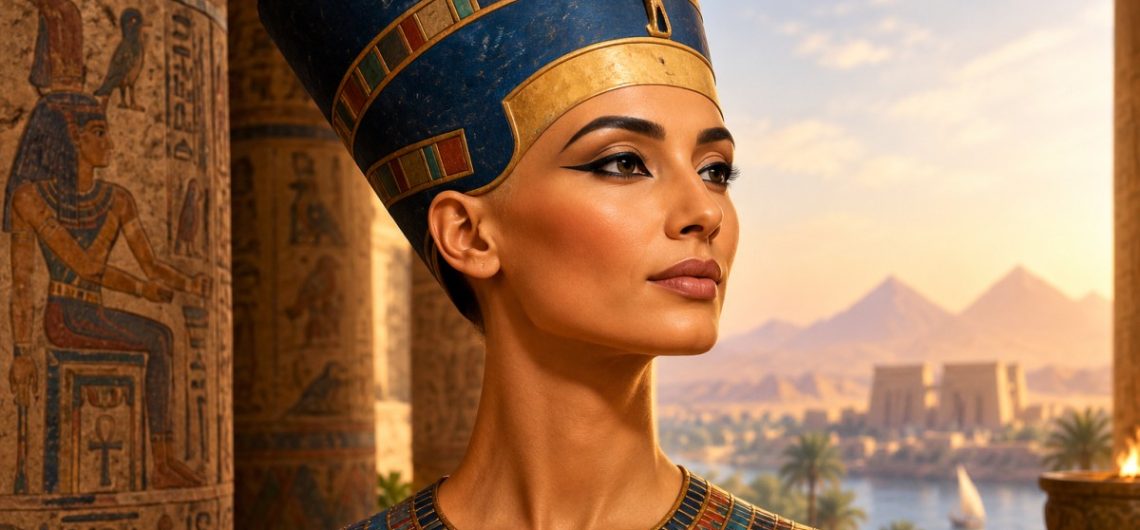
Queen Nefertiti is one of the most recognizable women in ancient history. Her name means “The Beautiful One Has Come,” and her image has become a global symbol of beauty, power, mystery, and Egyptian artistry. She was the Great Royal Wife of Pharaoh Akhenaten, one of the most controversial rulers of the New Kingdom, and she lived during the revolutionary Amarna period, when Egypt’s religious, artistic, and political world was dramatically transformed.
If you are planning a trip to Egypt in 2026, learning about Queen Nefertiti helps you understand much more than a famous painted bust in Berlin. It helps you read the story of Amarna, the temples of Karnak Temple, the royal family scenes of the New Kingdom, the religious revolution of the Aten, and the mysterious disappearance of one of Egypt’s most powerful queens. Whether you are searching for Nefertiti history, Nefertiti bust, Nefertiti husband, Nefertiti children, Nefertiti death, Nefertiti tomb, Nefertiti meaning, or where to see Queen Nefertiti in Egypt, this guide is designed to give you a complete and practical explanation.
Nefertiti was not only a queen consort. In the art and theology of the Amarna period, she appears with extraordinary prominence. She is shown wearing royal crowns, riding in chariots, offering to the Aten, embracing her daughters, and in some scenes performing actions usually reserved for kings. Her role in the religious revolution surrounding the worship of the sun disk Aten was central. She may have been a partner in power, a ritual specialist, a divine representative, or even a ruler in her own right, though scholars still debate the details.
Her fame today is inseparable from the famous painted limestone bust discovered at Amarna in 1912. That sculpture, now in the Neues Museum in Berlin, is one of the most copied and discussed artworks from ancient Egypt. Yet the bust is only one part of Nefertiti’s story. Her real historical world is found in temple reliefs, palace scenes, boundary stelae, family imagery, inscriptions, and the archaeological landscape of Tell el-Amarna, the site of Akhenaten’s short-lived capital.
This guide explores who Queen Nefertiti was, why she mattered, how she rose to prominence, what she represented in the Amarna revolution, where her image survives today, what remains unknown about her death and burial, and how to include Nefertiti-related sites in a wider Egypt itinerary. It is written for first-time visitors, returning travelers, history lovers, students, families, couples, solo explorers, and anyone fascinated by ancient women, royal power, and Egyptian art.
Queen Nefertiti is famous not only because her face is beautiful, but because her image challenges what we expect a queen to be: powerful, visible, religiously central, and historically mysterious.
Quick Answer: Who Was Queen Nefertiti?
Queen Nefertiti was the Great Royal Wife of Pharaoh Akhenaten during Egypt’s Eighteenth Dynasty in the New Kingdom, around the fourteenth century BCE. She became famous for her central role in the Amarna religious revolution, her extraordinary representation in art, and her celebrated painted limestone bust discovered at Amarna in 1912. Nefertiti appears in reliefs as a powerful queen, ritual participant, mother, and possibly co-ruler. She had several daughters with Akhenaten, including Meritaten and Ankhesenamun, but her final fate, burial place, and exact political role remain debated. Today, her legacy can be explored through Amarna archaeology, Luxor temple fragments, Egyptian museums, and the famous bust in Berlin.
Why Queen Nefertiti Matters
Queen Nefertiti matters because she is one of the clearest examples of how ancient Egyptian women could occupy visible, powerful, and religiously significant roles. She was not a shadow queen. In the art of the Amarna period, she appears beside Akhenaten, sometimes almost as his equal. She embraces her children, participates in rituals, wears royal headgear, and is shown in scenes that communicate authority, intimacy, and divine favor.
Her importance also comes from the historical moment in which she lived. Nefertiti was queen during one of the most dramatic transformations in Egyptian history. Akhenaten elevated the sun disk Aten, moved the capital to Amarna, changed royal art, and redefined the relationship between king, gods, and cosmos. Nefertiti was part of this revolution. She may have helped shape its theology, its imagery, and its public presentation.
Nefertiti also matters because she disappeared from the historical record at a crucial moment. Toward the end of Akhenaten’s reign, her name becomes less visible. New royal names appear, including Neferneferuaten and Smenkhkare. Scholars still debate whether Nefertiti died, fell from favor, retired, became co-regent, or ruled under a different name. This uncertainty makes her one of the most fascinating figures of the New Kingdom.
For travelers, Nefertiti is meaningful because her world can still be felt in Egypt. At Amarna, you can walk through the ruins of the capital she helped define. At Karnak, reused talatat blocks preserve scenes of her family and the Aten. In museums, fragments, reliefs, and statues allow you to study her image beyond the famous bust. Understanding Nefertiti enriches any itinerary that includes Luxor, Cairo, or the Amarna region.
Who Was Queen Nefertiti?
Nefertiti was the Great Royal Wife of Pharaoh Akhenaten, who ruled during the Eighteenth Dynasty of Egypt’s New Kingdom. Her reign is usually placed in the fourteenth century BCE, with Akhenaten’s rule commonly dated around 1353–1336 BCE or similar ranges depending on the chronological system used. Nefertiti would have been a young woman when she became queen, and she appears prominently in the early and middle years of the Amarna period.
Her origins are not completely certain. Some theories connect her with the powerful official Ay, who later became pharaoh, but this is not proven. She may have been born into a high-status Egyptian family, though her sudden prominence and unusual name have led to debate. The name Nefertiti, meaning “The Beautiful One Has Come,” appears early in her career and may have been a throne or honorific name adopted when she became queen.
What is clear is that Nefertiti became one of the most visible royal women in Egyptian history. She appears in temple reliefs, palace scenes, domestic images, boundary stelae, and private monuments from the Amarna period. Unlike many earlier queens, she is not only shown behind the king. She is shown acting, receiving, offering, comforting, and ruling in visual language.
Nefertiti’s full titles included Great Royal Wife, Favorite of the Aten, Lady of Upper and Lower Egypt, and other honorifics connected with royal and religious authority. These titles show that she was not merely a consort. She was part of the theological and political system that Akhenaten created around the worship of Aten.
Nefertiti Name Meaning
The name Nefertiti is usually translated as “The Beautiful One Has Come.” This meaning is important because it shaped her modern reputation. Nefertiti became associated with beauty, elegance, and idealized femininity, especially after the discovery of the famous Berlin bust. But in ancient Egypt, names were not only descriptive. They carried identity, destiny, and symbolic power.
The phrase “has come” may suggest arrival, presence, or manifestation. In the religious atmosphere of Amarna, where the Aten was the central visible divine force, Nefertiti’s name could be interpreted as part of a broader symbolic language of beauty, light, and divine favor. She was not only a queen with a beautiful name. Her name fit the ideological world she inhabited.
Some scholars suggest that “Nefertiti” may have been a name adopted at the beginning of her queenship, especially if she came from a non-royal background. If so, the name itself may have been part of the new Amarna identity: fresh, radiant, and connected to the revolutionary atmosphere of Akhenaten’s reign.
Historical Context: Egypt Before Amarna
To understand Queen Nefertiti, you need to understand the Egypt she entered. The Eighteenth Dynasty was one of Egypt’s most powerful dynasties. It had expelled the Hyksos, expanded Egyptian influence into the Levant and Nubia, and created a wealthy imperial state. By the time Akhenaten came to power, Egypt was cosmopolitan, administratively complex, and religiously rich.
The dominant religious center was Thebes, modern Luxor, where the god Amun was worshipped as king of the gods. The priesthood of Amun was powerful, wealthy, and deeply connected to state ritual. Temples such as Karnak had grown over centuries, accumulating donations, estates, statues, and religious authority.
Akhenaten, originally named Amenhotep before his religious transformation, changed this world. He elevated the Aten, a solar disk previously known but not central in this way, and eventually suppressed the name and cult of Amun. He moved the royal court to a new capital, Akhetaten, modern Amarna, located midway between Memphis and Thebes.
Nefertiti entered this transforming world as queen. Her rise coincided with one of the most radical religious experiments in Egyptian history. This context explains why her image is so unusual: she belonged to a court that was actively redefining kingship, divinity, art, and royal identity.
Akhenaten and the Religious Revolution
Akhenaten’s reign is one of the most debated periods in ancient Egypt. He changed his name from Amenhotep to Akhenaten, meaning “Effective for the Aten” or “Servant of the Aten,” depending on interpretation. He closed or restricted traditional temples, removed the name of Amun in many places, and promoted the Aten as the supreme visible divine force.
The Aten was represented as a sun disk with rays ending in small hands, often holding the ankh, the symbol of life. In Amarna art, the rays descend toward Akhenaten and Nefertiti, suggesting that the royal couple were central mediators of divine life. This imagery gave the monarchy a new theological role: the king and queen were not simply worshippers of the gods. They were part of the visible channel through which the Aten’s life-giving power reached the world.
The revolution was not only religious. It was artistic, political, and urban. Akhenaten founded a new capital, Amarna, with royal palaces, temples, administrative buildings, workshops, tombs, and residential districts. The royal family was shown in intimate scenes: kissing children, playing, offering, and sitting together. This new style broke with earlier ideals of distant, idealized kingship.
Nefertiti was central to this transformation. She appears with Akhenaten in many of the most important Amarna scenes. Her role may have been symbolic, ritual, political, or all three. She was the face of the new queenship, and perhaps the face of a new kind of royal partnership.
Nefertiti’s Role in Atenism
In the theology of Amarna, Nefertiti was more than a queen. She appears to have held a unique religious position. Some scholars compare her role to that of a divine counterpart, a priestess, or even a manifestation of a goddess associated with the Aten. The exact interpretation remains debated, but her prominence is undeniable.
In many reliefs, Akhenaten and Nefertiti are shown together before the Aten. The sun disk extends rays toward them, and they sometimes hold the ankh. This composition suggests that the royal couple mediated divine life to the people. Nefertiti is not passive. She is active, visible, and ritually important.
Some scenes show Nefertiti alone in ways that echo royal power. She is depicted smiting enemies, riding in a chariot, or receiving homage. These images are unusual for a queen in Egyptian art. They may indicate that Nefertiti was being presented as a near-regal figure, or that Amarna ideology allowed a more expansive role for the Great Royal Wife.
Nefertiti may also have been associated with Hathor, a goddess of femininity, joy, motherhood, music, and divine power. In later periods, Hathor was often connected with queenship. At Amarna, Nefertiti’s imagery may have absorbed aspects of Hathoric royalty, presenting her as a beautiful, powerful, nurturing, and sacred queen.
Nefertiti’s Family and Children
Nefertiti had several daughters with Akhenaten. Their names are known from inscriptions and reliefs, and they appear frequently in Amarna family scenes. The most commonly listed daughters include Meritaten, Ankhesenamun, Neferneferuaten Tasherit, Neferneferure, Setepenre, and Maketaten. Their exact birth order and fates are debated, but their presence shows how central the royal family was to Amarna ideology.
| Daughter | Known Role or Significance |
|---|---|
| Meritaten | Often appears prominently in Amarna scenes; may have held high status after Nefertiti’s disappearance. |
| Ankhesenamun | Originally Ankhesenpaaten; later became queen of Tutankhamun. |
| Neferneferuaten Tasherit | Name connected to the complex royal title Neferneferuaten, which has fueled debates about Nefertiti’s possible later rule. |
| Neferneferure | Appears in Amarna family imagery; exact later role uncertain. |
| Setepenre | One of the daughters shown in royal scenes; less is known about her later life. |
| Maketaten | May have died young; appears in some Amarna family contexts. |
The most historically significant daughter may be Ankhesenamun, who later became the Great Royal Wife of Tutankhamun. This connection links Nefertiti directly to one of the most famous pharaohs in history, even though Tutankhamun’s relationship to Akhenaten and Nefertiti is still discussed through archaeological and genetic evidence.
Meritaten also appears prominently in late Amarna and post-Amarna contexts. Some scholars have suggested that she may have taken on a role similar to that of Nefertiti, but the evidence is not conclusive. The daughters were not merely background figures. In Amarna ideology, the royal family itself was part of the theological message.
Art, Imagery, and Royal Representation
Nefertiti’s image is one of the most distinctive in Egyptian art. Amarna art broke with earlier conventions. Royal bodies became more elongated, heads more rounded, features more expressive, and family scenes more intimate. Akhenaten is often shown with exaggerated features, while Nefertiti appears with a long neck, elegant profile, and striking facial structure.
This does not mean Amarna art was “realistic” in a modern sense. Like all Egyptian royal art, it was symbolic. The goal was not to produce a photographic likeness, but to communicate power, theology, identity, and cosmic order. Nefertiti’s images may idealize her beauty, emphasize her royal status, and connect her to divine femininity.
She is often shown wearing the tall flat-topped blue crown, sometimes called the Nefertiti crown because it appears so strongly in her imagery. She also appears with the khat headdress, the vulture cap, and other royal or queenly headgear. In some scenes she wears a short dress or transparent garment, unusual in earlier Egyptian royal representation.
One of the most remarkable aspects of Nefertiti’s art is its intimacy. She is shown kissing her daughters, holding them, sitting with Akhenaten, and participating in family life. These images humanize the royal couple, but they also serve a political purpose: they present the king and queen as the ideal family under the Aten, the center of a new cosmic order.
The Nefertiti Bust: Discovery and Controversy
The most famous image of Queen Nefertiti is the painted limestone bust discovered in 1912 at Amarna by the German archaeologist Ludwig Borchardt. It was found in the workshop of the sculptor Thutmose, where many unfinished or discarded royal portraits were stored. The bust is about 48 centimeters high and is renowned for its symmetry, color preservation, and serene expression.
The sculpture shows Nefertiti with her characteristic blue crown, elegant neck, and carefully painted features. One eye is inlaid, while the other appears unfinished or missing its inlay. This has led to debate: was the bust an unfinished model, a ceremonial object, a training piece, or a deliberately incomplete work? There is no single agreed answer.
The bust became world-famous and is now housed in the Neues Museum in Berlin. Its presence outside Egypt has made it one of the most discussed objects in the debate over archaeological restitution. Egypt has requested its return for decades, arguing that it was removed under questionable circumstances during a period of colonial archaeology. Germany has maintained that it was legally obtained according to the division system of the time, though the ethics remain contested.
For travelers, the bust is important because it shaped modern ideas of Nefertiti. Many people imagine the queen exactly as the Berlin sculpture presents her: calm, beautiful, symmetrical, and almost modern. But the bust is only one image. The real Nefertiti appears in many forms across Amarna reliefs, private tombs, temple fragments, and museum collections.
The Berlin bust made Nefertiti immortal in modern eyes, but the historical queen is larger than the sculpture: she is a political figure, a religious symbol, and a mystery.
Nefertiti and Amarna
Amarna, ancient Akhetaten, was the capital founded by Akhenaten. It stretched along the east bank of the Nile in Middle Egypt, between Thebes and Memphis. The city was designed as a new religious and political center devoted to the Aten. It included royal palaces, temples, administrative buildings, workshops, residential quarters, tombs, and boundary stelae.
Nefertiti’s presence at Amarna can be felt throughout the site. Boundary stelae describe the founding of the city and mention the royal family. Temples and palaces once contained reliefs showing Akhenaten and Nefertiti offering to the Aten. The Great Palace, the Small Palace, the Maru-Aten, and the temple complexes all belonged to the world in which Nefertiti lived and performed her royal role.
The royal tombs at Amarna are also connected to the dynasty, though Nefertiti’s own burial has not been identified. The Royal Tomb was intended for Akhenaten and possibly other members of the royal family. Some burials and fragments found there relate to princesses and other royals, but the tomb’s history is complex and disturbed.
Amarna was abandoned soon after Akhenaten’s death. Later rulers returned power to Thebes, restored the cult of Amun, and effectively erased much of the Amarna experiment. This is one reason Nefertiti’s final years are unclear. The city that made her visible was also the city that was forsaken.
Was Nefertiti a Co-Regent or Ruler?
One of the most fascinating questions about Nefertiti is whether she ruled as co-regent or even as pharaoh in her own right. Toward the end of Akhenaten’s reign, new royal names appear: Neferneferuaten and Smenkhkare. These names are connected to a brief period of shared or transitional rule, and their identities remain debated.
Some scholars propose that Nefertiti became co-regent under the name Neferneferuaten. Others suggest she may have ruled after Akhenaten’s death. Alternative theories identify Neferneferuaten with Meritaten, Kiye, or another royal woman, while Smenkhkare may have been a male co-regent, a different name for Tutankhamun in some older theories, or a separate individual.
The evidence is not decisive. King lists, administrative documents, and objects from the period are fragmentary. What is clear is that Nefertiti’s visibility declines around Year 12 of Akhenaten’s reign, and the political situation becomes more complex. Whether she died, withdrew, was replaced, or assumed a new royal role remains one of Egyptology’s enduring mysteries.
If Nefertiti did rule as pharaoh, she would not be the first woman to do so. Earlier examples include Sobekneferu, and later Hatshepsut became one of the most famous female pharaohs. But Nefertiti’s case is different because it is less monumental and more ambiguous. She may have exercised power without leaving a clear royal name, or her identity may have been absorbed into the chaotic transition after Amarna.
Nefertiti’s Death, Disappearance, and Tomb Mystery
The death and burial of Queen Nefertiti remain unknown. No confirmed mummy, tomb, or sarcophagus has been identified as hers. This absence has made her one of the most searched-for figures in Egyptology. Her disappearance from records around the later years of Akhenaten’s reign has led to many theories.
One possibility is that she died naturally during the Amarna period and was buried in a tomb that has not survived clearly, was robbed, or was later concealed. Another is that she fell from political favor, though there is no direct evidence of disgrace. A third is that she continued to rule under a different name, making her later identity difficult to recognize.
In recent years, attention turned to the tomb of Tutankhamun. Some researchers proposed that hidden chambers might contain Nefertiti or another royal woman. Ground-penetrating radar and further studies did not confirm the existence of hidden burial chambers in the way earlier hypotheses suggested. The idea captured global media attention, but it remains unresolved in popular imagination.
Other mummies from the Eighteenth Dynasty have been studied using CT scans, DNA analysis, and forensic methods. The so-called Younger Lady in KV35, the mummy from KV55, and other remains have been connected to the Amarna family circle, but none has been definitively identified as Nefertiti.
This mystery is part of her modern appeal. Nefertiti is famous, but she is also absent. Her face is known through art, but her body, tomb, and final moments remain hidden. In that sense, she is more mysterious than many better-documented queens.
Nefertiti in Modern Culture
Queen Nefertiti has become a global icon. Her image appears in books, museums, documentaries, advertisements, jewelry, tattoos, fashion, and discussions of ancient beauty. The Berlin bust is often treated as a symbol of ideal feminine beauty, while Nefertiti herself is sometimes presented as an early example of powerful womanhood.
Her modern fame has both benefits and distortions. On one hand, it draws attention to ancient Egypt, Amarna art, and the role of royal women. On the other, it can reduce her to a beautiful face. The historical Nefertiti was not only an icon of beauty. She was a political actor, a religious figure, a mother, a queen, and possibly a ruler in a turbulent period.
Nefertiti also appears in debates about cultural heritage. The famous bust is one of the most discussed objects in the broader conversation about museums, archaeology, colonialism, and restitution. For many Egyptians, Nefertiti belongs in Egypt. For many international visitors, the Berlin bust is one of the world’s great artworks. This tension makes her story not only ancient, but deeply modern.
Where to See Queen Nefertiti Today
If you want to understand Queen Nefertiti in person, the best experience combines archaeological sites, museum objects, and historical context. Although the most famous bust is in Berlin, Egypt still offers important places connected to her world.
1. Tell el-Amarna
Amarna is the most important site for understanding Nefertiti’s historical world. Here you can see the layout of Akhenaten’s capital, the Great Aten Temple, the Small Aten Temple, royal palaces, boundary stelae, nobles’ tombs, and the Royal Tomb. The site is not as monumentally preserved as Luxor or Giza, but it is archaeologically powerful. It is where Nefertiti lived as queen and where her image was produced.
2. Karnak Temple, Luxor
At Karnak Temple, many talatat blocks from dismantled Aten temples were reused in later pylon constructions. These small sandstone blocks preserve scenes of Akhenaten, Nefertiti, the Aten, and Amarna ritual life. They are important because they show how later rulers tried to erase Amarna, yet accidentally preserved parts of it.
3. Luxor Museum
The Luxor Museum displays royal statues and artifacts from the Theban region. Depending on current exhibitions, it can help you understand New Kingdom kingship, Amarna transitions, and the later restoration of traditional religion.
4. Egyptian Museum, Cairo
The Egyptian Museum in Tahrir Square holds important New Kingdom collections, including Amarna-period fragments, royal reliefs, and objects connected to the Eighteenth Dynasty. It is a valuable place to study Nefertiti beyond the Berlin bust.
5. Grand Egyptian Museum
The Grand Egyptian Museum near Giza offers modern galleries and royal artifacts. While the famous Nefertiti bust is not in Egypt, the museum helps contextualize New Kingdom queenship, Amarna art, and the broader civilization in which Nefertiti lived.
6. Valley of the Kings and Tutankhamun Connections
Nefertiti’s daughter Ankhesenamun later became queen of Tutankhamun. The Valley of the Kings is therefore connected to the aftermath of the Amarna period. Tutankhamun’s reign restored traditional religion and reversed many Amarna changes, but the royal family links back to Akhenaten and Nefertiti.
7. Berlin: Neues Museum
The famous painted limestone bust of Nefertiti is displayed in the Neues Museum in Berlin. It is not in Egypt, but it is one of the most important objects for understanding her global image. Travelers interested in art history may seek it out, while those focused on Egypt can study the broader Amarna context through sites and museums in Egypt.
Visiting Nefertiti Sites: Practical Guide
Visiting places connected to Queen Nefertiti requires planning, especially if you want to include Amarna. The site is less developed than Luxor or Giza and can involve long transfers, heat, and limited shade. A guided visit is strongly recommended.
How to Reach Amarna
Tell el-Amarna is located in Middle Egypt, between Cairo and Luxor. It can be reached by private car, train plus road transfer, or specialized tour depending on current access and security arrangements. Travel times vary, and conditions can change, so confirm access before planning.
Best Time to Visit
The best season is usually from October to April, when temperatures are more comfortable. Amarna is open and exposed, so summer heat can be intense. Early morning visits are ideal for both comfort and photography.
What to Expect at Amarna
Amarna is an archaeological landscape rather than a single monument. You may see temple foundations, palace remains, boundary stelae, tombs, and scattered reliefs. It is especially rewarding if you understand the historical context. A guide can help you connect the ruins to Nefertiti, Akhenaten, and the Aten revolution.
What to Wear
Wear lightweight modest clothing, comfortable shoes, a hat, sunglasses, and sunscreen. Carry water, tissues, hand sanitizer, and small bills. The terrain can be sandy, uneven, and hot.
Is Amarna Worth Visiting?
For history lovers, yes. For casual travelers, it depends on your itinerary and interest. Amarna is not as visually dramatic as Karnak or the Valley of the Kings, but it is historically essential. It is the place where Nefertiti’s world was built.
Should You Hire a Guide?
Yes. Amarna can be difficult to interpret without context. A guide can explain the Aten temples, royal palaces, boundary stelae, tombs, and the political history of the Amarna period. For museum visits, a guide can also help you identify Nefertiti-related fragments and understand their significance.
How to Include Nefertiti in Your Egypt Itinerary
Queen Nefertiti can be included in a Egypt trip in several ways, depending on your time, interests, and travel style. The most common approach is to combine Cairo museums, Luxor temples, and optionally Amarna.
1. Classic Cairo and Luxor Route
If you are not visiting Amarna, you can still explore Nefertiti through museums and Karnak talatat blocks. Spend time in Cairo at the Egyptian Museum or Grand Egyptian Museum, then fly to Luxor and visit Karnak Temple, Luxor Temple, and the Luxor Museum. This is practical for most first-time visitors.
2. Amarna Specialist Route
If you are deeply interested in Nefertiti and the Amarna period, add Tell el-Amarna to your itinerary. This may require extra travel time between Cairo and Luxor or a private route. It is best for history lovers, repeat visitors, and travelers with flexible schedules.
3. Seven-Day Egypt Itinerary
In a 7 days in Egypt itinerary, Nefertiti can be included through Cairo museums and Luxor temples. Amarna may be too time-consuming unless you have a specialized plan. Focus on Karnak talatat blocks and museum context.
4. Ten-Day Egypt Itinerary
A 10 day Egypt itinerary gives more flexibility. You can spend time in Cairo, visit Luxor’s main temples, and add Amarna if access and interest allow. This route is better for travelers who want historical depth beyond the famous highlights.
5. Family Travel
Nefertiti can be engaging for children if presented as a story: a powerful queen, a famous face, a revolutionary city, and a mystery. Keep museum visits short, use visual aids, and combine Amarna or Luxor stops with enjoyable experiences such as Nile rides or hotel pool time. For broader advice, see our guide to Egypt with kids.
6. Couples and Honeymoon Travel
Nefertiti’s story can be romantic in a historical way: royal love, family scenes, power, beauty, and mystery. Combine Luxor temple visits with Nile sunset moments or a quiet hotel stay. For romantic planning, see our Egypt honeymoon itinerary guide.
7. Solo Female Travel
Solo female travelers may find Nefertiti especially compelling. Her story raises questions about women, power, visibility, and legacy. Use private guides, trusted transfers, and well-reviewed accommodations. For practical advice, see our solo female travel Egypt guide.
Common Misconceptions About Queen Nefertiti
One common misconception is that Nefertiti was only a beautiful queen with no political importance. The evidence shows otherwise. She appears in Amarna art with unusual prominence and may have held religious and political authority beyond the typical role of a consort.
Another misconception is that the Berlin bust is the only true image of Nefertiti. In fact, she appears in many reliefs, fragments, and sculptures from Amarna and later reused blocks. The bust is famous, but it is not the complete historical picture.
Some people believe Nefertiti was definitely a pharaoh. This is possible but not proven. The names Neferneferuaten and Smenkhkare complicate the late Amarna succession, and scholars continue to debate whether Nefertiti ruled under one of these names.
Another myth is that Nefertiti’s tomb has been found. It has not. Theories about hidden chambers, mummies, and lost burials have attracted attention, but no confirmed tomb of Nefertiti exists.
Finally, some travelers assume Akhenaten’s unusual artistic style was meant to mock him or show him as physically weak. The style was symbolic and theological, not necessarily realistic. Amarna art was part of a new visual language, not a modern caricature.
Frequently Asked Questions About Queen Nefertiti
Who was Queen Nefertiti?
Queen Nefertiti was the Great Royal Wife of Pharaoh Akhenaten during Egypt’s Eighteenth Dynasty. She became one of the most visible royal women in Egyptian history, especially through Amarna art and the famous painted limestone bust discovered in 1912.
What does Nefertiti mean?
Nefertiti means “The Beautiful One Has Come.” The name reflects her symbolic association with beauty, presence, and royal ideology during the Amarna period.
Who was Nefertiti’s husband?
Nefertiti’s husband was Pharaoh Akhenaten, originally known as Amenhotep before his religious transformation. Together they led the Amarna revolution centered on the worship of the Aten.
How many children did Nefertiti have?
Nefertiti is known to have had several daughters with Akhenaten, including Meritaten, Ankhesenamun, Neferneferuaten Tasherit, Neferneferure, Setepenre, and Maketaten. No confirmed son of Nefertiti is known.
Is Nefertiti related to Tutankhamun?
Tutankhamun is generally believed to be a son of Akhenaten, though his mother is not confirmed as Nefertiti. Tutankhamun’s wife, Ankhesenamun, was a daughter of Akhenaten and Nefertiti, making Nefertiti possibly his mother-in-law and grandmother depending on family relationships.
Where is the Nefertiti bust?
The famous painted limestone bust of Nefertiti is in the Neues Museum in Berlin, Germany. It was discovered at Amarna in 1912 and has become one of the most iconic artworks of ancient Egypt.
Why is the Nefertiti bust controversial?
The bust is controversial because it was removed from Egypt during a period of colonial archaeology. Egypt has requested its return, while Germany maintains that it was legally acquired under the division system of the time. The debate touches on heritage, ownership, and museum ethics.
Did Nefertiti become pharaoh?
It is possible but not proven. Some scholars suggest that Nefertiti may have ruled as co-regent or pharaoh under the name Neferneferuaten, while others disagree. The late Amarna succession remains complex and debated.
Where is Nefertiti buried?
Nefertiti’s tomb has not been found. No confirmed mummy or burial place has been identified as hers, making her death and burial one of the great mysteries of Egyptian history.
Was Nefertiti in Tutankhamun’s tomb?
There were theories that hidden chambers in Tutankhamun’s tomb might contain Nefertiti, but later scientific studies did not confirm hidden burial chambers in the way earlier hypotheses suggested. The idea remains popular, but there is no evidence that Nefertiti is buried there.
What was Nefertiti’s role in the Aten religion?
Nefertiti appears prominently in Amarna religious scenes with Akhenaten before the Aten. She may have served as a ritual participant, divine intermediary, royal symbol, or theological counterpart in the new religious system.
Can you visit Amarna today?
Yes, but access and conditions can vary. Amarna is an archaeological site in Middle Egypt and is less developed than Luxor or Giza. Travelers should confirm current access, security, and transport arrangements before visiting.
Is Nefertiti worth learning about before visiting Egypt?
Yes. Understanding Nefertiti enriches visits to Luxor, Cairo museums, and especially Amarna. She helps explain the Amarna period, the religious revolution of Akhenaten, and the unusual role of royal women in Egyptian art.
Related Topics and Internal Links
If you are researching Queen Nefertiti, you may also be interested in the wider world of the Amarna period, Egyptian queens, royal families, religious revolution, and travel planning. These topics help place Nefertiti within the larger civilization she lived in.
- Queen Nefertiti for the main queen guide
- Akhenaten for Nefertiti’s husband and the Amarna revolution
- Amarna for the capital of Akhenaten and Nefertiti
- Tutankhamun for the post-Amarna royal connection
- Ancient Egyptian Queens for broader royal women context
- Hatshepsut for another famous powerful woman of Egypt
- Cleopatra for later Egyptian royal women
- Egyptian Gods Family Tree for Ra, Aten, Hathor, and divine relationships
- Symbols of Ancient Egypt for royal and religious imagery
- Eye of Ra Symbol Meaning for solar theology connected to Amarna
- Scarab Beetle Meaning for rebirth and transformation symbols
- Karnak Temple for talatat blocks and Amarna fragments
- Luxor Temple for royal ritual and divine kingship
- Valley of the Kings for Tutankhamun and post-Amarna royal burial
- Luxor Museum for New Kingdom artifacts
- Egyptian Museum for Cairo collections
- Grand Egyptian Museum for modern museum context
- Cairo for capital city travel planning
- Luxor for temples, museums, and west bank sites
- Egypt itinerary guide for trip planning
- 7 days in Egypt itinerary for short classic routes
- 10 day Egypt itinerary for relaxed routes
- Nile cruise itinerary for river travel planning
- Egypt travel tips for practical preparation
- Is it safe to travel to Egypt for safety guidance
- Tourist scams in Egypt for avoiding common hassles
- Egypt with kids for family travel
- Solo female travel Egypt guide for independent women travelers
- Egypt honeymoon itinerary for romantic travel planning
- Top museums in Egypt for museum-focused visits
Final Thoughts: Why Queen Nefertiti Still Captivates the World
Queen Nefertiti still captivates the world because she combines beauty, power, mystery, and historical disruption. She lived during one of Egypt’s most unusual periods, when religion, art, and monarchy were reshaped around the Aten. She was not only a wife or mother. She was a visible force in a royal ideology that placed her at the center of divine life.
Her famous bust made her an icon, but the historical Nefertiti is richer than the sculpture. She was part of a revolutionary court, a new capital, a controversial theology, and a family whose descendants shaped the end of the Amarna period. Her disappearance only deepens her fascination. We know her face, her name, and her daughters, but not her tomb, her final years, or her true fate.
For travelers, Nefertiti offers a way into the more complex side of ancient Egypt. She reminds us that Egypt was not always stable, traditional, or monumental in the way popular images suggest. There were periods of upheaval, experimentation, erasure, and recovery. Nefertiti belongs to one of those turning points.
When you visit Luxor, Cairo, or Amarna with her story in mind, the ruins become more vivid. A reused block at Karnak is not just stone. A museum fragment is not just an artifact. A desert palace foundation is not just a ruin. They are traces of a queen who became eternal through art, mystery, and the human fascination with power and beauty.
Queen Nefertiti endures because she is more than a face in a museum. She is a symbol of ancient Egypt’s capacity for beauty, revolution, silence, and survival.
Ready to Explore the World of Queen Nefertiti in Egypt?
Let Egypt Via Travel help you plan a meaningful itinerary through Cairo museums, Luxor temples, Amarna history, and New Kingdom royal sites, with private guides, comfortable transfers, and tailored routes for travelers interested in Queen Nefertiti and the Amarna period.
Contact Egypt Via Travel to Plan Your Queen Nefertiti and Amarna Journey