
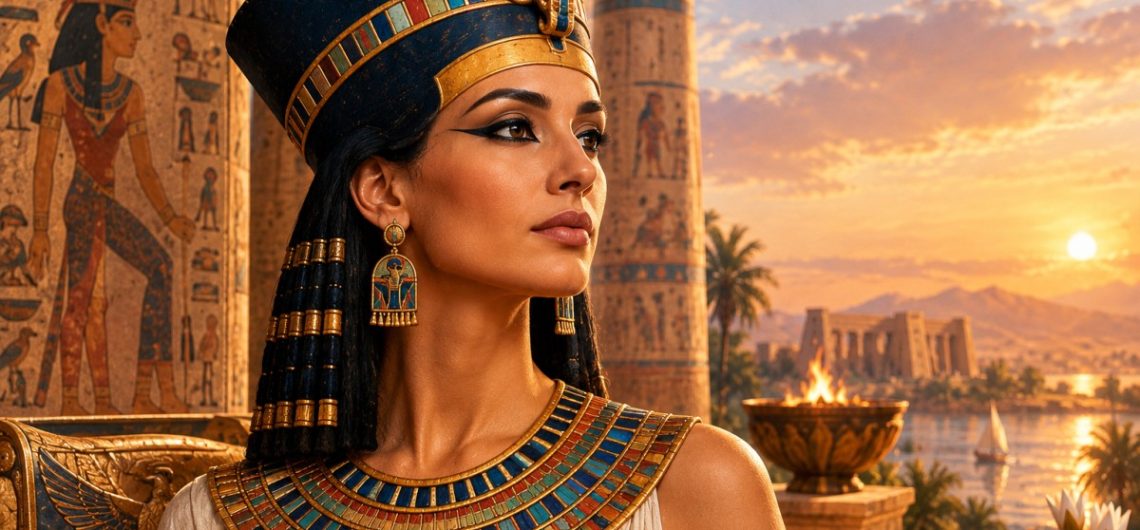
Queen Nefertari is one of the most celebrated women of ancient Egypt and one of the most visible queens in the entire New Kingdom. She was the Great Royal Wife of Pharaoh Ramesses II, one of Egypt’s most powerful and longest-reigning kings, and her name survives today in temples, statues, tomb paintings, royal letters, and some of the most beautiful archaeological scenes in the country. If you are planning a trip to Egypt in 2026, understanding Queen Nefertari helps you read the monumental world of Ramesses II with greater depth, especially at Abu Simbel, the Valley of the Queens, Luxor, Aswan, and Cairo’s major museums.
Unlike many ancient queens who are known mainly through brief inscriptions or later references, Nefertari appears with remarkable frequency and prominence. She is shown beside her husband in royal scenes, honored in colossal statuary, equated with the goddess Hathor, represented in intimate family imagery, and celebrated in one of the most beautiful tombs ever discovered in the Valley of the Queens. Her tomb, QV66, contains paintings that are still admired for their color, elegance, religious complexity, and emotional power. Her small temple at Abu Simbel is one of the rare places where a queen was given monumental status almost equal to the king himself.
But Queen Nefertari was not only a famous face in Egyptian art. She was a political, religious, and diplomatic figure in one of Egypt’s richest imperial periods. She lived during the reign of Ramesses II, a king known for massive building projects, military campaigns, dynastic propaganda, international diplomacy, and an extraordinary family. Nefertari appears to have occupied a central place in that world. She may have been one of the chief royal wives, a mother of important princes and princesses, a participant in state religion, and a correspondent in international royal networks.
For travelers, Queen Nefertari is especially meaningful because her story is visible in the landscape. At Abu Simbel, you can stand before colossal statues where she is shown at the same scale as Ramesses II. In the Valley of the Queens, you can enter a tomb filled with spells, goddesses, and images designed to secure her eternal life. In museums, you can study fragments of her statuary, coffin pieces, shabtis, and reliefs. Her world connects naturally to the great temples of Luxor, the monuments of Aswan, the royal legacy of the Nineteenth Dynasty, and the wider story of ancient Egyptian queenship.
This guide is written for first-time visitors to Egypt, returning travelers, history lovers, students, families, couples, solo explorers, Nile cruise passengers, and anyone who wants to understand who Queen Nefertari was, why she mattered, what she built, how she was represented, where to see her legacy today, and how to include her story in a practical Egypt itinerary. Whether you are searching for Queen Nefertari facts, Nefertari tomb, Nefertari Ramesses II, Nefertari Abu Simbel, Nefertari Valley of the Queens, Nefertari children, Nefertari meaning, or where to see Queen Nefertari in Egypt, this article is designed to give you a complete and travel-friendly guide.
Queen Nefertari is remembered not only because she was beautiful, but because she was visible: in royal art, temple stone, diplomatic letters, and the painted chambers of a tomb built to make her eternal.
Quick Answer: Who Was Queen Nefertari?
Queen Nefertari was the Great Royal Wife of Pharaoh Ramesses II during Egypt’s Nineteenth Dynasty in the New Kingdom, around the thirteenth century BCE. Her name means “Beautiful Companion,” and she is one of the best-known queens in ancient history because of her prominent representation in art, her association with the goddess Hathor, her monumental statues at Abu Simbel, and the extraordinary paintings in her tomb, QV66, in the Valley of the Queens near Luxor. Nefertari appears to have been one of Ramesses II’s chief wives and the mother of several royal children. She also played a diplomatic role, as shown by a surviving letter to the Hittite queen Puduhepa. Although her exact origins and final years remain partly uncertain, her legacy survives through temples, tombs, statues, and some of the most beautiful royal imagery in Egypt.
Why Queen Nefertari Matters
Queen Nefertari matters because she is one of the clearest examples of how a New Kingdom queen could become visible, powerful, and religiously significant. Ancient Egyptian queenship was not a single fixed role. Queens could be mothers of kings, ritual participants, diplomatic figures, administrators, landowners, cult leaders, and symbolic partners in royal ideology. Nefertari appears in many of these dimensions, but what makes her especially striking is the monumental scale of her representation.
In the art of Ramesses II, Nefertari is not hidden behind the king or reduced to a minor figure. She stands beside him. She embraces her children. She offers to the gods. She wears royal headdresses. She is associated with Hathor, one of the most important goddesses of femininity, love, music, motherhood, and divine power. At Abu Simbel, she is given colossal statues almost equal in height to Ramesses II himself, a rare honor for a queen in Egyptian art.
Her tomb in the Valley of the Queens is another reason she matters. QV66 is one of the most beautifully decorated royal tombs ever found. Its paintings show Nefertari in the presence of Osiris, Isis, Nephthys, Hathor, Nut, and other deities, surrounded by spells from the Book of the Dead. The tomb was robbed in antiquity, but its art survived, allowing modern visitors to experience the religious imagination that was designed to secure her eternal life.
Nefertari also matters historically because she lived during one of Egypt’s most famous reigns. Ramesses II ruled for decades, built extensively, fought the Hittites, celebrated the Battle of Kadesh, fathered a huge royal family, and shaped a visual language of kingship that still defines ancient Egypt in the popular imagination. Nefertari was part of that imperial world. She helps us understand how royal power was presented not only through war and monuments, but also through family, religion, diplomacy, and gender.
For travelers, Queen Nefertari adds emotional and intellectual depth to Egypt. When you visit Abu Simbel, Luxor, Aswan, or the Valley of the Queens, she becomes more than a name in a guidebook. She becomes a historical person whose image was carefully created to communicate beauty, legitimacy, divine favor, maternal power, and eternal existence.
Who Was Queen Nefertari?
Queen Nefertari was one of the Great Royal Wives of Pharaoh Ramesses II, who ruled during the Nineteenth Dynasty of Egypt’s New Kingdom. Her reign is usually placed in the thirteenth century BCE, with Ramesses II commonly dated around 1279–1213 BCE, though exact chronologies vary. Nefertari appears to have been one of the king’s most prominent wives, especially during the earlier and middle parts of his long reign.
She is known from temples, statues, tomb paintings, small objects, royal inscriptions, and diplomatic correspondence. Her name appears in cartouches, and her images often include titles that emphasize royal status, beauty, affection, and divine favor. Unlike some queens known mainly from a single statue or mention, Nefertari appears across multiple media and locations, which is one reason her historical presence feels unusually strong.
Her exact family origins remain uncertain. She may have come from a high-ranking Egyptian noble family, but no definitive parentage has been proven. Some theories connect her to powerful court circles, but the evidence is not conclusive. What is clear is that she became one of the most visible royal women of the Nineteenth Dynasty and that her image was integrated into the ideological program of Ramesses II.
Nefertari should not be confused with other royal women of similar names. Egyptian royal naming could repeat across generations, and there were earlier and later women with related names. The Queen Nefertari discussed here is the wife of Ramesses II, famous for Abu Simbel, the Valley of the Queens, and her role in one of Egypt’s most monumental royal households.
Queen Nefertari Name Meaning
The name Nefertari is usually translated as “Beautiful Companion.” The name is built from Egyptian elements connected with beauty, loveliness, and companionship. In ancient Egypt, names were not merely labels. They carried identity, aspiration, and symbolic meaning. A queen’s name could communicate her role, her idealized qualities, and her place within royal ideology.
“Beautiful Companion” is especially fitting for Nefertari because her surviving images emphasize both beauty and closeness to the king. She is shown beside Ramesses II, embracing children, participating in rituals, and occupying a visual position that suggests partnership. Her name also resonates with her association with Hathor, a goddess connected with love, joy, femininity, music, motherhood, and divine allure.
Some modern discussions also connect Nefertari’s name with phrases such as “the most beautiful of them” or “sweet of love,” but the most widely accepted translation remains “Beautiful Companion.” What matters for travelers is that her name itself became part of her royal image: she was presented as beautiful, desirable, dignified, and intimately connected to the king.
Historical Context: Ramesses II and the New Kingdom
To understand Queen Nefertari, you need to understand the world of Ramesses II. The New Kingdom was Egypt’s imperial age, a period of military expansion, diplomatic correspondence, monumental building, wealth from Nubia and the Levant, and a highly developed religious culture centered on Amun, Ra, Ptah, Hathor, and other major deities. The Nineteenth Dynasty, to which Ramesses II belonged, was especially powerful and visually ambitious.
Ramesses II came to power after his father Seti I, who had already restored stability after the Amarna period and rebuilt Egypt’s international position. Ramesses II inherited a strong state and transformed it into one of the most spectacular royal machines in ancient history. He built temples across Egypt and Nubia, created colossal statues, celebrated military victories, fathered many children, and used art and inscription to project an image of eternal kingship.
Nefertari lived inside this system. She was not a passive consort in a distant palace. She was part of a royal household that was constantly performed in temples, festivals, diplomatic letters, family scenes, and funerary monuments. The New Kingdom court was highly visible, and queens could play important roles in ritual, diplomacy, and symbolic representation.
The reign of Ramesses II also included major international events, especially the conflict with the Hittite Empire and the eventual peace treaty between Egypt and Hatti. Nefertari’s diplomatic letter to the Hittite queen Puduhepa shows that royal women could participate in these networks. Queens were not only symbols inside Egypt; they could also be actors in the broader Bronze Age world.
Origins, Family, and Rise to Prominence
The exact origins of Queen Nefertari remain one of the interesting uncertainties of her biography. No definitive inscription identifies her father or mother with certainty. She may have belonged to the Egyptian elite, possibly connected to powerful court families, but scholars continue to debate the details. This lack of clear genealogical evidence does not weaken her historical importance; it simply means that her prominence was not solely based on royal birth.
Nefertari appears to have become one of Ramesses II’s Great Royal Wives early in his reign. Ramesses II had several principal wives, including Isetnofret, who was the mother of the later pharaoh Merenptah, and possibly other wives whose historical visibility varies. Among them, Nefertari is especially prominent in art and monuments, particularly during the earlier part of the reign.
Her rise may have been connected to personal favor, political alliance, religious symbolism, or a combination of factors. Egyptian queenship often involved a mixture of birth, marriage, motherhood, ritual role, and royal propaganda. Nefertari seems to have benefited from all of these dimensions. She was not only the wife of a king; she became part of the visual and theological language of his reign.
One clue to her importance is the scale of her representation. In many periods, queens appear smaller than kings or only in limited contexts. Nefertari, by contrast, is shown at Abu Simbel in colossal form, in tomb paintings designed for eternal ritual, and in scenes that associate her with Hathor and other powerful goddesses. This suggests that Ramesses II wanted her image to be publicly and permanently visible.
Nefertari as Great Royal Wife of Ramesses II
The title Great Royal Wife was one of the highest positions available to a woman in ancient Egypt. It identified the queen as the principal wife of the king and gave her a formal role in royal ideology. Nefertari held this title, and her monuments emphasize not only status but also intimacy, beauty, and divine favor.
In Egyptian royal art, the Great Royal Wife could be shown offering to gods, standing beside the king, participating in festivals, and accompanying the ruler in funerary contexts. Nefertari appears in many of these roles. She is not merely decorative. Her presence helps communicate that the king’s household is complete, blessed, and connected to divine order.
Nefertari’s position may also have included practical responsibilities. Queens in the New Kingdom could manage estates, receive offerings, participate in temple endowments, and influence court politics. The exact administrative scope of Nefertari’s role is not fully documented, but her visibility suggests that she held real importance within the royal household.
Her relationship with Ramesses II is one of the reasons she remains famous. The king’s monuments often present the royal couple as a powerful pair. Nefertari is shown close to him, sometimes in gestures of affection, sometimes in ritual equality, and sometimes in scenes that link her to goddesses. This representation helped elevate her beyond the role of a simple consort.
Children and Royal Family
Queen Nefertari is known or believed to have been the mother of several children of Ramesses II. The exact list is debated because the royal family was large and some names appear in different contexts. However, several princes and princesses are commonly associated with her, and their presence helps explain her prominence within the dynasty.
| Child | Role or Significance |
|---|---|
| Amun-her-khepeshef | Often identified as a son of Nefertari and Ramesses II; appears in royal family contexts and may have held high status. |
| Pareherwenemef | Another prince commonly associated with Nefertari; appears in military and royal family scenes. |
| Meritamen | A princess associated with the royal family; may have been a daughter of Nefertari, though details remain debated. |
| Henutmira | Sometimes listed among the daughters connected to Nefertari, though evidence is less complete. |
| Other possible children | Additional princes and princesses may have belonged to Nefertari, but the large size of Ramesses II’s family makes precise attribution difficult. |
The children of Ramesses II were not only private family members. They were part of royal ideology. Princes could serve as military commanders, administrators, priests, or successors. Princesses could hold religious titles, appear in ritual scenes, and marry into the next generation of royal power. Nefertari’s role as mother therefore strengthened her position within the dynasty.
It is also important to note that Merenptah, who succeeded Ramesses II, is generally believed to have been the son of another Great Royal Wife, Isetnofret, not Nefertari. This distinction matters because popular retellings sometimes simplify the royal family. The historical reality was complex: Ramesses II had many wives and children, and different queens and princes occupied different roles over time.
Religious Role, Hathor, and Divine Kingship
Queen Nefertari’s religious role is one of the most fascinating aspects of her historical image. In Egyptian thought, the king was the primary intermediary between gods and people, but queens could also participate in ritual life and divine symbolism. Nefertari is especially associated with Hathor, the goddess of love, beauty, music, motherhood, joy, and feminine power.
At Abu Simbel, the small temple dedicated to Hathor and Nefertari makes this connection explicit. Nefertari is not merely honored beside the king; she is integrated into a cultic landscape where Hathor and the queen are visually and theologically linked. This association gave Nefertari a sacred dimension that went beyond ordinary queenship.
In her tomb, religious imagery becomes even more intimate. Nefertari is shown before Osiris, the god of resurrection and the afterlife. She encounters goddesses, recites spells, and is presented as a blessed deceased woman hoping for eternal life. The tomb is not only a burial place. It is a ritual machine designed to transform death into renewal.
Nefertari’s religious visibility also reflects the broader New Kingdom idea that royal women could embody divine qualities. Hathor was often associated with queens, and the queen could be presented as a living representation of the goddess. This did not mean Nefertari was worshipped as a god in the same way as the king, but it did mean her image carried sacred power.
For travelers, understanding Nefertari’s religious role helps you read her monuments more deeply. When you see her beside Ramesses II offering to the gods, you are not seeing a simple portrait. You are seeing theology in stone: the king and queen as partners in maintaining Ma’at, the cosmic order of truth, justice, and balance.
Diplomatic Role and the Letter to Puduhepa
One of the most surprising aspects of Queen Nefertari’s historical role is her participation in diplomacy. A surviving letter connects her with Puduhepa, the queen of the Hittite king Hattusili III. This correspondence shows that royal women could be part of international networks in the Late Bronze Age.
The letter is not a military document. It is more personal and diplomatic in tone. Nefertari expresses goodwill toward Puduhepa, mentions well-being, and refers to gifts or exchanges. The exact details are debated, but the significance is clear: queens were not isolated from international politics. They could represent their courts, maintain relationships, and participate in the soft diplomacy of royal correspondence.
This letter also helps modern readers understand the human side of ancient diplomacy. Relations between empires were not only negotiated by kings and generals. They were also shaped by families, marriages, gifts, letters, rituals, and personal reputations. Nefertari’s name in this context shows that she was recognized beyond Egypt’s borders.
For history lovers, the letter to Puduhepa is one of the most important pieces of evidence for Nefertari’s real political and social importance. It moves her beyond the realm of beautiful statues and tomb paintings and places her within the international theater of the New Kingdom.
Queen Nefertari at Abu Simbel
Abu Simbel is one of the most powerful places to understand Queen Nefertari. The Temples of Abu Simbel, located near the border with Sudan in southern Egypt, were built by Ramesses II and later relocated in the 1960s to save them from flooding caused by the Aswan High Dam. The site includes the Great Temple of Ramesses II and the Small Temple associated with Hathor and Nefertari.
The Small Temple is especially important for Nefertari. Its facade includes colossal statues of Ramesses II and Nefertari. In a striking departure from many earlier Egyptian monuments, Nefertari’s statues are nearly the same height as those of the king. This is rare. It communicates that the queen was not a minor appendage to royal power, but a central figure in the theological and political message of the temple.
Inside the Small Temple, reliefs show Nefertari offering to gods, participating in ritual scenes, and being associated with Hathor. The temple’s dedication connects the queen with divine femininity, protection, love, and royal legitimacy. Visitors often notice the intimacy and dignity of these scenes, which present Nefertari as both queen and sacred figure.
Abu Simbel also helps explain why Nefertari’s image was so carefully controlled. Ramesses II used the temple complex to project power, divinity, and eternity. Nefertari was included in that projection. Her presence strengthened the royal household and connected the king’s southern monument to themes of Hathoric grace, queenship, and divine partnership.
For travelers, Abu Simbel is one of the most emotional places to encounter Nefertari. The scale of the statues, the desert-lake setting, the precision of the reliefs, and the history of the temple’s relocation all create a powerful atmosphere. Standing before her image, you can feel how deliberately she was made visible.
The Valley of the Queens and Tomb QV66
The Valley of the Queens, located on the west bank of Luxor near the Valley of the Kings, is the burial landscape where many queens and royal children were interred. Queen Nefertari’s tomb, known as QV66, is one of the most important and beautiful tombs in the necropolis.
QV66 was discovered in 1904 by the Italian archaeologist Ernesto Schiaparelli. Like many Egyptian tombs, it had been robbed in antiquity. The burial itself was disturbed, and fragments of the mummy, coffin, and funerary objects were found. However, the painted decoration survived in remarkable condition, making the tomb one of the finest examples of New Kingdom royal funerary art.
The paintings show Nefertari in the presence of Osiris, the god of resurrection, and in the company of major goddesses such as Isis, Nephthys, Hathor, and Nut. The scenes are drawn from funerary literature, including spells connected to the Book of the Dead. They were designed to guide, protect, and justify the queen in the afterlife.
What makes QV66 especially moving is its combination of grandeur and intimacy. Nefertari is shown as a royal figure, but also as a deceased woman facing judgment, seeking protection, and hoping for eternal life. The colors, gestures, and inscriptions create a vivid portrait of Egyptian belief in resurrection, divine care, and the persistence of the name.
Access to the tomb is limited for conservation reasons. The number of visitors is controlled, and photography rules may apply. This restriction is unfortunate for some travelers, but it is necessary to protect the paintings from humidity, dust, and light damage. If you are able to visit QV66, it is one of the most rewarding experiences in Luxor.
Art, Titles, and Royal Imagery
Queen Nefertari’s art is one of the keys to her historical fame. She appears in statues, reliefs, tomb paintings, small objects, and temple scenes. Her imagery combines beauty, royalty, divinity, and affection. She is often shown with a tall crown, vulture headdress, or Hathoric elements, and her faces in surviving art are serene, elegant, and idealized.
Egyptian royal art was not meant to be a simple portrait in the modern sense. It was symbolic. A queen’s image could communicate her status, her relationship to the king, her connection to the gods, and her eternal role. Nefertari’s art was designed to make her recognizable, venerable, and everlasting.
Her titles reinforce this message. She is called Great Royal Wife, Lady of Upper and Lower Egypt, Sweet of Love, and other honorifics that emphasize authority, beauty, and royal favor. Some titles were standard for queens, but their repetition in Nefertari’s monuments shows how fully she was integrated into royal ideology.
| Title or Attribute | Meaning |
|---|---|
| Great Royal Wife | Principal wife of the king, with formal royal status. |
| Lady of Upper and Lower Egypt | Connected to the unified kingdom and royal authority. |
| Sweet of Love | Emphasizes beauty, affection, and desirability. |
| Associated with Hathor | Links the queen to goddess imagery, femininity, music, motherhood, and divine power. |
| Mother of Royal Children | Strengthens dynastic legitimacy and her role in the royal family. |
Nefertari’s imagery also includes intimate family scenes. She is shown with children, sometimes in gestures that feel surprisingly human. These scenes served a political purpose as well as an emotional one. They presented the royal household as stable, fertile, blessed, and connected to divine order.
Death, Mummy, and Afterlife Belief
The exact date and circumstances of Queen Nefertari’s death are not fully known, but evidence suggests she died during the later part of Ramesses II’s reign, possibly around Year 24 or Year 25. She does not appear prominently in monuments from the very end of the king’s long rule, which has led scholars to conclude that she predeceased him by many years.
Her burial in QV66 was designed to secure her afterlife. Egyptian belief held that the dead needed preservation, ritual, spells, offerings, and the continued use of their name. The tomb paintings show Nefertari undergoing the spiritual journey expected of a blessed royal woman: meeting Osiris, receiving protection from goddesses, and being justified before divine powers.
The tomb was robbed in antiquity, and her mummy was not preserved intact. Fragments of the burial, including pieces of the mummy, coffin, and funerary objects, were found. These remains have been studied by modern scholars, but the tomb’s greatest survival is its art. The paintings allow visitors to experience Nefertari’s hoped-for eternity even though her physical body was disturbed.
The contrast between robbery and survival is important. In ancient Egypt, tomb robbery threatened both material wealth and spiritual existence. Yet the decorated walls of QV66 resisted complete destruction. Nefertari’s name and image continued to speak through stone and pigment, fulfilling part of the tomb’s purpose.
For travelers, her tomb is a powerful reminder that Egyptian funerary art was not decoration. It was technology for eternity. Every spell, gesture, color, and deity was meant to help the deceased pass safely into the next world. Nefertari’s tomb is one of the most beautiful examples of that belief.
Rediscovery and Archaeological History
Queen Nefertari was rediscovered through modern archaeology, especially the excavation of her tomb in the Valley of the Queens. Ernesto Schiaparelli’s discovery in 1904 brought international attention to the beauty and importance of the tomb. Although the burial had been robbed, the paintings were so well preserved that QV66 quickly became one of the most celebrated royal tombs in Egypt.
Over the twentieth century, the tomb underwent study, documentation, and conservation. The paintings faced risks from humidity, salt, dust, visitor traffic, and biological growth. Conservation efforts have aimed to stabilize the colors and protect the fragile plaster. Access has been restricted at times to preserve the tomb for future generations.
The rediscovery of Nefertari’s tomb also contributed to broader understanding of the Valley of the Queens. The necropolis contains tombs of queens, princes, princesses, and other royal family members. Nefertari’s tomb is one of the most elaborate and visually impressive, showing how important royal women could be in New Kingdom funerary culture.
Modern scholarship continues to study Nefertari through epigraphy, art history, archaeology, conservation science, and comparisons with other royal women. Her letter to Puduhepa, her Abu Simbel statues, her tomb paintings, and her small finds all contribute to a more complex picture of her life and afterlife.
Nefertari Compared with Other Famous Queens
Queen Nefertari is often compared with other famous Egyptian women, but each had a different historical role. Understanding these differences helps travelers avoid oversimplifying ancient queenship.
| Queen | Period | Main Significance | Connection to Nefertari |
|---|---|---|---|
| Nefertari | Nineteenth Dynasty, Ramesses II | Great Royal Wife, Abu Simbel statues, Valley of the Queens tomb, Hathor association | The central subject of this guide |
| Nefertiti | Eighteenth Dynasty, Akhenaten | Amarna revolution, famous Berlin bust, possible co-regency | Another highly visible queen, but from a different religious and political context |
| Hatshepsut | Eighteenth Dynasty | Female pharaoh, Deir el-Bahari temple, Punt expedition | Ruled as king, while Nefertari was queen consort with exceptional visibility |
| Tiye | Eighteenth Dynasty, Amenhotep III | Powerful Great Royal Wife, diplomatic correspondence, monumental statues | An earlier model of prominent queenship that helps contextualize Nefertari |
| Cleopatra VII | Ptolemaic Period | Last active ruler of the Ptolemaic Kingdom, Mediterranean politics | Ruled much later in a Greek-Egyptian context, not as a New Kingdom queen |
Nefertari’s uniqueness lies in the combination of royal visibility, religious association, monumental representation, and funerary art. She was not necessarily a ruling pharaoh in the way Hatshepsut was, and she did not live through the Amarna revolution like Nefertiti. But she became one of the most beautifully preserved queens in Egyptian history because Ramesses II’s artistic program gave her an extraordinary public role.
Where to See Queen Nefertari Today
If you want to understand Queen Nefertari in person, Egypt offers several important places. The best experience combines Luxor, Abu Simbel, and museum study in Cairo or Luxor.
1. Valley of the Queens, Luxor
The most important site is QV66, Nefertari’s tomb in the Valley of the Queens. The painted chambers are among the most beautiful royal funerary artworks in Egypt. Access is limited, so check current availability and book early when possible.
2. Abu Simbel
The Temples of Abu Simbel are essential for understanding Nefertari’s monumental image. The Small Temple dedicated to Hathor and Nefertari includes colossal statues and reliefs that give her rare visual equality with Ramesses II.
3. Luxor Museum
The Luxor Museum displays royal statues and artifacts from the Theban region. Depending on current exhibitions, it can help you understand New Kingdom queenship, Ramesside art, and the wider religious landscape connected to Nefertari.
4. Egyptian Museum, Cairo
The Egyptian Museum in Tahrir Square holds important New Kingdom collections. It may include Ramesside statues, reliefs, small objects, and material connected to royal women. Museums are especially useful for studying details that are hard to see in bright outdoor sites.
5. Grand Egyptian Museum
The Grand Egyptian Museum near Giza offers modern galleries and monumental royal artifacts. It is useful for understanding New Kingdom kingship, Ramesside sculpture, and the broader civilization in which Nefertari lived.
6. Karnak Temple and Luxor Temple
While Nefertari is not the central figure at Karnak Temple or Luxor Temple, these sites help you understand the religious and royal world of the New Kingdom. Ramesside additions, divine scenes, and royal ritual contexts provide background for her role as queen.
7. Aswan
Aswan is the usual gateway to Abu Simbel. Even if Nefertari’s main monuments are not in Aswan city itself, the Nile landscape, Philae Temple, and southern travel context help you understand the regional world that shaped her cultic and royal image.
Visiting Queen Nefertari Sites: Practical Guide
Visiting places connected to Queen Nefertari requires planning, especially if you want to include the Valley of the Queens and Abu Simbel. Both are highly rewarding, but access, heat, travel distance, and conservation rules can affect your experience.
Visiting the Valley of the Queens
The Valley of the Queens is located on Luxor’s west bank. Tickets usually include access to a limited number of tombs, and Nefertari’s tomb may require an additional ticket or special reservation depending on current rules. Access is controlled to protect the paintings. Visitors should check opening hours, tomb availability, photography rules, and conservation closures before traveling.
Best Time to Visit the Valley of the Queens
Early morning is usually best. The temperature is cooler, the site is less crowded, and you can combine the visit with other west bank attractions such as the Valley of the Kings, Medinet Habu, and the Colossi of Memnon. Late afternoon can also be pleasant, but check closing times and traffic.
Visiting Abu Simbel
Abu Simbel is usually reached by domestic flight from Aswan or by an organized overland convoy, depending on current travel arrangements. The flight is the most comfortable option for most travelers. If you visit Abu Simbel, allow time to see both the Great Temple of Ramesses II and the Small Temple of Hathor and Nefertari.
Best Time to Visit Abu Simbel
Early morning is ideal. Many visitors take the first flight from Aswan, visit the temples, and return the same day. The site can be busy when tour groups arrive, so arriving early helps. The famous sun festival alignments occur twice a year, but regular visits are rewarding at any time.
What to Wear
Wear lightweight modest clothing, comfortable walking shoes, a hat, sunglasses, and sunscreen. The Valley of the Queens involves walking, steps, and uneven surfaces. Abu Simbel is open and exposed, with heat and bright light. Carry water, tissues, hand sanitizer, and small bills.
Photography Rules
Photography rules can change and may differ by tomb, temple, and season. In Nefertari’s tomb, flash photography, tripods, and commercial equipment may be restricted. Always follow site instructions and respect conservation limits. The paintings are fragile, and even small amounts of light, humidity, and dust can cause damage over time.
Should You Hire a Guide?
Yes. A guide can make a major difference, especially in the Valley of the Queens and Abu Simbel. Nefertari’s tomb contains religious spells, goddess scenes, and funerary imagery that are easy to miss without explanation. At Abu Simbel, a guide can help you understand the theological relationship between Ramesses II, Nefertari, Hathor, and the solar symbolism of the temple complex.
Is Nefertari’s Tomb Worth Visiting?
For many travelers, yes. QV66 is one of the most beautiful royal tombs in Egypt. The paintings are delicate, emotionally powerful, and historically important. If access is available and the price fits your budget, it is one of Luxor’s standout experiences.
Is Abu Simbel Worth Visiting for Nefertari?
Yes, especially if you are interested in royal women, Ramesside monuments, or Egyptian religious art. The Small Temple gives Nefertari a monumental presence that is rare in ancient Egypt. Even if you cannot visit her tomb, Abu Simbel offers a powerful encounter with her royal image.
How to Include Queen Nefertari in Your Egypt Itinerary
Queen Nefertari fits naturally into a Luxor and Aswan itinerary, but she can also enrich a wider Egypt trip. The best approach depends on your time, budget, and interest in royal women, New Kingdom history, and temple art.
1. Classic Luxor West Bank Day
Combine the Valley of the Queens with the Valley of the Kings, Medinet Habu, and the Colossi of Memnon. Start early at Nefertari’s tomb if access is available, then continue to other west bank sites. This is one of the most rewarding ways to experience Luxor’s royal necropolis.
2. Luxor East Bank and West Bank Route
Spend the morning on the west bank at the Valley of the Queens and Valley of the Kings. Return to the east bank for Karnak Temple and Luxor Temple in the late afternoon or evening. This route balances funerary art, temple ritual, and royal history.
3. Nile Cruise Itinerary
If you are traveling on a Nile cruise itinerary, Luxor and Aswan are essential stops. You can visit the Valley of the Queens in Luxor and continue to Abu Simbel from Aswan. This creates a strong Nefertari-focused route through southern Egypt.
4. Seven-Day Egypt Itinerary
In a 7 days in Egypt itinerary, Nefertari can be included through Luxor’s west bank and possibly Abu Simbel. A typical route includes Cairo, Giza, Luxor, Aswan, and return. If time is short, prioritize either Nefertari’s tomb or Abu Simbel based on your interests.
5. Ten-Day Egypt Itinerary
A 10 day Egypt itinerary allows a more relaxed Nefertari route. You can spend more time in Luxor, visit the Valley of the Queens without rushing, continue to Aswan, and add Abu Simbel by flight. This is ideal for history lovers and couples.
6. Family-Friendly Luxor Day
Children may enjoy Nefertari’s tomb if the visit is short and explained through story: a queen, a beautiful tomb, gods, goddesses, and the journey after death. Bring water, snacks, and sunscreen. Combine the visit with a more open site such as Karnak or a Nile felucca ride. For broader advice, see our guide to Egypt with kids.
7. Romantic Egypt Trip
Nefertari’s story can be romantic in a historical way: royal love, family scenes, beauty, power, and eternity. Combine Luxor temple visits with a Nile sunset, a quiet hotel stay, or a felucca ride. For couples, see our Egypt honeymoon itinerary guide.
8. Solo Female Travel
Solo female travelers may find Nefertari especially inspiring. Her story raises questions about women, visibility, power, beauty, and legacy. Use private guides, trusted transfers, and well-reviewed accommodations. For practical advice, see our solo female travel Egypt guide.
9. Museum-Focused Route
If you cannot visit the Valley of the Queens or Abu Simbel, you can still explore Nefertari through museums. The Egyptian Museum, Grand Egyptian Museum, and Luxor Museum can provide context for Ramesside queenship, royal art, and New Kingdom religion. For broader museum planning, see our guide to top museums in Egypt.
Common Misconceptions About Queen Nefertari
One common misconception is that Nefertari was the only wife of Ramesses II. She was not. Ramesses II had several Great Royal Wives, including Isetnofret, and many children. Nefertari was prominent, but the royal household was large and complex.
Another misconception is that Nefertiti and Nefertari are the same woman. They are not. Nefertiti lived during the Eighteenth Dynasty and was the wife of Akhenaten. Nefertari lived during the Nineteenth Dynasty and was the wife of Ramesses II. Their names sound similar, but their historical worlds are very different.
Some travelers assume Nefertari was a pharaoh. There is no strong evidence that she ruled as king. She was a Great Royal Wife with exceptional visibility, religious association, and monumental representation, but she should not be confused with Hatshepsut, who ruled as pharaoh.
Another myth is that Nefertari’s tomb was found intact. It was not. The tomb had been robbed in antiquity. However, its paintings survived beautifully, which is why QV66 remains one of the most important royal tombs in Egypt.
Some people also believe that the Abu Simbel statues prove Nefertari was more powerful than Ramesses II. The statues show her extraordinary prominence, but they do not mean she replaced the king. They reflect a carefully constructed royal ideology in which the queen was elevated as part of the king’s divine household.
Finally, Nefertari should not be reduced to a symbol of beauty alone. Her name means “Beautiful Companion,” and her images emphasize elegance, but her historical importance lies in religion, diplomacy, motherhood, queenship, and funerary power. She was a political and sacred figure, not only an icon of appearance.
Frequently Asked Questions About Queen Nefertari
Who was Queen Nefertari?
Queen Nefertari was the Great Royal Wife of Pharaoh Ramesses II during Egypt’s Nineteenth Dynasty in the New Kingdom. She is famous for her prominent representation in art, her association with the goddess Hathor, her colossal statues at Abu Simbel, and her beautifully painted tomb, QV66, in the Valley of the Queens.
What does Nefertari mean?
Nefertari is usually translated as “Beautiful Companion.” The name reflects her royal image of beauty, closeness to the king, and symbolic grace. It also connects well with her association with Hathor, the goddess of love, beauty, motherhood, and joy.
Who was Nefertari’s husband?
Nefertari’s husband was Ramesses II, one of ancient Egypt’s most famous pharaohs. He ruled during the Nineteenth Dynasty and is known for monumental temples, military campaigns, diplomatic treaties, a large royal family, and extensive building projects.
Did Nefertari have children?
Yes. Nefertari is known or believed to have been the mother of several children of Ramesses II, including princes and princesses such as Amun-her-khepeshef, Pareherwenemef, and possibly Meritamen. The exact list is debated because Ramesses II had a very large family.
Where is Queen Nefertari buried?
Nefertari was buried in the Valley of the Queens near Luxor. Her tomb is known as QV66 and is one of the most beautifully decorated royal tombs in Egypt. The tomb was robbed in antiquity, but its paintings survived.
Can visitors enter Nefertari’s tomb?
Access to Nefertari’s tomb is possible but limited for conservation reasons. Visitors may need a special ticket, and the number of people allowed inside can be restricted. Photography rules may also apply. Always check current access before visiting Luxor.
What is famous about Nefertari’s tomb?
QV66 is famous for its elegant and well-preserved paintings showing Nefertari with Osiris, Isis, Nephthys, Hathor, Nut, and other deities. The tomb contains spells connected to the Book of the Dead and is one of the finest examples of New Kingdom funerary art.
Why is Nefertari important at Abu Simbel?
At Abu Simbel, Nefertari appears in the Small Temple dedicated to Hathor and herself. Her colossal statues are nearly the same height as those of Ramesses II, which is rare and significant. This gives her one of the most prominent royal images in Egyptian art.
Was Nefertari a powerful queen?
Yes, within the framework of Egyptian queenship. She was a Great Royal Wife, a mother of royal children, a religious figure associated with Hathor, and a diplomatic correspondent. She was not a pharaoh, but she held exceptional visibility and status.
Did Nefertari write a letter to the Hittite queen?
Yes. A surviving letter connects Nefertari with Puduhepa, the Hittite queen. The letter shows that royal women could participate in diplomatic networks and international correspondence during the New Kingdom.
Is Nefertari the same as Nefertiti?
No. Nefertiti lived during the Eighteenth Dynasty and was the wife of Akhenaten. Nefertari lived during the Nineteenth Dynasty and was the wife of Ramesses II. Their names are similar, but they belong to different historical periods and different royal worlds.
Was Nefertari a pharaoh?
There is no strong evidence that Nefertari ruled as pharaoh. She was a Great Royal Wife with extraordinary prominence. Hatshepsut is the more famous example of a woman who ruled as king in the New Kingdom.
When did Queen Nefertari live?
Queen Nefertari lived during the thirteenth century BCE, during the reign of Ramesses II. Exact dates vary by chronology, but she is generally placed in the New Kingdom, Nineteenth Dynasty.
When did Nefertari die?
The exact date of Nefertari’s death is uncertain, but evidence suggests she died during the later part of Ramesses II’s reign, possibly around Year 24 or Year 25. She appears to have predeceased the king by many years.
Was Nefertari’s mummy found?
Nefertari’s tomb was robbed, and her mummy was not preserved intact. Fragments of the burial, coffin, and funerary objects were found. The tomb’s paintings, however, survived and remain its greatest treasure.
Where can I see Queen Nefertari in Egypt?
You can see Queen Nefertari’s legacy at the Valley of the Queens in Luxor, Abu Simbel near Aswan, and museums such as the Egyptian Museum, Grand Egyptian Museum, and Luxor Museum. The Valley of the Queens and Abu Simbel are the most important sites.
Is Queen Nefertari worth visiting?
Yes. For travelers interested in ancient Egypt, royal women, temple art, and funerary belief, Nefertari is one of the most compelling figures. Her tomb and Abu Simbel statues offer a rare glimpse into the power and visibility of a New Kingdom queen.
Do I need a guide to understand Queen Nefertari?
A guide is not mandatory, but it is highly recommended. Nefertari’s tomb and Abu Simbel contain religious scenes, symbolic gestures, and historical context that are easy to miss without explanation. A good guide can make the visit much richer.
Related Topics and Internal Links
If you are researching Queen Nefertari, you may also be interested in the wider world of ancient Egyptian queens, Ramesses II, Abu Simbel, the Valley of the Queens, Luxor, Aswan, and practical travel planning. These topics help place Nefertari within the larger civilization she lived in and the monuments she left behind.
- Queen Nefertari for the main queen guide
- Ramesses II for Nefertari’s husband and his reign
- Temples of Abu Simbel for the Small Temple of Hathor and Nefertari
- Valley of the Queens for Nefertari’s tomb QV66
- Valley of the Kings for New Kingdom royal burial context
- Luxor for west bank and east bank planning
- Aswan for southern Egypt and Abu Simbel access
- Karnak Temple for New Kingdom religious architecture
- Luxor Temple for royal ritual and divine kingship
- Temple of Philae for goddess-centered worship in Aswan
- Ancient Egyptian Queens for broader royal women context
- Queen Nefertiti for comparison with another famous queen
- Hatshepsut for comparison with a female pharaoh
- Cleopatra for later Egyptian royal women
- Egyptian Gods Family Tree for Hathor, Osiris, Isis, and divine relationships
- Symbols of Ancient Egypt for royal and religious imagery
- Eye of Ra Symbol Meaning for solar theology
- Scarab Beetle Meaning for rebirth and transformation symbolism
- Egyptian Museum for Cairo collections
- Grand Egyptian Museum for modern museum context
- Luxor Museum for Theban royal artifacts
- Egypt itinerary guide for trip planning
- 7 days in Egypt itinerary for short classic routes
- 10 day Egypt itinerary for relaxed routes
- Nile cruise itinerary for river travel planning
- Egypt travel tips for practical preparation
- Is it safe to travel to Egypt for safety guidance
- Tourist scams in Egypt for avoiding common hassles
- What to pack when traveling to Egypt for packing advice
- Egypt with kids for family travel
- Solo female travel Egypt guide for independent women travelers
- Egypt honeymoon itinerary for romantic travel planning
- Top museums in Egypt for museum-focused visits
- Best time of year to visit Egypt for seasonal planning
- Climate and weather in Egypt for heat and season advice
- Egypt travel costs for budget planning
- Tipping in Egypt for service etiquette
Final Thoughts: Why Queen Nefertari Still Captivates the World
Queen Nefertari still captivates the world because she combines beauty, power, faith, motherhood, diplomacy, and mystery. She lived in the shadow of one of Egypt’s greatest kings, yet she refused to remain invisible. Her monuments, tomb paintings, statues, and letters show that she was not only a wife in a royal household. She was a carefully constructed image of queenship, divine favor, and eternal memory.
When you visit the Valley of the Queens, you are not merely entering an ancient tomb. You are entering a spiritual landscape designed to protect and elevate Nefertari after death. When you stand at Abu Simbel, you are not only seeing colossal statues. You are witnessing a rare moment when a queen was given monumental presence almost equal to the king. When you study her images in museums, you are seeing the visual language of a woman who wanted to be remembered.
Nefertari’s story also reminds us that ancient Egypt was not only a civilization of pharaohs, pyramids, and wars. It was also a civilization of families, rituals, letters, gardens, tombs, goddesses, and queens. Nefertari belongs to that more intimate side of Egyptian history, but she belongs to it with extraordinary grandeur.
For travelers, learning about Queen Nefertari makes Egypt richer. It helps you slow down and look more closely. It encourages you to ask who the women were behind the monuments, how power was represented, and how belief in the afterlife shaped art and architecture. Nefertari is one of the best guides to these questions because her image survives with rare clarity and beauty.
Queen Nefertari endures because she was made visible in stone, paint, gold, and memory: a beautiful companion, a royal mother, a servant of Hathor, and a woman whose name still walks through the temples and tombs of Egypt.
Ready to Explore Queen Nefertari in Egypt?
Let Egypt Via Travel help you plan a meaningful itinerary through Luxor, the Valley of the Queens, Abu Simbel, Aswan, Cairo museums, and New Kingdom royal sites, with private guides, comfortable transfers, and tailored routes for travelers interested in Queen Nefertari and the world of Ramesses II.
Contact Egypt Via Travel to Plan Your Queen Nefertari Journey