
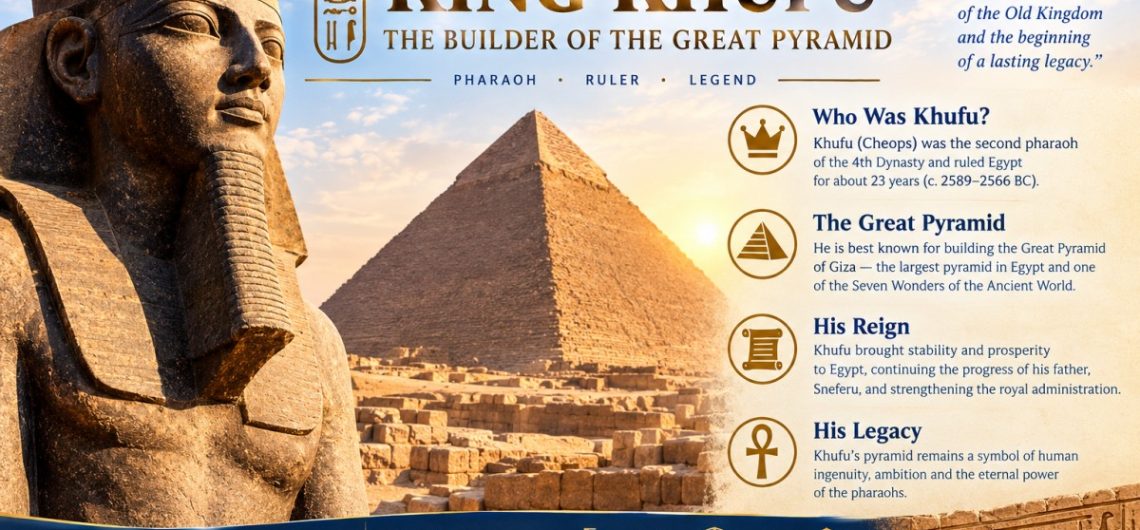
King Khufu, also known by his Greek name Cheops, is one of the most famous pharaohs in ancient history. He ruled during Egypt’s Fourth Dynasty, in the Old Kingdom, and is best known for commissioning the Great Pyramid of Khufu at Giza, the oldest and largest of the three great pyramids and the only surviving wonder of the ancient Seven Wonders of the World. If you visit the Giza Pyramids Complex, you are standing in the monumental world created by Khufu’s reign, his architects, his officials, and thousands of organized workers.
Khufu’s story is not only about a pyramid. It is about the rise of centralized kingship, the development of pyramid architecture, the power of the Old Kingdom state, religious belief in resurrection, and the extraordinary engineering skills of ancient Egypt. His pyramid was not built by slaves, as later Greek writers claimed, but by a highly organized workforce of skilled craftsmen, seasonal laborers, engineers, scribes, bakers, brewers, physicians, and administrators. The Great Pyramid remains one of the most impressive achievements in human history.
For travelers planning a trip to Egypt in 2026, understanding King Khufu makes the Giza Plateau much more meaningful. Instead of seeing only giant stone triangles, you begin to understand the political, religious, and architectural revolution behind them. Khufu was not simply a king who wanted a tomb. He was a ruler who used monumental architecture to express divine kingship, eternal order, and the power of the Egyptian state.
This guide explains who Khufu was, his family, his reign, the Great Pyramid, his solar boat, his statues and artifacts, his connection to the Sphinx, common misconceptions, and where to see traces of his legacy today. It also includes practical visiting tips and ways to include Khufu in a wider Egypt itinerary. Whether you are searching for King Khufu facts, Khufu pyramid history, Cheops pyramid, Khufu boat, Khufu statue, Great Pyramid construction, or Giza travel guide, this article is designed to help you understand one of ancient Egypt’s most powerful rulers.
King Khufu did not merely build a tomb. He built a statement of eternal kingship, and the Great Pyramid still speaks across more than four thousand years.
Quick Answer: Who Was King Khufu?
King Khufu, also called Cheops, was a pharaoh of Egypt’s Fourth Dynasty during the Old Kingdom, ruling around the middle of the third millennium BCE. He is best known for building the Great Pyramid of Giza, the largest pyramid in Egypt and the only surviving wonder of the ancient world. Khufu was the son of Pharaoh Sneferu and Queen Hetepheres, and his reign marked the height of Old Kingdom royal power, pyramid construction, and centralized administration. Contrary to later legends, the Great Pyramid was not built by slaves but by organized Egyptian workers. Today, Khufu’s legacy survives in the Great Pyramid, his solar boat, small statues and inscriptions, and the wider Giza necropolis.
Why King Khufu Matters
King Khufu matters because he represents one of the highest points of ancient Egyptian royal power. The Old Kingdom is often called the age of the pyramids, and Khufu’s Great Pyramid is the most iconic monument of that age. It was not only a burial place. It was a theological machine, a political statement, a national project, and a symbol of the king’s ability to organize resources, labor, belief, and time.
Before Khufu, pyramid building had already developed through earlier rulers, especially his father Sneferu, who experimented with the Meidum Pyramid, the Bent Pyramid, and the Red Pyramid. Khufu inherited this architectural knowledge and transformed it into a monument of unprecedented scale. The Great Pyramid was not an isolated invention. It was the culmination of generations of engineering, religious thought, and royal ambition.
Khufu also matters because his pyramid changed the landscape of Egypt. Giza became a sacred plateau associated with resurrection, solar power, and eternal kingship. Later pharaohs, including Khafre and Menkaure, built nearby, creating the famous trio of pyramids that still defines Egypt’s global image. When travelers think of Egypt, they often think first of Giza, and Giza begins with Khufu.
For modern visitors, Khufu’s story adds depth to the experience of standing before the pyramids. The Great Pyramid is not simply a huge stone structure. It is the product of a sophisticated state, a complex religious worldview, and a king who wanted to secure his place among the gods. Understanding Khufu helps you understand why the Egyptians invested so much in monumental architecture.
Who Was King Khufu?
Khufu was a pharaoh of the Fourth Dynasty, ruling during Egypt’s Old Kingdom. His Egyptian name is often reconstructed as Khufu, while the Greek form Cheops comes from later classical traditions. He was the son of Pharaoh Sneferu, the great builder of the Third or early Fourth Dynasty depending on chronological models, and Queen Hetepheres, whose magnificent burial equipment was discovered near the Great Pyramid at Giza.
Khufu’s throne name was Medjedu, though he is most commonly known by his birth name Khufu. He ruled from Memphis, the ancient capital, while his pyramid complex was built at Giza, on the west bank of the Nile near modern Cairo. The west bank was associated with the land of the dead because the sun set in the west, making it a fitting location for royal resurrection architecture.
Very few complete statues of Khufu survive, which is surprising given the scale of his pyramid. The most famous is a small ivory seated figure, only a few centimeters high, now in the Egyptian Museum in Cairo. This contrast between the massive pyramid and the modest number of royal images shows how much of Khufu’s material record has been lost, damaged, or dispersed over time.
Despite the limited number of statues, Khufu’s presence is everywhere at Giza. His pyramid, his causeway, his valley temple remains, his satellite pyramids, his queens’ pyramids, his workers’ settlement, and his solar boat all form part of a vast funerary landscape. To study Khufu is to study the organization of the early Egyptian state at its most ambitious.
Khufu’s Family and Rise to Power
Khufu’s family was central to his legitimacy. His father, Sneferu, was one of the most important builders of the Old Kingdom. Sneferu’s reign saw major experiments in pyramid design, including structures that helped prepare the way for the perfected form of the Great Pyramid. By inheriting Sneferu’s architectural tradition, Khufu inherited not only a throne but also a corps of skilled builders, engineers, and administrators.
His mother, Queen Hetepheres, is one of the most archaeologically important women of the Old Kingdom. Her tomb near Giza contained extraordinary furniture, jewelry, canopic equipment, and ceremonial objects. The quality of her burial shows the wealth and sophistication of Khufu’s court. It also suggests that royal women played important roles in dynastic legitimacy and funerary ritual.
Khufu had several wives and children, though the exact details remain debated. Known or proposed family members include queens such as Meretites and Henumet, and sons including Djedefre, who succeeded him, and possibly Khafre, who later built the second pyramid at Giza. Another son, Kawab, is mentioned in some sources, though his historical role is uncertain. Khufu’s daughter Hetepheres also appears in the dynastic record.
The succession after Khufu was not always smooth. Djedefre, his son, chose to build his pyramid at Abu Rawash rather than Giza, a decision that may reflect political, religious, or strategic changes. Later, Khafre returned to Giza and built the second great pyramid, connected in popular imagination with the Great Sphinx of Giza. These family dynamics show that Khufu’s dynasty was not a simple line of monument builders, but a complex royal house navigating power, memory, and ideology.
Khufu’s Reign and Chronology
The exact dates of Khufu’s reign are debated, but he is usually placed around the middle of the third millennium BCE, often cited approximately as 2589–2566 BCE or similar ranges depending on the chronological system used. The Old Kingdom was a period of strong central government, agricultural wealth, and monumental royal architecture, and Khufu ruled at the height of this system.
Ancient sources give different lengths for his reign. The Turin Canon, a king list from later Egypt, credits him with a long reign, while other evidence suggests a somewhat shorter rule. Modern scholars often estimate around two decades or more, enough time to plan, build, and furnish the Great Pyramid complex. The scale of the project implies a stable state capable of organizing labor, food supply, stone transport, and religious administration over many years.
Khufu’s reign was not only about building. Inscriptions and expedition records show activity in mining regions such as the Sinai, where turquoise and copper were obtained. The king’s name appears in contexts connected with trade, quarrying, and royal authority beyond the Nile Valley. This indicates that Khufu controlled resources far outside Egypt’s core agricultural land.
The Palermo Stone and related annals record events such as cattle counts, temple foundations, and royal donations. Although the surviving portions are fragmentary, they show that Khufu’s reign was documented by later Egyptian tradition as an important period of administration and religious endowment. The Great Pyramid itself was the most visible expression of that power.
The Great Pyramid of Khufu
The Great Pyramid of Khufu is the largest pyramid ever built in Egypt and one of the most remarkable structures in human history. It was originally about 146.6 meters high, though today it stands around 138.8 meters because the top casing stones and pyramidion are missing. Its base sides measure approximately 230 meters, and the structure was aligned almost perfectly to the cardinal points.
The pyramid is estimated to contain around 2.3 million stone blocks, with an average weight of about 2.5 tons each, though some granite elements in the internal chambers weigh far more. The outer casing was made of fine white limestone from Tura, across the Nile from Giza, while the inner core used local limestone. Granite from Aswan was used for the King’s Chamber, sarcophagus, and other important elements.
Inside the Great Pyramid, the known chambers include the Subterranean Chamber, the Queen’s Chamber, and the King’s Chamber. The King’s Chamber contains a granite sarcophagus, but no mummy or burial equipment of Khufu has ever been found inside the pyramid. This has led to much speculation, but it is likely that ancient tomb robbery, later reuse, and the loss of organic materials explain the absence of the king’s body.
The pyramid complex included more than the main monument. It had a valley temple near the Nile, a causeway leading up to the pyramid, a mortuary temple on the eastern side, smaller queens’ pyramids, satellite structures, boats pits, and worker settlements. Giza was not a single tomb but a full funerary landscape designed to support the king’s eternal cult.
| Feature | Details |
|---|---|
| Builder | King Khufu, Fourth Dynasty, Old Kingdom |
| Location | Giza Plateau, west bank of the Nile near Cairo |
| Original height | About 146.6 meters |
| Current height | About 138.8 meters |
| Base length | Approximately 230 meters per side |
| Estimated blocks | Around 2.3 million stone blocks |
| Main materials | Local limestone, Tura casing limestone, Aswan granite |
| Known chambers | Subterranean Chamber, Queen’s Chamber, King’s Chamber |
| Significance | Oldest and largest of the Giza pyramids; only surviving ancient Wonder of the World |
How the Great Pyramid Was Built
The construction of the Great Pyramid has fascinated travelers, engineers, and scholars for centuries. There is no single surviving Egyptian blueprint explaining every step, but archaeology, experimental archaeology, and textual evidence have given us a strong general understanding. The pyramid was built using organized labor, local and imported stone, ramps, sledges, levers, ropes, wooden tools, and precise surveying.
The core blocks were mostly quarried locally on the Giza plateau. The fine white casing limestone came from Tura, across the Nile, and was transported by boat. Granite from Aswan, hundreds of kilometers to the south, was used for the King’s Chamber and sarcophagus. This required a sophisticated logistics network involving boats, harbors, canals, roads, and labor coordination.
Ramps were almost certainly used to raise stones, though the exact ramp design remains debated. Possibilities include straight external ramps, zigzagging ramps, spiral ramps, or internal ramp theories. No single theory explains every detail, but the most important point is that the Egyptians had the organizational capacity to move enormous quantities of stone over a long period.
The pyramid’s alignment is remarkably precise. Its sides are oriented close to the cardinal points, suggesting the use of astronomical observation and careful surveying. The Egyptians did not need modern machines to achieve this. They had geometry, patience, skilled scribes, and a religious motivation to create a monument worthy of eternal kingship.
Modern discoveries at Giza, including workers’ villages, bakeries, breweries, storage areas, and cemeteries, have transformed our understanding of construction. The pyramid was not built by mysterious aliens or helpless slaves. It was built by Egyptians, organized by a state capable of feeding, housing, medicalizing, and directing thousands of workers.
Khufu’s Workers: Not Slaves
One of the most important corrections in modern Egyptology is that the Great Pyramid was not built by slaves. This idea comes largely from later Greek writers such as Herodotus, who described Khufu as a tyrant who forced his people to work. Archaeological evidence from Giza tells a different story.
Excavations have revealed a planned workers’ settlement, evidence of large-scale food production, animal bones showing meat consumption, medical treatment remains, and cemeteries where workers were buried with care. These findings indicate that many laborers were paid, fed, medically supported, and honored in death. They were part of a state project, not disposable slaves.
The workforce likely included permanent skilled craftsmen, engineers, sculptors, scribes, foremen, and architects, as well as seasonal workers who came during agricultural downtime. Egypt’s flood cycle meant that many peasants could contribute labor when fields were inundated. This was not slavery in the ancient or modern sense; it was a form of state service, religious duty, and economic organization.
Work gangs had names such as “Friends of Khufu” and other group identities. These names suggest pride, team organization, and perhaps rotation systems. The workers were not anonymous masses. They had roles, routines, rations, and community structures. The Great Pyramid was a collective achievement of Egyptian society.
For travelers, this changes the emotional meaning of Giza. The pyramid is not a monument to cruelty alone. It is also a monument to human cooperation, technical skill, and the ability of an early state to organize labor on a massive scale. That does not make ancient life romantic or easy, but it does make it more historically accurate.
The Khufu Solar Boat
One of the most remarkable discoveries connected to Khufu is his solar boat. In 1954, archaeologists found a dismantled cedarwood vessel in a sealed pit on the south side of the Great Pyramid. Known as the Khufu ship or Khufu solar barque, it is one of the oldest intact wooden vessels in the world.
The boat measured about 43.6 meters long and was carefully disassembled into hundreds of pieces before burial. It was reconstructed over many years and became one of Egypt’s most important archaeological treasures. Its purpose is debated, but it is strongly connected to solar symbolism and the king’s journey with Ra across the sky and through the underworld.
In Egyptian belief, the sun god traveled by day across the sky and by night through the duat, the underworld. A royal barque could help the deceased king join this eternal cycle. The Khufu boat therefore was not simply a practical vessel. It was a ritual object connected to resurrection, kingship, and cosmic order.
A second boat pit was also found near the Great Pyramid, and studies of ancient boat remains continue using modern technology. Depending on current museum arrangements, the Khufu ship may be displayed in a dedicated museum context connected to Giza or the Grand Egyptian Museum. Travelers should check current exhibition locations before planning a visit.
The boat is important because it gives physical form to Khufu’s religious world. The pyramid was the visible mountain of stone, but the boat represented movement, transformation, and the king’s journey into eternity. Together, pyramid and barque express two sides of Old Kingdom resurrection belief: stability and travel, stone and wood, earth and sky.
Khufu Statues, Inscriptions, and Artifacts
Compared with later pharaohs such as Ramesses II or Tutankhamun, Khufu has surprisingly few surviving full statues. This makes each object connected to him especially valuable. The most famous is a small ivory seated figure, often called the Khufu statuette, showing the king on a throne with his name inscribed. It is a rare direct image of the builder of the Great Pyramid.
Other artifacts include fragments, reliefs, inscriptions, and objects connected to his cult or building activity. His name appears in mining and expedition contexts, including Sinai turquoise mining, showing that his authority extended beyond Egypt’s valley. These inscriptions help historians reconstruct the geographic reach of his reign.
The mortuary temple of Khufu was likely dismantled or heavily damaged in later periods, and many blocks may have been reused. This is one reason so little of his sculptural program survives in situ. The pyramid itself remained, but the temples, statues, and ritual spaces around it suffered from time, quarrying, and changing religious priorities.
For museum visitors, the challenge is to look beyond the famous pyramid and search for the small traces of the king. A tiny ivory statue, a fragmentary relief, a boat plank, or a name in a cartouche can connect you to the man behind one of the largest monuments ever built. These objects make Khufu feel less mythical and more historical.
Khufu and the Great Sphinx
The Great Sphinx of Giza is one of the most famous monuments on the plateau, but its connection to Khufu is debated. The mainstream scholarly view associates the Sphinx primarily with Pharaoh Khafre, whose pyramid complex lies nearby and whose valley temple area is closely connected to the monument.
However, some alternative theories have suggested links to Khufu or even Djedefre. These ideas remain minority positions, and the evidence most strongly supports Khafre as the likely royal face of the Sphinx, especially because of its location within the wider Giza necropolis and its relationship to later temple activity.
Even if the Sphinx was not built for Khufu, it belongs to the same sacred landscape that Khufu helped define. The Giza Plateau was a evolving royal necropolis, and each monument interacted with the others. Khufu’s pyramid, Khafre’s pyramid, Menkaure’s pyramid, queens’ pyramids, causeways, temples, and the Sphinx together form a ceremonial geography of resurrection and kingship.
For travelers, the Sphinx should be appreciated as part of the larger Giza story rather than as an isolated mystery. It is guardian, symbol, and landmark, but it does not stand outside history. It belongs to the same world of Fourth Dynasty royal power that Khufu dominated.
Khufu in Ancient Texts and Later Legends
Khufu appears in several ancient Egyptian literary and documentary traditions. One of the most famous is the Westcar Papyrus, a Middle Kingdom tale collection that includes stories involving Sneferu and Khufu. In these narratives, Khufu is portrayed as curious, authoritative, and interested in sacred knowledge, not simply as a cruel tyrant.
Later Greek writers, especially Herodotus, described Cheops in negative terms, claiming he closed temples and forced his people into labor. These accounts were written thousands of years after Khufu and reflect Greek moralizing traditions as much as Egyptian reality. Modern archaeology has corrected much of this picture, showing that pyramid workers were organized, fed, and valued.
In Egyptian tradition, Khufu was remembered as a great builder and a powerful king. His pyramid became so famous that later generations associated it with mystery, wisdom, and royal grandeur. Over time, the Great Pyramid attracted travelers, scholars, pilgrims, and adventurers, long before modern tourism existed.
The contrast between Egyptian evidence and later legends is important. Khufu was not a cartoon villain, nor was he a supernatural architect. He was a historical king whose state used religion, labor, and architecture to express eternal power. Separating archaeology from myth helps us understand him more clearly.
Khufu’s Successors and Dynasty
After Khufu’s death, his son Djedefre succeeded him. Djedefre built his pyramid at Abu Rawash, north of Giza, rather than continuing directly on the Giza plateau. This choice may reflect religious innovation, political strategy, family dynamics, or a desire to associate his reign with a different solar or royal tradition.
Khafre, often considered another son or relative of Khufu, later built the second pyramid at Giza. His complex is closely connected with the Sphinx and the famous valley temple. Menkaure, the builder of the third great pyramid at Giza, completed the iconic trio that still defines the plateau.
The Fourth Dynasty continued after Khufu, but the scale and organization of royal building evolved. Giza remained a sacred royal landscape, yet later dynasties shifted emphasis toward other necropolises, temples, and theological forms. Khufu’s pyramid, however, remained the benchmark of monumental ambition.
Khufu’s legacy also influenced how later Egyptians remembered the Old Kingdom. The Fourth Dynasty became associated with stability, royal power, and architectural genius. In a civilization that valued Ma’at, order and cosmic balance, Khufu’s pyramid stood as a physical expression of a king who had successfully maintained divine rule.
Where to See Khufu’s Legacy Today
If you want to understand King Khufu in person, the most important place is the Giza Plateau. But museums and related sites also help reconstruct his world. The best experience combines the Great Pyramid with museum objects, nearby royal complexes, and broader Old Kingdom context.
1. Great Pyramid of Khufu, Giza
This is the essential site. Walking around the base, entering the internal passages if access is available, and viewing the panorama from the Giza viewpoint all help you grasp the scale of Khufu’s project. The pyramid is not just a tomb; it is the center of a vast funerary landscape.
2. Giza Pyramids Complex
The Giza Pyramids Complex includes the pyramids of Khufu, Khafre, and Menkaure, along with queens’ pyramids, causeways, temples, and the Sphinx. Seeing them together helps you understand Giza as a royal necropolis rather than a collection of isolated monuments.
3. Great Sphinx of Giza
Although more commonly linked to Khafre, the Sphinx belongs to the same plateau and deepens your understanding of guardian symbolism, solar power, and royal identity at Giza.
4. Khufu Solar Boat
The Khufu ship is one of the most moving artifacts connected to the king. It reveals the religious imagination behind the pyramid and the importance of solar travel in Old Kingdom kingship. Check current museum location and opening arrangements before visiting.
5. Egyptian Museum, Cairo
The Egyptian Museum in Tahrir Square holds important Old Kingdom objects, including the small ivory statue associated with Khufu and material connected to his family and period. It is especially useful for seeing artifacts up close.
6. Grand Egyptian Museum
The Grand Egyptian Museum near Giza offers modern galleries, monumental statues, and contextual displays connected to the pyramid age. It is an excellent companion to a Giza visit, especially for understanding the wider world of Old Kingdom kingship.
7. Saqqara and Dahshur
To understand Khufu’s architectural inheritance, visit Saqqara and Dahshur. Saqqara contains the Step Pyramid of Zoser, the beginning of monumental stone pyramid architecture, while Dahshur includes Sneferu’s Bent Pyramid and Red Pyramid, which helped prepare the way for Khufu’s achievement.
8. Ancient City of Memphis
The Ancient City of Memphis helps explain the political and religious center from which Old Kingdom kings ruled. Khufu’s world was not only Giza; it was also Memphis, the Memphite necropolis, and the wider Nile landscape.
Visiting the Great Pyramid: Practical Guide
Visiting the Great Pyramid of Khufu is one of the most memorable experiences in Egypt, but it requires planning. The site is open, hot, crowded at times, and physically demanding. A little preparation makes the visit much more enjoyable.
Best Time to Visit
Early morning is usually best. The temperature is cooler, the light is softer, and the plateau feels less crowded. Late afternoon can also be beautiful, especially for photography, but check current opening hours and plan for traffic back to Cairo.
How Much Time Do You Need?
A basic Giza visit usually takes two to four hours. If you want to explore the pyramids, Sphinx, panorama point, boat museum or related displays, and take time for photography, allow a full morning or afternoon. With a guide, you can spend more time understanding details that are easy to miss.
Entering the Great Pyramid
Access inside the Great Pyramid may be available with a special ticket, but conditions, capacity, and conservation rules can change. The internal passages are narrow, steep, low in places, and can feel hot and crowded. If you have claustrophobia, mobility issues, heart or breathing problems, or strong heat sensitivity, consider viewing the exterior instead.
What to Wear
Wear comfortable walking shoes, modest lightweight clothing, a hat, sunglasses, and sunscreen. Carry water, tissues, hand sanitizer, and small bills for tips. The ground can be sandy and uneven, especially around the plateau.
Should You Hire a Guide?
Yes, especially if you want to understand Khufu. A good guide can explain pyramid construction, Old Kingdom religion, the workers’ settlement, the solar boat, and the relationship between Khufu, Khafre, Menkaure, and the Sphinx. Without context, the pyramids are awe-inspiring; with context, they become historically vivid.
Camel and Horse Rides
Camel and horse rides around Giza are popular, but agree on price, duration, route, and currency before starting. Be cautious with unofficial handlers, and choose operators connected to your hotel or trusted tour company when possible. For broader advice, see our guide to tourist scams in Egypt.
Photography Tips
The classic panorama of the three pyramids is best from the designated viewpoint above the plateau. Early morning and late afternoon provide softer light. Inside the pyramid, photography rules may apply, and low light can make images difficult. Respect barriers, do not climb on ancient stones, and follow site instructions.
How to Include Khufu in Your Egypt Itinerary
Khufu is most naturally included in a Cairo and Giza itinerary, but he can also enrich a wider Egypt trip. The Great Pyramid works best when connected to museums, Old Kingdom sites, and practical travel planning.
1. Cairo and Giza Day Trip
A classic day can include the Great Pyramid, Sphinx, Panorama Point, the Grand Egyptian Museum or Egyptian Museum, and an evening Nile experience. This is ideal for travelers with limited time or those arriving in Cairo.
2. Giza, Saqqara, and Memphis Route
For deeper Old Kingdom context, combine Giza with Saqqara and Memphis. This route shows the evolution from the Step Pyramid of Zoser to Sneferu’s pyramids and finally Khufu’s Great Pyramid. See our private day tour to the Pyramids of Giza, Dahshur, Memphis, and Saqqara for planning ideas.
3. Three-Day Egypt Itinerary
In a 3-day Egypt itinerary, Khufu and Giza should be a central focus. Pair the Great Pyramid with the Egyptian Museum or Grand Egyptian Museum, Islamic Cairo, and a short Nile experience.
4. Seven-Day Egypt Itinerary
In a 7 days in Egypt itinerary, Khufu can be visited on the second day after Cairo arrival, followed by Saqqara and Memphis before flying to Luxor. This creates a strong ancient Egypt introduction.
5. Ten-Day Egypt Itinerary
With more time, a 10 day Egypt itinerary allows you to spend two days around Cairo and Giza, including Dahshur, Saqqara, Memphis, museums, and the Great Pyramid without rushing.
6. Family-Friendly Giza Visit
Children often love the pyramids, camels, and open spaces. Keep the visit short, bring water and snacks, and explain Khufu as a king who built the largest pyramid in the world. For family planning, see our guide to Egypt with kids.
7. Solo and Couple Travel
Giza can be romantic and reflective, especially at sunrise or sunset. Solo travelers should use trusted transfers, avoid isolated areas, and consider guided visits. For practical advice, see our solo female travel Egypt guide and Egypt honeymoon itinerary.
Common Misconceptions About King Khufu
One common misconception is that the Great Pyramid was built by slaves. Archaeological evidence shows that it was built by organized Egyptian workers, including skilled laborers and seasonal state workers, who were fed, housed, and cared for.
Another myth is that aliens or lost civilizations built the pyramid. The Great Pyramid was built by ancient Egyptians using known materials, tools, labor systems, and architectural knowledge developed over generations. Its precision is impressive, but it is not impossible.
Some travelers assume Khufu’s mummy was found inside the Great Pyramid. It was not. The sarcophagus in the King’s Chamber is empty, and no confirmed body of Khufu has been discovered. This does not diminish his historical importance; it reflects tomb robbery, reuse, and the vulnerability of organic remains over millennia.
Another misunderstanding is that Khufu was a lonely genius inventor of the pyramid. In reality, he inherited a tradition. Earlier rulers, especially Sneferu, developed the architectural experiments that made the Great Pyramid possible.
Finally, many people think the Sphinx was definitely built by Khufu. The mainstream view connects it more strongly with Khafre, although the entire Giza plateau belongs to the same royal and religious landscape. Khufu’s pyramid is certain; the Sphinx attribution is more debated.
Frequently Asked Questions About King Khufu
Who was King Khufu?
King Khufu was a pharaoh of Egypt’s Fourth Dynasty during the Old Kingdom. He is best known for building the Great Pyramid of Giza, the largest pyramid in Egypt and the only surviving wonder of the ancient world. His Greek name is Cheops.
When did King Khufu rule?
Khufu ruled during the Old Kingdom, around the middle of the third millennium BCE. Exact dates vary by chronology, but he is often placed approximately around 2589–2566 BCE or a similar range.
Why is Khufu famous?
Khufu is famous because he commissioned the Great Pyramid of Giza, the largest and oldest of the three main Giza pyramids. The pyramid remains one of the most impressive architectural achievements in human history.
Was Khufu the same as Cheops?
Yes. Cheops is the Greek form of Khufu’s name. Ancient Greek writers used Cheops, while modern Egyptology usually uses Khufu.
Did Khufu build the Great Pyramid?
Khufu commissioned the Great Pyramid as his tomb and resurrection monument. It was built by skilled Egyptian workers, engineers, scribes, and laborers organized by the state.
Were slaves used to build the pyramids?
No. Modern archaeological evidence shows that the Great Pyramid was built by organized workers, not slaves. Workers’ villages, cemeteries, food supplies, and medical remains support this conclusion.
What is inside the Great Pyramid of Khufu?
The known internal spaces include the Subterranean Chamber, the Queen’s Chamber, the Grand Gallery, and the King’s Chamber. The King’s Chamber contains a granite sarcophagus, but no mummy or burial goods of Khufu have been found.
Was Khufu’s mummy found?
No confirmed mummy of Khufu has been found. The Great Pyramid was likely robbed in antiquity, and organic remains rarely survive intact after thousands of years.
What was the Khufu solar boat?
The Khufu solar boat is a large cedarwood vessel discovered dismantled in a pit near the Great Pyramid. It is connected to royal resurrection belief and the king’s journey with the sun god Ra.
Who was Khufu’s father?
Khufu’s father was Pharaoh Sneferu, a major builder of the Old Kingdom who constructed several important pyramids, including the Bent Pyramid and Red Pyramid at Dahshur.
Who succeeded Khufu?
Djedefre, likely a son of Khufu, succeeded him. Djedefre built his pyramid at Abu Rawash rather than Giza. Later, Khafre and Menkaure continued the famous Giza pyramid tradition.
Did Khufu build the Sphinx?
The Great Sphinx is most commonly associated with Khafre, not Khufu. However, the Sphinx belongs to the same Giza royal landscape that Khufu helped define.
Can visitors go inside the Great Pyramid?
Internal access may be available with a special ticket, depending on conservation rules, capacity, and current site regulations. The passages are narrow, steep, and can be hot, so visitors should assess their comfort and health before entering.
How tall is the Great Pyramid of Khufu?
The Great Pyramid was originally about 146.6 meters tall. Today it stands around 138.8 meters because the top casing stones and pyramidion are missing.
How many blocks are in the Great Pyramid?
The Great Pyramid is estimated to contain around 2.3 million stone blocks, with an average weight of about 2.5 tons each, though some granite elements are much heavier.
Where can I see Khufu artifacts?
You can see Khufu-related artifacts at the Egyptian Museum in Cairo, the Grand Egyptian Museum, the Giza Plateau, and the Khufu solar boat display, depending on current museum arrangements.
Is King Khufu worth learning about before visiting Egypt?
Yes. Understanding Khufu makes the Giza Plateau much more meaningful. You begin to see the pyramids not just as ancient stones, but as expressions of royal power, religious belief, engineering skill, and state organization.
Related Topics and Internal Links
If you are researching King Khufu, you may also be interested in the wider world of the Giza Plateau, Old Kingdom pyramids, Egyptian symbols, royal families, and travel planning. These topics help place Khufu within the larger civilization he helped shape.
- King Khufu for the main pharaoh guide
- Great Pyramid of Cheops for pyramid details
- Giza Pyramids Complex for visiting Giza
- Great Sphinx of Giza for guardian symbolism
- Pyramid of Khafre for the second Giza pyramid
- Pyramid of Menkaure for the third Giza pyramid
- Sneferu for Khufu’s father and pyramid experiments
- Djedefre for Khufu’s successor
- Khafre for the builder of the second pyramid
- Menkaure for the third great pyramid at Giza
- Step Pyramid of Zoser for the origin of pyramid architecture
- Red Pyramid for Sneferu’s pyramid at Dahshur
- Bent Pyramid for architectural evolution before Khufu
- Dahshur for royal pyramid fields near Memphis
- Saqqara for the Memphite necropolis
- Ancient City of Memphis for Old Kingdom capital context
- Egyptian Museum for Khufu statues and artifacts
- Grand Egyptian Museum for modern Giza-context displays
- Symbols of Ancient Egypt for royal and religious imagery
- Egyptian Gods Family Tree for Ra, Horus, Osiris, and solar belief
- Eye of Ra Symbol Meaning for solar power and divine protection
- Scarab Beetle Meaning for rebirth and transformation symbolism
- Hatshepsut for another famous royal builder
- Cairo for capital city travel planning
- Egypt itinerary guide for trip planning
- 3-day Egypt itinerary for short Cairo-Giza visits
- 7 days in Egypt itinerary for classic routes
- 10 day Egypt itinerary for relaxed routes
- Egypt travel tips for practical preparation
- Is it safe to travel to Egypt for safety guidance
- Tourist scams in Egypt for avoiding common hassles
- Egypt with kids for family travel
- Solo female travel Egypt guide for independent travelers
- Egypt honeymoon itinerary for romantic travel planning
Final Thoughts: Why King Khufu Still Matters
King Khufu still matters because his pyramid is more than a tomb. It is a mirror of early Egyptian civilization: its beliefs, its labor systems, its engineering, its royal ideology, and its desire to defeat death through stone. The Great Pyramid has survived for more than four thousand years, and it continues to draw millions of visitors who want to stand in the presence of something ancient, massive, and humanly impossible.
Khufu was not a mythological figure. He was a historical king who inherited a tradition, expanded state power, and created a monument that became the symbol of Egypt itself. His small ivory statue, his solar boat, his workers’ villages, and his empty sarcophagus all tell parts of a larger story. The pyramid survives, but so do the questions around it, and that is what makes it endlessly fascinating.
For travelers, learning about Khufu transforms Giza from a photo stop into a historical encounter. You begin to see the plateau as a sacred landscape, not just a tourist site. You understand that the pyramids were built by people, organized by a state, motivated by belief, and designed to last forever. In that sense, Khufu succeeded.
King Khufu wanted eternity, and in a remarkable way he received it: his name, his pyramid, and his story still rise above the sands of Giza.
Ready to Visit the Great Pyramid of King Khufu?
Let Egypt Via Travel help you plan a meaningful Giza and Cairo itinerary with private guides, comfortable transfers, museum visits, pyramid exploration, Saqqara and Memphis routes, and wider Egypt travel tailored to your interests and pace.
Contact Egypt Via Travel to Plan Your King Khufu and Giza Trip