
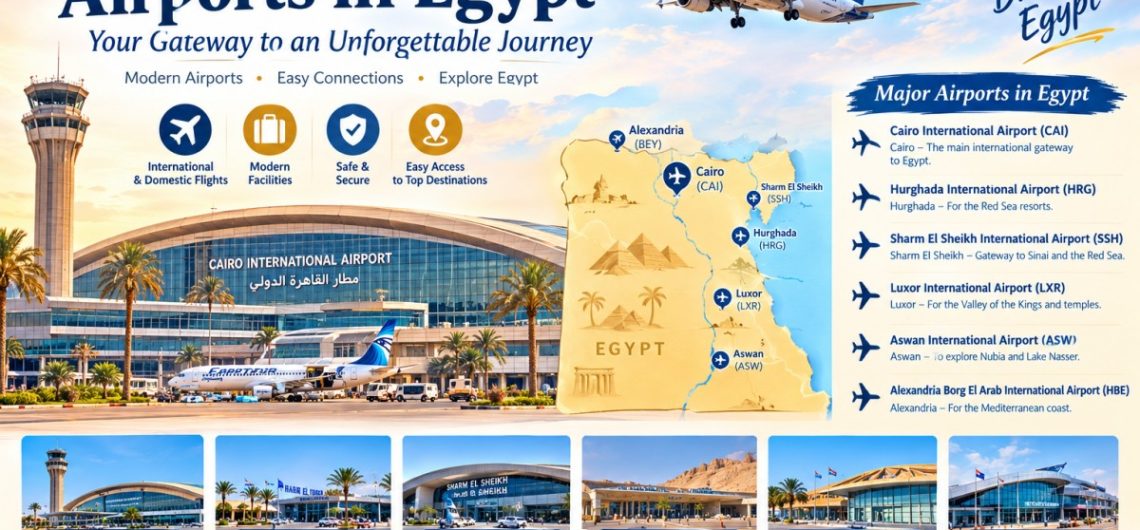
Understanding the airports in Egypt is one of the most practical steps when planning a trip to this historically rich and geographically spread-out country. Egypt is not a tiny destination that can be explored comfortably from one base alone. Its major attractions are separated by deserts, the Nile Valley, the Red Sea coast, the Mediterranean coast, and long highway routes. Cairo, the Giza Pyramids Complex, Luxor, Aswan, Hurghada, Sharm El Sheikh, Marsa Alam, Alexandria, and Abu Simbel are all reached more efficiently by air than by long overland travel in many cases.
Whether you are searching for “Egypt airports,” “Cairo International Airport,” “Hurghada Airport,” “Sharm El Sheikh Airport,” “Luxor Airport,” “Aswan Airport,” “domestic flights in Egypt,” or “airport transfer Egypt,” this guide is designed to help you choose the right airport, plan smooth arrivals and departures, avoid common travel mistakes, and connect Egypt’s aviation network to a realistic itinerary. It is written for first-time visitors, returning travelers, families, couples, solo travelers, Red Sea beachgoers, Nile cruise passengers, history lovers, and anyone who wants to travel Egypt with more confidence in 2026.
Egypt’s airport system includes major international gateways, seasonal tourist airports, domestic airfields, and small regional airports that serve specific destinations. The most important airports for travelers are usually Cairo, Hurghada, Sharm El Sheikh, Luxor, Aswan, Marsa Alam, Borg El Arab serving Alexandria, Sohag, Assiut, and Abu Simbel. Each airport has a different role. Some are best for pyramid visits, some for Nile cruises, some for Red Sea relaxation, and some for combining culture with beach time.
This guide explains the main airports in Egypt, how to use them practically, what to expect during arrival, how to transfer to hotels and attractions, which airport is best for your itinerary, and how to combine air travel with private tours, Nile cruises, trains, buses, and guided excursions. It also includes tips on visas, SIM cards, taxis, ride-hailing apps, airport scams, luggage, safety, family travel, luxury travel, budget planning, seasonal timing, and internal links to major Egypt destinations and travel resources.
Egypt is a country best understood through its distances. The right airport can save hours, reduce fatigue, and turn a complicated itinerary into a smooth journey.
Quick Answer: What Are the Main Airports in Egypt?
The main airports in Egypt for travelers are Cairo International Airport, Hurghada International Airport, Sharm El Sheikh International Airport, Luxor International Airport, Aswan International Airport, Marsa Alam International Airport, Borg El Arab Airport serving Alexandria, Sohag Airport, Assiut Airport, and Abu Simbel Airport. Cairo is the primary international gateway and best for pyramids, museums, and connecting flights. Hurghada and Sharm El Sheikh are major Red Sea tourist airports. Luxor and Aswan are essential for temples, tombs, and Nile cruises. Marsa Alam is ideal for quieter beach and diving holidays. Borg El Arab serves Alexandria and the northern coast, while Sohag, Assiut, and Abu Simbel support Upper Egypt and southern travel. Choosing the right Egypt airport depends on your itinerary, pace, budget, and whether you want culture, beaches, Nile travel, or a combination of all three.
Why Airports in Egypt Matter
Egypt is large. Cairo to Luxor is roughly 670 kilometers by road, Cairo to Aswan is over 850 kilometers, and the Red Sea coast adds another major travel dimension. While trains, buses, private cars, and Nile cruises are all useful, domestic flights are often the most efficient way to move between regions. This is why knowledge of airports in Egypt is not just a logistics detail. It is part of itinerary design.
A well-planned Egypt trip usually begins by answering a simple question: where will you fly in, where will you fly out, and where will you move internally? Some travelers fly into Cairo and out of Hurghada. Others fly into Sharm El Sheikh for a beach holiday and add Cairo for a short pyramid stop. Others use Luxor and Aswan as cultural hubs before finishing on the Red Sea. The airport choice shapes the entire rhythm of the journey.
Airports also affect comfort. Egypt can be hot, busy, and physically demanding. Long road transfers can be tiring, especially for families, older travelers, or visitors with limited mobility. Domestic flights can reduce fatigue and give you more time at major attractions such as the Karnak Temple, Valley of the Kings, Philae Temple, and the Temples of Abu Simbel.
For first-time visitors, airports can also feel intimidating. You may arrive late at night, deal with currency exchange, immigration, baggage claim, taxi drivers, hotel transfers, and heat all at once. Preparation makes a major difference. Knowing which terminal you are using, arranging transport in advance, understanding visa rules, and having a clear plan for your first hour in Egypt can turn a stressful arrival into a smooth beginning.
Egypt Airports by Region
It helps to think of Egypt’s airports in regional clusters rather than as a single list. Each cluster serves a different travel purpose.
1. Cairo and Giza Region
Cairo International Airport is the country’s main gateway. It is best for travelers visiting the pyramids, museums, Islamic Cairo, Coptic Cairo, the Citadel of Saladin, the Grand Egyptian Museum, and the Egyptian Museum. It is also the main connection point for domestic flights to Luxor, Aswan, Hurghada, Sharm El Sheikh, and other destinations.
2. Red Sea Region
The Red Sea airports include Hurghada, Sharm El Sheikh, and Marsa Alam. These airports are ideal for beach holidays, resorts, diving, snorkeling, family vacations, honeymoons, and relaxation after cultural sightseeing. Hurghada is often combined with Luxor by road or flight. Sharm El Sheikh is popular for reef diving and Sinai experiences. Marsa Alam is quieter and more remote, ideal for travelers seeking calm beaches and marine life.
3. Upper Egypt and Nile Valley
Luxor and Aswan are the key airports for ancient temples, tombs, museums, Nile cruises, Nubian culture, and southern Egypt. Luxor is often called the world’s largest open-air museum. Aswan is more relaxed and scenic, with access to Philae, the High Dam, the Unfinished Obelisk, Elephantine Island, and Abu Simbel. Abu Simbel itself also has a small airport used mainly for domestic flights from Aswan or Cairo.
4. Alexandria and Northern Coast
Borg El Arab Airport serves Alexandria and the wider northern region. It is useful for travelers who want Mediterranean atmosphere, seafood, historic forts, libraries, and a different side of Egypt. However, it is farther from central Alexandria than some visitors expect, so transfer time should be planned carefully.
5. Middle and Upper Egypt Regional Airports
Sohag and Assiut airports serve areas north of Luxor and are useful for specialized travelers, domestic connections, or visitors exploring Upper Egypt beyond the main tourist trail. They are not usually the first choice for short leisure trips, but they can be practical for certain itineraries.
Main Airports in Egypt: Quick Comparison
The table below gives a practical overview of the most important airports in Egypt for travelers.
| Airport | Code | Best For | Travel Notes |
|---|---|---|---|
| Cairo International Airport | CAI | Pyramids, museums, international connections, domestic flights | Main gateway to Egypt; traffic to central Cairo and Giza can be heavy. |
| Hurghada International Airport | HRG | Red Sea resorts, beaches, diving, family holidays | Close to many resorts; useful for combining beach time with Luxor. |
| Sharm El Sheikh International Airport | SSH | Reefs, diving, Sinai, luxury resorts, honeymoon travel | Popular international leisure destination; transfers depend on resort area. |
| Luxor International Airport | LXR | Temples, tombs, Nile cruises, history-focused travel | Best for Karnak, Luxor Temple, Valley of the Kings, and West Bank sites. |
| Aswan International Airport | ASW | Philae, Nubian villages, Nile scenery, Abu Simbel connections | Gateway to southern Egypt and Abu Simbel flights. |
| Marsa Alam International Airport | RMF | Quiet beaches, diving, remote resorts, relaxation | More spread-out transfers; ideal for unhurried beach holidays. |
| Borg El Arab Airport | HBE | Alexandria, Mediterranean coast, northern Egypt | Located outside Alexandria; allow extra transfer time. |
| Sohag Airport | HMV | Regional Upper Egypt travel, domestic connections | Less common for short leisure trips but useful for specific routes. |
| Assiut Airport | ATZ | Middle Egypt, regional travel, domestic flights | Not a major tourist hub but practical for certain itineraries. |
| Abu Simbel Airport | ABS | Abu Simbel temples, southern monument visits | Small airport; usually reached by domestic flight from Aswan or Cairo. |
Cairo International Airport: Egypt’s Main Gateway
Cairo International Airport, usually referred to as CAI, is the most important airport in Egypt for international travelers. It connects Egypt to Europe, the Middle East, Africa, Asia, and North America through direct or connecting flights. For many visitors, Cairo is the first stop because it provides access to the pyramids, museums, historic districts, and domestic flights to other parts of the country.
The airport is located northeast of central Cairo. Depending on traffic, the drive to downtown Cairo, Zamalek, Maadi, Giza, or the pyramids can take anywhere from 30 minutes to more than an hour and a half. Traffic is one of the most important factors to consider when planning arrivals, departures, and day trips from the airport.
What Cairo Airport Is Best For
- First-time visitors who want to combine pyramids, museums, and city culture.
- Travelers connecting to Luxor, Aswan, Hurghada, Sharm El Sheikh, or other domestic destinations.
- Visitors planning a short Cairo stop before a Nile cruise or Red Sea extension.
- Travelers who want the widest choice of international flights and hotel options.
Cairo Airport Arrival Tips
- Have your passport, accommodation details, return ticket, and any required visa documentation ready.
- Use official currency exchange offices or ATMs rather than unlicensed money changers.
- If you need a local SIM card, compare providers after immigration and check current requirements.
- Pre-arrange airport transfer whenever possible, especially if arriving late at night or traveling with children.
- Ignore aggressive taxi touts and verify prices before entering a vehicle.
- Allow extra time for immigration, baggage claim, customs, and traffic.
Getting from Cairo Airport to the Pyramids
Many travelers ask whether they can go directly from Cairo Airport to the Giza Pyramids. It is possible, but traffic can make it tiring, especially after a long flight. If you arrive early in the morning and have energy, a direct transfer to Giza can be efficient. If you arrive late, tired, or with family, it is often better to check into a hotel first and visit the pyramids the next morning.
The Giza Pyramids Complex is best visited early, when temperatures are lower and crowds are thinner. From Cairo Airport, travel time to Giza can vary significantly. Private transfers are usually the most comfortable option, especially if you want a direct route without multiple stops.
Cairo Airport and Museums
If your first day includes museums, choose carefully. The Grand Egyptian Museum is closer to Giza and can be combined with the pyramids. The classic Egyptian Museum in Tahrir Square is in central Cairo and may be more convenient if you are staying downtown. For a structured first day, consider a Cairo day tour or a private day tour Cairo sightseeing option.
Red Sea Airports: Hurghada, Sharm El Sheikh, and Marsa Alam
The Red Sea coast is one of Egypt’s most popular travel regions, and its airports are essential for beach holidays, diving, resorts, families, honeymooners, and travelers who want relaxation after sightseeing. The three main Red Sea airports are Hurghada, Sharm El Sheikh, and Marsa Alam.
Hurghada International Airport
Hurghada is one of the most convenient Red Sea destinations because it has a major international airport and many resorts relatively close by. It is popular for families, budget-conscious travelers, divers, snorkelers, and visitors who want to combine beach time with a Luxor day trip or short cultural extension.
Transfers from Hurghada Airport to hotels can be short, but some resorts are located farther north or south along the coast. Always confirm your hotel’s distance from the airport. Hurghada is also a useful base for travelers who want to visit Luxor by domestic flight or long road transfer, although flying is usually more comfortable.
Sharm El Sheikh International Airport
Sharm El Sheikh is a major leisure airport on the Sinai coast. It is known for coral reefs, diving, luxury resorts, water sports, and proximity to notable marine areas. Transfers depend heavily on which part of Sharm you are visiting: Naama Bay, Shark’s Bay, Nabq, Hadaba, Soho Square, or other areas can have different travel times.
Sharm is ideal for travelers who want a beach-centered holiday with international flight access. It can also be combined with Cairo for a short pyramid stop, although the overall trip requires careful scheduling because of flight connections and distance.
Marsa Alam International Airport
Marsa Alam is quieter and more remote than Hurghada or Sharm El Sheikh. It is ideal for travelers seeking calm beaches, coral reefs, dugong and turtle diving, and a slower resort rhythm. However, transfers can be longer because resorts and dive sites are spread out along the coast.
Marsa Alam is not usually the best airport for first-time travelers who want to combine pyramids and temples quickly. It is best for beach-focused holidays, diving trips, and travelers who prefer fewer crowds.
El Gouna and Red Sea Boutique Destinations
El Gouna is a polished Red Sea resort town known for lagoons, yachts, dining, and a more planned environment. Travelers often reach it through Hurghada Airport, depending on current transport options and hotel arrangements. Always confirm the latest transfer route when planning your trip.
Luxor and Aswan Airports: Gateways to Ancient Egypt
For history lovers, Luxor and Aswan are among the most important airports in Egypt. They provide direct access to temples, tombs, museums, Nile cruises, and some of the country’s most powerful archaeological landscapes.
Luxor International Airport
Luxor is often described as the world’s largest open-air museum. Luxor International Airport is the main gateway to the East Bank and West Bank. From the airport, you can reach Karnak Temple, Luxor Temple, the Valley of the Kings, Hatshepsut Temple, Medinet Habu, the Colossi of Memnon, and the Luxor Museum.
Luxor Airport is usually more convenient than long road transfers from Cairo or Hurghada, especially if you want to maximize time at archaeological sites. The airport is relatively close to the city, but traffic, heat, and security checks can still affect timing. Private transfers are recommended for comfort and efficiency.
Aswan International Airport
Aswan is one of Egypt’s most relaxed and scenic cities. Aswan International Airport is close to the city and useful for visiting Philae Temple, the High Dam, the Unfinished Obelisk, Elephantine Island, Nubian villages, felucca rides, and the Nile waterfront.
Aswan is also the main connection point for Abu Simbel. Many travelers fly from Aswan to Abu Simbel early in the morning and return the same day. This is one of the most efficient ways to include Egypt’s southern monumental temples in a short itinerary.
Luxor and Aswan with Nile Cruises
If you are traveling on a Nile cruise itinerary, Luxor and Aswan airports are especially important. Many cruises begin or end in one of these cities. You may fly into Luxor, board a cruise to Aswan, then fly out from Aswan or continue to Abu Simbel. Alternatively, you may reverse the route.
Cruise passengers should confirm embarkation and disembarkation times carefully. Airport transfers, hotel stays, and cruise boarding schedules should be coordinated to avoid stress, especially during high season.
Abu Simbel Airport: The Southern Monument Gateway
Abu Simbel Airport is a small but important airport for travelers visiting the Temples of Abu Simbel. The temples are located far south of Aswan, near the border with Sudan, and the flight is usually the most practical way to reach them within a short trip.
Most visitors fly from Aswan to Abu Simbel early in the morning, visit the temples, and return to Aswan the same day. Some itineraries include flights from Cairo, but availability and connections vary. Because Abu Simbel is remote and hot, advance planning is essential.
Is Abu Simbel Worth the Flight?
For many travelers, yes. Abu Simbel is one of Egypt’s most dramatic archaeological sites. The colossal statues of Ramesses II, the temple complex, the relocation story, and the desert-lake setting create a powerful experience. However, it adds cost and logistics. If you have limited time, prefer a slower pace, or want to avoid early mornings, you can skip Abu Simbel and spend more time in Aswan or on the Nile.
Alexandria and Borg El Arab Airport
Alexandria is Egypt’s Mediterranean city, known for seafood, the corniche, the Bibliotheca Alexandrina, the Citadel of Qaitbay, Pompey’s Pillar, and a relaxed coastal atmosphere. The main airport serving the region is Borg El Arab Airport, located outside the city.
Travelers should plan for a transfer of roughly 45 to 75 minutes to central Alexandria, depending on traffic and exact destination. Borg El Arab is useful for visitors focusing on Alexandria and the northern coast, but it is not usually the most efficient airport for a first-time trip centered on pyramids, Luxor, and Aswan.
When to Use Borg El Arab Airport
- You are visiting Alexandria for seafood, history, and Mediterranean atmosphere.
- You are traveling to the northern coast or Delta region.
- You have a connecting flight or regional route that makes Borg El Arab practical.
- You want a different side of Egypt beyond Cairo, Luxor, and the Red Sea.
Sohag and Assiut Airports
Sohag Airport and Assiut Airport serve regional travel in Middle and Upper Egypt. They are not usually the first airports chosen by short-break tourists, but they can be useful for domestic connections, specialized itineraries, or travelers exploring areas beyond Luxor and Aswan.
For most first-time visitors, Luxor and Aswan remain more practical because they are closer to the major temple and tomb complexes. Sohag and Assiut may be relevant for longer trips, academic travel, regional business, or travelers who want to move through Upper Egypt with more flexibility.
Domestic Flights in Egypt
Domestic flights are one of the most useful tools for planning efficient Egypt itineraries. They save time, reduce road fatigue, and allow travelers to cover more regions within a short vacation. The most common domestic routes include Cairo to Luxor, Cairo to Aswan, Cairo to Hurghada, Cairo to Sharm El Sheikh, Aswan to Abu Simbel, and seasonal or connecting routes between tourist hubs.
Benefits of Domestic Flights
- They save many hours compared with long road transfers.
- They are more comfortable for families, older travelers, and heat-sensitive visitors.
- They allow tighter itineraries without excessive overnight driving.
- They make Abu Simbel practical within a 7-day or 10-day trip.
- They can be combined with Nile cruises for a balanced route.
When Not to Fly Domestically
Domestic flights are not always necessary. If you are traveling slowly, on a tight budget, or enjoy overland movement, trains and private cars can be practical. Some travelers prefer the Nile train between Cairo and Luxor or Aswan for the river landscape. Others use private drivers for flexibility. The best choice depends on your time, budget, comfort level, and itinerary.
Booking Domestic Flights
- Book early during high season, especially from October to April.
- Check baggage allowances carefully, as fares may vary.
- Allow buffer time between connecting flights.
- Confirm airport transfer arrangements at both ends.
- If using a tour operator, ask whether flights are included or optional.
- For Abu Simbel, confirm whether the flight is from Aswan or Cairo and what time departure occurs.
Airport Transfers in Egypt
Airport transfers are one of the most important practical details when traveling in Egypt. A smooth transfer can make your arrival relaxing. A poorly arranged transfer can create stress, especially after a long international flight. The main options include private transfers, taxis, ride-hailing apps, hotel shuttles, shared minibuses, and pre-arranged tour transport.
Private Airport Transfer
A private transfer is usually the most comfortable option, especially for families, couples, older travelers, first-time visitors, and anyone arriving late. A driver meets you outside arrivals, helps with luggage, and takes you directly to your hotel. This reduces uncertainty and avoids negotiations at the airport.
Taxis and Ride-Hailing Apps
Taxis are available at Egyptian airports, but prices and service quality can vary. Ride-hailing apps may be available in some cities, depending on current operations. If using a taxi, agree on the fare in advance or ensure the meter is used when appropriate. Avoid unlicensed drivers who approach you aggressively inside the terminal.
Hotel Shuttles and Resort Transfers
Many Red Sea hotels and some Cairo hotels offer shuttle or private transfer services. This is often convenient for resort stays, especially in Hurghada, Sharm El Sheikh, and Marsa Alam. Confirm pickup instructions, meeting points, and whether the service is free or paid.
Shared Minibuses
Shared transport can be cheaper but is less comfortable and less predictable. It may involve multiple hotel drops, waiting for other passengers, and longer travel times. For short trips or first arrivals, private transport is usually better.
Transfer Time Estimates
| Route | Approximate Time | Notes |
|---|---|---|
| Cairo Airport to central Cairo | 30–90 minutes | Highly traffic-dependent. |
| Cairo Airport to Giza Pyramids | 40–90 minutes | Better to visit pyramids the next morning if arriving tired. |
| Hurghada Airport to resorts | 10–45 minutes | Depends on resort location along the coast. |
| Sharm El Sheikh Airport to hotel areas | 10–40 minutes | Naama Bay, Shark’s Bay, Nabq, and Soho areas vary. |
| Luxor Airport to East Bank hotels | 10–25 minutes | Convenient for Karnak and Luxor Temple. |
| Luxor Airport to West Bank | 20–45 minutes | Valley of the Kings and Hatshepsut Temple are on the west bank. |
| Aswan Airport to city center | 10–25 minutes | Close to Nile hotels and Philae access points. |
| Borg El Arab Airport to Alexandria | 45–75 minutes | Allow extra time for traffic and destination within the city. |
Arrival Process: Visa, SIM, Money, Bags
Arriving at an Egyptian airport is usually straightforward if you prepare in advance. The main steps are immigration, baggage claim, customs, currency exchange, SIM card purchase if needed, and transport to your hotel. Rules and services can change, so always check current requirements before travel.
Passport and Visa
Most travelers need a valid passport with sufficient remaining validity. Visa requirements depend on nationality. Some visitors can obtain a visa on arrival, while others should apply for an e-visa or embassy visa in advance. Always verify the latest rules through official sources before flying.
Immigration and Customs
Immigration lines can be busy, especially during peak tourist season and arrival waves from Europe. Have your documents accessible. Customs is usually straightforward, but declare restricted or valuable items if required. Do not accept packages or luggage transfers from strangers.
Money and ATMs
ATMs and currency exchange offices are available at major airports. It is useful to have some Egyptian pounds for tips, small purchases, transport, and immediate expenses. Avoid exchanging money with unlicensed individuals inside or outside the terminal.
SIM Cards and Connectivity
Local SIM cards can be purchased at major airports, subject to current registration rules. If you rely on maps, ride-hailing apps, hotel communication, or translation tools, connectivity is valuable. Some travelers prefer eSIMs if their device and carrier support them. Check compatibility before departure.
Luggage and Packing
Egypt travel often involves heat, walking, cobblestones, temple steps, sand, and hotel transfers. Pack light where possible, use comfortable bags, and keep essentials in your carry-on: passport, medications, charger, water bottle after security, tissues, hand sanitizer, and a change of clothes if arriving late. For detailed preparation, see our guide to what to pack when traveling to Egypt.
How to Choose the Right Egypt Airport
Choosing the right airport is not only about flight price. It is about how the airport fits your itinerary, energy level, travel style, and time constraints. The best Egypt airport for you depends on what you want to experience.
Choose Cairo if You Want:
- The pyramids, Sphinx, Grand Egyptian Museum, Egyptian Museum, Islamic Cairo, and Coptic Cairo.
- The widest international flight selection.
- Easy connections to Luxor, Aswan, Hurghada, and Sharm El Sheikh.
- A first-time Egypt introduction with major historical highlights.
Choose Hurghada if You Want:
- Red Sea beaches, resorts, diving, and family-friendly leisure.
- A convenient base for combining beach time with Luxor.
- Shorter transfers to many resort areas.
- Good value options and broad international flight access.
Choose Sharm El Sheikh if You Want:
- World-class reefs, diving, snorkeling, and luxury resorts.
- A beach-centered holiday with strong international connections.
- Sinai landscapes and marine experiences.
- Romantic or family resort travel.
Choose Luxor if You Want:
- Karnak Temple, Luxor Temple, Valley of the Kings, Hatshepsut Temple, and West Bank monuments.
- A history-focused stay without long road transfers from Cairo.
- Nile cruise boarding or disembarkation.
- Deep temple and tomb exploration.
Choose Aswan if You Want:
- Philae Temple, Nubian villages, felucca rides, and relaxed Nile scenery.
- A gateway to Abu Simbel.
- A calmer pace after Luxor.
- Romantic, scenic, or culturally immersive travel.
Choose Marsa Alam if You Want:
- Quiet beaches, remote resorts, diving, and marine life.
- A slower holiday away from major tourist crowds.
- Longer transfer tolerance in exchange for calm and space.
Airports for Popular Egypt Itineraries
Different Egypt trips require different airport strategies. Below are common itinerary models and the airports that usually work best.
1. First-Time Classic Egypt Trip
A classic route usually includes Cairo, Giza, Saqqara, Memphis, Luxor, and Aswan. The best airport strategy is often fly into Cairo, fly to Luxor, travel to Aswan by flight, train, or cruise, then fly back to Cairo or depart from Aswan if your international connection allows.
For a shorter version, see our 7 days in Egypt itinerary. For a more relaxed route, see our 10 day Egypt itinerary.
2. Pyramids and Museums Short Trip
If you only have a few days, Cairo is the logical airport. You can focus on the Giza Plateau, Grand Egyptian Museum, Egyptian Museum, Islamic Cairo, Coptic Cairo, and the Citadel. This route works well for 3-day Egypt itineraries and 4-day Egypt itineraries.
3. Culture plus Red Sea Relaxation
A popular combination is Cairo and Luxor or Aswan, followed by Hurghada, Sharm El Sheikh, Marsa Alam, or El Gouna. Fly into Cairo, move to Upper Egypt by domestic flight, then fly to the Red Sea for beach time. This is excellent for honeymooners, families, and travelers who want balance.
For romantic planning, see our Egypt honeymoon itinerary guide.
4. Nile Cruise Route
Nile cruises usually connect Luxor and Aswan. You may fly into Luxor and out of Aswan, or reverse the direction. Some itineraries include Abu Simbel by flight from Aswan. Cruise travelers should coordinate airport transfers with embarkation and disembarkation times.
For river travel planning, see our Nile cruise itinerary guide.
5. Beach-Only Egypt Trip
If your goal is sun, sea, diving, and resort relaxation, choose Hurghada, Sharm El Sheikh, or Marsa Alam based on the type of beach holiday you want. Hurghada is convenient and family-friendly, Sharm is strong for reefs and luxury resorts, and Marsa Alam is quieter and more remote.
6. Family Egypt Trip
Families often benefit from minimizing long transfers. Flying into Cairo for pyramids, then flying to Luxor or Aswan, and finishing on the Red Sea can be a comfortable structure. Private airport transfers, early starts, and hotel pools help reduce travel fatigue.
For family advice, see our guide to Egypt with kids.
7. Solo Traveler Route
Solo travelers can use Cairo as the main hub and add Luxor or Aswan by domestic flight. Pre-arranged transfers, well-reviewed hotels, and guided day tours make solo travel smoother. Women traveling alone may prefer private airport transfers and daytime arrivals when possible.
For practical advice, see our solo female travel Egypt guide.
Safety, Scams, and Smart Airport Behavior
Egyptian airports are generally busy, monitored, and accustomed to international travelers. Most visitors arrive and depart without problems. However, airports are also places where pressure selling, confusing transport offers, and unofficial helpers can appear. A calm, prepared approach is best.
Smart Airport Safety Tips
- Pre-arrange your transfer whenever possible.
- Do not follow strangers claiming to be hotel representatives unless verified.
- Keep passports, cards, and phones secure in arrival areas.
- Agree taxi fares before riding or use trusted apps where available.
- Avoid displaying large amounts of cash.
- Use official ATMs and exchange offices.
- If a deal sounds too helpful or too cheap, pause and verify.
- Travel with a charged phone and offline hotel address map.
Common Airport Hassles
The most common issues are not dangerous crimes but persistent vendors, unclear pricing, unofficial taxi offers, and confusion over meeting points. These can be reduced by knowing your hotel address, having a transfer voucher, and walking confidently toward official exits or your prearranged driver.
For broader advice, read our guides on whether it is safe to travel to Egypt and tourist scams in Egypt.
Family Travel, Accessibility, and Older Travelers
Airports can be especially important for families, older travelers, and wheelchair users. Long terminals, luggage, security checks, heat, and transfer logistics can become tiring. Planning ahead makes a major difference.
Tips for Families
- Arrange private transfers to avoid taxi negotiations with children.
- Choose hotels close to the airport if you have late arrivals or early departures.
- Pack snacks, water after security, wet wipes, and entertainment for delays.
- Avoid scheduling major sightseeing immediately after a long flight when possible.
- Use strollers where helpful, but be prepared for uneven surfaces in some areas.
Tips for Wheelchair Users and Travelers with Limited Mobility
If you travel with mobility needs, contact your airline in advance for assistance. Confirm airport transfer vehicle suitability, hotel accessibility, and whether your itinerary includes uneven terrain, steps, sand, or long walking distances. Egypt’s airports and hotels vary in accessibility, and private planning is strongly recommended.
For broader guidance, see our article on whether Egypt is wheelchair friendly.
Seasonal Travel and Airport Timing
Season affects airport congestion, flight prices, hotel availability, and overall comfort. Egypt’s high season is generally from October to April, when temperatures are milder for sightseeing. Summer travel is possible, but heat can be intense, especially in Cairo, Luxor, and Aswan.
High Season Considerations
- Airports can be busier, especially Cairo, Hurghada, and Sharm El Sheikh.
- Domestic flights and hotel transfers should be booked earlier.
- Christmas, New Year, Easter, and European school holidays increase demand.
- Popular attractions may have larger crowds, making early starts more valuable.
Low Season and Summer Considerations
- Fewer crowds can make airports and attractions feel calmer.
- Heat can make outdoor sightseeing more tiring.
- Air-conditioned transfers and hotels become more important.
- Red Sea travel remains popular, but inland cultural sites require careful pacing.
For seasonal planning, see our guides to best time of year to visit Egypt and climate and weather in Egypt.
Airport Costs and Budget Planning
When budgeting for Egypt, airport-related costs should be included in your overall travel plan. These may include international flights, domestic flights, airport transfers, tips, SIM cards, currency exchange margins, baggage fees, and possible lounge access.
Typical Airport-Related Expenses
- International airfare to Cairo, Hurghada, Sharm El Sheikh, or other entry points.
- Domestic flights between Cairo, Luxor, Aswan, Hurghada, Sharm El Sheikh, and Abu Simbel.
- Private airport transfer or taxi fare.
- Tips for drivers, porters, and hotel luggage assistance where appropriate.
- SIM card or eSIM data plan.
- Visa fees if applicable.
- Baggage excess charges on low-cost or regional fares.
For broader budget guidance, see our article on Egypt travel costs. For tipping customs, see our guide to tipping in Egypt.
Common Mistakes Travelers Make with Egypt Airports
One common mistake is choosing the cheapest flight without considering transfer time, fatigue, and itinerary flow. A slightly more expensive route that saves hours on the road can be worth it.
Another mistake is planning too much for arrival day. After a long international flight, immigration, baggage, traffic, and heat, many travelers are less energetic than expected. Keep the first day light.
Some travelers also underestimate domestic flight buffers. If you are connecting internationally to domestically, allow enough time for terminal changes, security, check-in, and unexpected delays.
Another error is leaving airport transfers to chance. Arranging transport in advance reduces stress, especially at night, during high season, or when traveling with family.
Finally, some visitors assume all Egyptian airports are equally close to attractions. This is not true. Borg El Arab is outside Alexandria, Marsa Alam resorts can be spread out, and Abu Simbel is remote. Always check real transfer distances before booking.
Frequently Asked Questions About Airports in Egypt
What are the main airports in Egypt?
The main airports in Egypt include Cairo International Airport, Hurghada International Airport, Sharm El Sheikh International Airport, Luxor International Airport, Aswan International Airport, Marsa Alam International Airport, Borg El Arab Airport, Sohag Airport, Assiut Airport, and Abu Simbel Airport. The best airport depends on whether you are visiting pyramids, temples, Nile cruises, Red Sea beaches, Alexandria, or southern monuments.
Which airport is best for first-time visitors to Egypt?
Cairo International Airport is usually best for first-time visitors because it provides access to the pyramids, museums, historic Cairo, and domestic flights to Luxor, Aswan, and the Red Sea. It is also the main international gateway with the widest flight selection.
Is Cairo Airport close to the Pyramids of Giza?
Cairo Airport is not right next to the pyramids, but it is connected by road. Travel time can range from about 40 to 90 minutes depending on traffic. If you arrive tired, it is often better to check into your hotel first and visit the pyramids the next morning.
Which airport is best for the Red Sea?
Hurghada, Sharm El Sheikh, and Marsa Alam are the main Red Sea airports. Hurghada is convenient and family-friendly, Sharm El Sheikh is strong for diving and luxury resorts, and Marsa Alam is quieter and more remote. The best choice depends on the type of beach holiday you want.
Do I need domestic flights in Egypt?
Domestic flights are not mandatory, but they are very useful for saving time and reducing fatigue. They are especially helpful for moving between Cairo, Luxor, Aswan, Hurghada, Sharm El Sheikh, and Abu Simbel. For short trips, flying is often more practical than long road transfers.
Can I fly from Cairo to Luxor?
Yes, Cairo to Luxor is one of the most common domestic routes in Egypt. The flight usually takes around an hour and is much faster than road travel. It is ideal for travelers who want to maximize time at Karnak Temple, Luxor Temple, and the Valley of the Kings.
How do I get to Abu Simbel?
Most travelers reach Abu Simbel by domestic flight from Aswan. The flight is usually early in the morning, allowing visitors to see the temples and return to Aswan the same day. Overland travel is possible but much longer and less practical for short trips.
Which airport should I use for Alexandria?
Borg El Arab Airport is the main airport serving Alexandria and the northern region. It is located outside the city, so allow extra transfer time. If you are visiting Alexandria as part of a Cairo-based trip, day trips by road or train may also be considered depending on your schedule.
Are airport transfers included in Egypt tours?
Many organized Egypt tours include airport transfers, but this depends on the operator and package. Always check what is included. For independent travel, pre-booking a private transfer is often the most comfortable option, especially for families, older travelers, or late arrivals.
Is it safe to arrive in Egypt at night?
Night arrivals can be safe, but they are less convenient, especially for first-time visitors. If possible, arrange a private transfer, share your flight details with your hotel, keep documents accessible, and avoid unverified taxi offers. Daytime arrivals are generally easier for orientation.
Can I get a visa on arrival at Egyptian airports?
Visa rules depend on nationality. Some travelers can obtain a visa on arrival, while others should apply in advance through an e-visa or embassy. Always check current official requirements before traveling, as regulations can change.
Which Egypt airport is closest to the pyramids?
Cairo International Airport is the main airport used for visiting the pyramids, although it is not immediately adjacent to Giza. The Sphinx International Airport may also serve some routes depending on current operations, but Cairo remains the most common and practical gateway for pyramid visitors.
Should I fly into Cairo and out of Hurghada?
This can be an excellent option if you want to combine culture and beach relaxation. Fly into Cairo for pyramids and museums, continue to Luxor or Aswan, then finish in Hurghada for Red Sea time. It reduces backtracking and creates a balanced itinerary.
What is the easiest Egypt airport for families?
Hurghada is often easy for families because of short resort transfers and many family-friendly hotels. Cairo is also practical if you pre-arrange private transfers and keep the first day light. The best family airport depends on whether your priority is culture, beaches, or a combination.
Are Egyptian airports modern?
Major Egyptian airports have modernized over time, especially Cairo, Hurghada, Sharm El Sheikh, Luxor, and Aswan. However, service levels, congestion, and facilities can vary by terminal, season, and time of day. Preparation and private transfers can make the experience smoother.
How early should I arrive at the airport for departure?
For international flights, arrive at least three hours early during high season. For domestic flights, two hours is often prudent, but check with your airline. Traffic in Cairo and other cities can be unpredictable, so build buffer time into your departure plan.
Related Topics and Internal Links
If you are researching airports in Egypt, you may also be searching for terms such as Egypt airports list, Cairo International Airport guide, Hurghada Airport transfer, Sharm El Sheikh Airport, Luxor Airport to Valley of the Kings, Aswan Airport to Philae, Marsa Alam Airport, Borg El Arab Airport Alexandria, domestic flights Egypt, Egypt airport transfer, Egypt visa on arrival, Egypt travel planning, and best airport for Egypt itinerary. These topics all connect to the same goal: helping travelers move through Egypt more smoothly, comfortably, and confidently.
- Airports in Egypt for the main airport guide
- Cairo for capital city planning
- Giza Pyramids Complex for pyramid visits
- Grand Egyptian Museum for museum planning
- Egyptian Museum for classic Cairo museum visits
- Luxor for temples and tombs
- Aswan for Nile-side travel
- Karnak Temple for Luxor attraction planning
- Valley of the Kings for West Bank visits
- Temple of Philae for Aswan attraction planning
- Temples of Abu Simbel for southern monument travel
- Hurghada for Red Sea resort planning
- Sharm El Sheikh for Sinai beach and diving travel
- Marsa Alam for quieter Red Sea holidays
- El Gouna for polished Red Sea resort travel
- Nile cruise itinerary for river travel planning
- Egypt itinerary guide for broader trip planning
- 7 days in Egypt itinerary for short classic routes
- 10 day Egypt itinerary for relaxed routes
- Egypt travel tips for practical preparation
- What to pack when traveling to Egypt for luggage advice
- Is it safe to travel to Egypt for safety guidance
- Tourist scams in Egypt for avoiding common hassles
- Egypt travel costs for budget planning
- Tipping in Egypt for service etiquette
- Egypt with kids for family travel
- Solo female travel Egypt guide for independent travelers
- Egypt honeymoon itinerary for romantic travel planning
- Best time of year to visit Egypt for seasonal planning
- Climate and weather in Egypt for heat and season advice
Final Thoughts: Airports Are Part of the Egypt Experience
Airports in Egypt are more than arrival points. They are the opening chapters of your journey. The airport you choose affects how much time you spend traveling, how energetic you feel at major attractions, how comfortably you move between regions, and how relaxed your first and last impressions of Egypt will be.
A well-planned Egypt trip uses airports strategically. Cairo gives you pyramids and museums. Luxor and Aswan give you temples and tombs. Hurghada, Sharm El Sheikh, and Marsa Alam give you Red Sea rest. Abu Simbel gives you monumental southern drama. Borg El Arab opens Alexandria and the Mediterranean. When these airports are connected with realistic timing, private transfers, and a clear itinerary, Egypt becomes much easier to enjoy.
You do not need to memorize every airport code or terminal detail before travel. What matters is understanding the logic of the country: fly where distance is greatest, transfer privately where comfort matters, arrive with a plan, and build rest into your route. Egypt rewards travelers who prepare without losing spontaneity.
The best Egypt itinerary is not only a list of monuments. It is a smart movement plan that lets you arrive calm, explore deeply, and leave with wonder instead of exhaustion.
Ready to Plan Your Egypt Trip with the Right Airports and Transfers?
Let Egypt Via Travel help you design a smooth Egypt itinerary with the best airport routes, private transfers, domestic flight guidance, hotel planning, guided tours, Nile cruise options, and Red Sea extensions tailored to your travel style.
Contact Egypt Via Travel to Plan Your Egypt Airport and Travel Route