
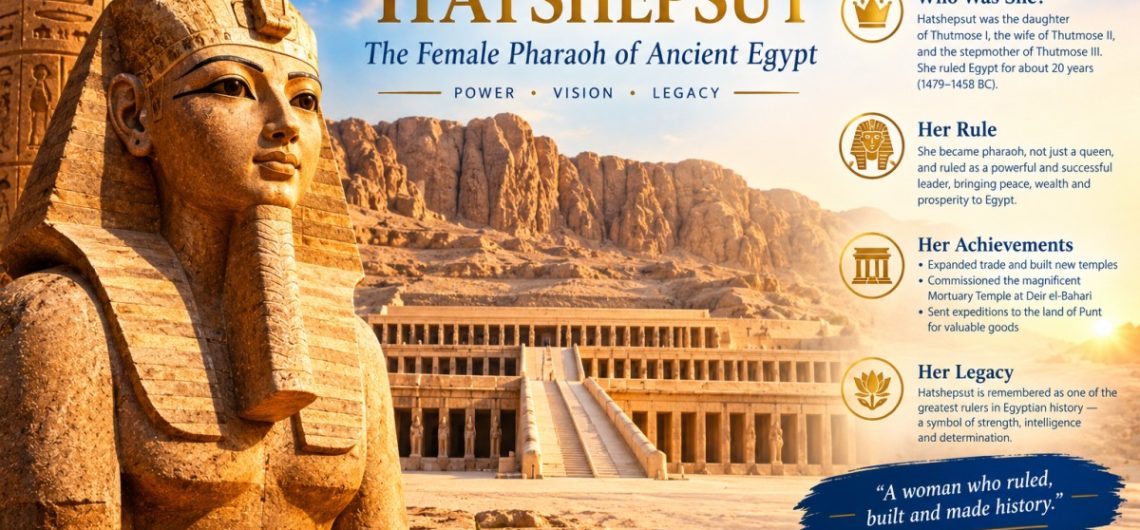
Hatshepsut is one of the most remarkable rulers in ancient history. She was not simply a queen, a wife, or a mother. She became a pharaoh, one of the few women in Egyptian history to rule with the full title, authority, and imagery of a king. Her name means “Foremost of Noble Ladies,” and her reign, during the Eighteenth Dynasty of the New Kingdom, left behind some of the most beautiful temples, statues, reliefs, and inscriptions in Egypt.
If you are planning a trip to Luxor, visiting the Mortuary Temple of Hatshepsut at Deir el-Bahari is one of the most powerful experiences in Egypt. The temple rises in terraces against the limestone cliffs of the Theban necropolis, and its reliefs tell the story of Hatshepsut’s divine birth, her trade expedition to Punt, her building projects, and her carefully constructed image as a legitimate king.
But Hatshepsut’s story is not only about architecture. It is about power, gender, religion, propaganda, memory, and survival. She ruled in a society where kingship was normally male. She presented herself as the daughter of the god Amun, the chosen ruler of Egypt, and the maintainer of Ma’at, the cosmic order of truth and justice. After her death, parts of her memory were erased, yet her monuments were too grand to disappear completely. Today, she stands as one of the strongest symbols of female authority in the ancient world.
This guide is written for first-time visitors to Egypt, returning travelers, history lovers, students, families, couples, solo explorers, and anyone who wants to understand who Hatshepsut was, why she mattered, what she built, how she ruled, where to see her legacy today, and how to include her story in a wider Egypt itinerary. Whether you are searching for Hatshepsut history, Hatshepsut temple, Queen Hatshepsut facts, female pharaoh Egypt, or Hatshepsut Luxor travel tips, this article is designed to give you a complete and practical guide.
Hatshepsut’s world connects to many other major themes in Egyptian civilization: the gods, the Nile, kingship, funerary belief, temple architecture, trade, art, and the politics of memory. To understand her is to understand how ancient Egypt could bend tradition when necessity, ambition, and divine ideology allowed it. She was not an exception who briefly appeared and vanished. She was a ruler who reshaped the image of pharaoh itself.
Hatshepsut did not merely wear the crown of a king. She rebuilt the meaning of kingship around herself, using temples, statues, trade, religion, and memory as tools of power.
Quick Answer: Who Was Hatshepsut?
Hatshepsut was a female pharaoh of ancient Egypt who ruled during the Eighteenth Dynasty of the New Kingdom, around the fifteenth century BCE. She was the daughter of Pharaoh Thutmose I, the Great Royal Wife of Thutmose II, and initially regent for her stepson Thutmose III. She later assumed the full title and imagery of pharaoh, ruling as king for more than twenty years. Hatshepsut is famous for her prosperous reign, major building projects, trade expedition to Punt, and her spectacular mortuary temple at Deir el-Bahari near Luxor. Although parts of her memory were erased after death, her monuments survived and made her one of the most important women in ancient Egyptian history.
Why Hatshepsut Matters
Hatshepsut matters because she challenges simple ideas about power in the ancient world. Egypt was not a society where women were invisible. Queens, goddesses, mothers, administrators, and elite women all played important roles. Yet the office of pharaoh was overwhelmingly male. The king was not only a political ruler. He was the intermediary between gods and people, the defender of Ma’at, the high priest of the land, and the living embodiment of Horus. Hatshepsut entered that world not as a consort, but as a ruler.
Her reign shows that ancient Egyptian kingship could be flexible when political and religious circumstances required it. She did not claim to be a queen ruling beside a king. She claimed to be king. She took a throne name, wore royal clothing, appeared in monuments with the traditional false beard, and was addressed with the language of male pharaonic authority. This was not a minor adjustment. It was a radical reimagining of what a pharaoh could look like.
Hatshepsut also matters because her reign was successful. She did not simply survive in power. She built, traded, celebrated religious festivals, commissioned art, maintained administration, and projected stability. Her temple at Deir el-Bahari remains one of the architectural masterpieces of Egypt. Her expedition to Punt is one of the most famous trade missions in ancient history. Her statues show a ruler who wanted to be remembered as pious, strong, legitimate, and divinely favored.
For modern travelers, Hatshepsut is especially meaningful because her story is visible in the landscape. At Deir el-Bahari, you can walk through a temple designed to express her theology of rule. At Karnak, you can see traces of her building activity. In museums, you can study her statues, reliefs, and inscriptions. Unlike many ancient rulers whose power is known mainly through texts, Hatshepsut left a monumental visual record.
Her story also raises difficult questions about memory. After her death, some of her images were removed, defaced, or reassigned. Why did this happen? Was it personal revenge, political correction, religious concern, dynastic strategy, or a combination of factors? Scholars still debate the details, but the result is clear: Hatshepsut was partially erased, yet not completely destroyed. Her survival as a historical figure is itself a triumph.
Early Life and Family Background
Hatshepsut was born into the Eighteenth Dynasty, the founding dynasty of Egypt’s New Kingdom, a period of imperial strength, wealth, and monumental building. Her father was Thutmose I, a pharaoh who expanded Egyptian influence and established the tradition of royal burial in the Valley of the Kings. Her mother was Ahmose, a queen who appears to have played an important role in Hatshepsut’s legitimacy.
As a daughter of the king, Hatshepsut belonged to the highest royal circle. Her early life would have included education, religious training, and preparation for a prestigious role in the temple or palace. She likely served as God’s Wife of Amun, a powerful religious title associated with Thebes and the cult of Amun. This position gave her access to wealth, ritual authority, and political networks.
She later married her half-brother Thutmose II, following a royal tradition intended to keep the throne within the family. Thutmose II was not as prominent as some other New Kingdom kings, and his reign appears to have been shorter and less monumentally active. Hatshepsut became Great Royal Wife, the principal queen. Their daughter, Neferure, would later become an important royal figure in her own right.
Thutmose II also had a son, Thutmose III, by another woman. When Thutmose II died, Thutmose III was young. Hatshepsut became regent for her stepson. Regency was not unusual in Egyptian history, especially when a child king needed protection and guidance. But Hatshepsut did not remain only a regent. Over time, she assumed the full status of pharaoh.
The exact chronology of her rise is debated, but the broad pattern is clear. She began as queen, then regent, then co-ruler, and finally king. Her early monuments may have shown her in more conventional female royal imagery. Later representations increasingly emphasized her identity as a male pharaoh. This transformation was not accidental. It was part of a carefully managed royal image.
How Hatshepsut Rose to Power
Hatshepsut’s rise to power was possible because of a combination of birthright, marriage, religious office, political support, and personal ambition. She was the daughter of a king, the wife of a king, the mother or stepmother of a king, and a high-ranking priestess connected to Amun, the most important state god of the period. These identities gave her multiple sources of legitimacy.
When Thutmose III was too young to rule alone, Hatshepsut became regent. In that role, she could already exercise authority. But regency was temporary. To rule permanently, she needed a stronger ideological foundation. She found it by presenting herself as the true chosen successor of her father and as the beloved daughter of Amun.
One of the most important tools of her legitimacy was the divine birth narrative. In reliefs at Deir el-Bahari, Amun appears to visit Hatshepsut’s mother, predicts the birth of a future ruler, and participates in the child’s creation and naming. This scene allowed Hatshepsut to claim that her right to rule came not only from human lineage, but from divine election.
She also used the language of Ma’at. Egyptian kings were expected to establish truth, justice, order, and stability. Hatshepsut portrayed her reign as a period of peace, construction, trade, and piety. Rather than emphasizing military conquest, she emphasized prosperity, religious devotion, and the restoration of temples and monuments.
Political support was essential. Hatshepsut appears to have been backed by powerful officials, including Senenmut, one of the most famous non-royal figures of the New Kingdom. Senenmut held major titles and may have been her architect, steward, or close administrator. Other elites, priests, scribes, and military figures also seem to have accepted her rule.
Thutmose III remained alive and officially a king, but Hatshepsut appears to have dominated the government for much of the joint reign. Monuments from this period often place Hatshepsut in a prominent position, sometimes even ahead of Thutmose III. This visual hierarchy communicated who held real authority.
Her rise was not simply a usurpation in the modern sense. Egyptian kingship was complex, and succession could involve negotiation, ritual, and reinterpretation. Hatshepsut worked within the system, but she also changed it. She made female kingship visible, monumental, and ideologically defensible.
Hatshepsut as a Female Pharaoh
The most fascinating aspect of Hatshepsut is the way she represented herself. She did not hide her sex completely, but she increasingly used the visual language of male kingship. In statues and reliefs, she appears wearing the nemes headdress, the royal kilt, and sometimes the false beard associated with pharaohs. Her name was written in cartouches like a king’s name. Her titles were royal, not merely queenly.
This representation can confuse modern viewers. Was Hatshepsut pretending to be a man? The answer is more nuanced. Egyptian royal imagery was not simply realistic portraiture. It was ideological. The pharaoh had to embody eternal kingship, divine authority, and Ma’at. By adopting traditional male royal forms, Hatshepsut was not denying her identity. She was claiming the full symbolic power of the office.
Some statues show a blend of masculine and feminine features. Her face may retain softness, while her body and costume follow royal male conventions. This mixture suggests that ancient artists and patrons were negotiating a new image: a woman who is also a king.
Hatshepsut also used feminine religious roles to strengthen her kingship. As God’s Wife of Amun, she had a ritual identity connected to the god’s earthly household. By linking that role to the throne, she created a powerful combination: female divine consort and male royal ruler.
Her reign demonstrates that ancient Egypt could accept female kingship under certain conditions. It was rare, but not impossible. Earlier and later women also ruled or exercised royal power, including Merneith, Sobekneferu, Twosret, and eventually Cleopatra VII. Hatshepsut, however, is the most famous because she ruled with full pharaonic ideology and left extraordinary monuments.
For travelers, understanding Hatshepsut’s image changes the way you look at Egyptian art. When you see a statue labeled as a king but with a face that seems unexpectedly gentle, or a royal figure with traditionally male clothing but a name that is feminine, you may be looking at the visual strategy of a female pharaoh.
Major Building Projects of Hatshepsut
Hatshepsut was one of the great builders of the New Kingdom. Her reign produced temples, chapels, obelisks, statues, reliefs, restoration projects, and ceremonial monuments. Building was not vanity. It was a royal duty. A pharaoh demonstrated devotion to the gods by constructing and maintaining temples, and by ensuring that Egypt’s sacred landscape remained powerful and ordered.
Her most famous building is the Mortuary Temple at Deir el-Bahari, but she also worked extensively at Karnak. She erected obelisks, built the Red Chapel, contributed to festival spaces, and commemorated her relationship with Amun. Her monuments often emphasize piety, divine election, and prosperity rather than warfare.
At Karnak, Hatshepsut’s obelisks were major statements of royal power. Obelisks were solar monuments, connected to Ra and to the king’s relationship with the sun god. By erecting them, Hatshepsut placed her name within the sacred geography of Thebes. Some of her monuments were later modified or partially erased, but her building activity remained visible.
The Red Chapel, also known as the Chapelle Rouge, was a small but important structure associated with the barque shrine of Amun. It was later dismantled and reused as fill in a pylon, which accidentally helped preserve many of its blocks. Egyptologists have reconstructed parts of it, giving valuable insight into Hatshepsut’s religious architecture.
Hatshepsut also restored older temples and cult sites. This was politically meaningful. By repairing the work of previous kings, she presented herself as a guardian of tradition. She was not overturning Egyptian kingship. She was fulfilling it.
Her building program extended beyond Thebes. Evidence suggests activity at sites such as Abydos, Dendera, and other cult centers. She also worked in Nubia, where Egyptian royal authority and religious influence were important. Her monuments helped integrate regional cults into the broader ideology of her reign.
What makes Hatshepsut’s architecture distinctive is its clarity and narrative power. Her reliefs do not merely show a king. They tell a story: divine birth, election by Amun, trade with Punt, offering to the gods, jubilee celebration, and eternal kingship. Her buildings were designed to communicate legitimacy.
The Mortuary Temple at Deir el-Bahari
The Mortuary Temple of Hatshepsut at Deir el-Bahari is one of the most beautiful ancient monuments in Egypt. It is located on the west bank of Luxor, near the Valley of the Kings and the Theban necropolis. The temple was designed to harmonize with the towering limestone cliffs behind it, creating a dramatic architectural landscape that feels both human and divine.
The temple is usually attributed to Hatshepsut’s architect or official, Senenmut. Its design departs from earlier mortuary temple traditions. Instead of a single massive axis, it uses terraces, ramps, colonnades, gardens, chapels, and open courts. The result is elegant, spatial, and deeply symbolic.
Visitors enter through a causeway and approach the lower terrace. The first terrace includes gardens, possibly planted with exotic trees and plants connected to Hatshepsut’s expedition to Punt. These gardens were not merely decorative. They represented fertility, divine favor, and the king’s ability to bring distant abundance into Egypt.
The middle terrace contains one of the most famous reliefs in Egyptian art: the Punt expedition. Here, ships, cargoes, live incense trees, exotic animals, and the queen of Punt are depicted with remarkable detail. The scene celebrates trade, diplomacy, and the wealth brought under Hatshepsut’s rule.
The upper terrace includes the main cult area, with chapels dedicated to Hatshepsut’s cult, Amun, and other deities. The Temple of Amun is central, reinforcing her connection to the god who legitimized her kingship. There is also a chapel associated with Hathor, the goddess of femininity, joy, motherhood, and divine power.
The most famous relief cycle is the divine birth of Hatshepsut. In this scene, Amun appears to Hatshepsut’s mother, announces the future child’s greatness, and participates in the child’s creation. The god Khnum molds the body, and the goddesses guide the newborn. This narrative transformed Hatshepsut’s accession into a cosmic event.
The temple also includes scenes of Hatshepsut as a ruler, offering to the gods, celebrating festivals, and receiving divine approval. Some reliefs show her with traditionally male royal features, while others retain more feminine facial characteristics. This blending is one of the temple’s most intriguing artistic qualities.
Later erasure affected parts of the temple. Some of Hatshepsut’s names and images were removed or overwritten. Yet the architecture was so integrated into the cliffside that it could not be easily destroyed. The temple survived, and its reliefs continue to tell her story.
For modern travelers, Deir el-Bahari is not just a sightseeing stop. It is a place where history, architecture, religion, and gender politics meet. Standing in the courtyard, looking up at the terraces and cliffs, you can feel how Hatshepsut tried to make her kingship eternal.
The Expedition to Punt
One of the defining achievements of Hatshepsut’s reign was her expedition to Punt. Punt was a wealthy land known for incense, ebony, ivory, gold, exotic animals, myrrh trees, and luxury goods. Its exact location is debated, but it was likely in the region of the Red Sea, possibly including parts of modern Somalia, Eritrea, Sudan, Ethiopia, or Yemen.
The expedition is famously depicted at Deir el-Bahari. The reliefs show ships loaded with goods, sailors, soldiers, diplomats, and the queen of Punt. They also show live myrrh trees being transported back to Egypt and planted in Hatshepsut’s temple gardens. This was not simply a trade mission. It was a demonstration of royal power, divine favor, and economic reach.
Punt had been visited by earlier Egyptian expeditions, but Hatshepsut’s mission became one of the most celebrated. The reliefs emphasize abundance. They show that under her rule, Egypt could access distant resources, maintain diplomatic relationships, and bring exotic wealth into the sacred landscape of Thebes.
The queen of Punt is depicted with unusual physical features, possibly reflecting artistic convention, ethnic difference, illness, or symbolic emphasis. Scholars continue to discuss the representation, but the scene clearly presents Punt as a foreign land whose ruler engages with Egyptian authority.
The expedition also had religious meaning. Incense was essential in Egyptian temple ritual. By obtaining myrrh and other fragrant materials, Hatshepsut could demonstrate her devotion to the gods and her ability to supply the temples with sacred offerings.
For travelers, the Punt reliefs are among the most vivid windows into ancient Egyptian global connections. They show that Egypt was not isolated. It traded, traveled, negotiated, and imagined distant lands. Hatshepsut used this international wealth to strengthen her image at home.
Religion, Ma’at, and Divine Legitimacy
Religion was central to Hatshepsut’s rule. She did not present herself as a ruler despite tradition. She presented herself as the fulfillment of divine will. The god Amun was especially important. As the chief deity of Thebes and a major state god, Amun provided Hatshepsut with a theological foundation for kingship.
The divine birth scenes at Deir el-Bahari are crucial. They claim that Hatshepsut was not merely the daughter of a human king, but the child of Amun himself. This made her right to rule sacred. It also linked her to the oldest language of Egyptian monarchy: the king as divine son, chosen one, and earthly representative of the gods.
Ma’at was another key concept. Ma’at meant truth, justice, balance, cosmic order, and proper conduct. A pharaoh’s duty was to establish Ma’at and repel chaos. Hatshepsut’s inscriptions often stress that she ruled with righteousness, built temples, restored order, and honored the gods.
This religious language was politically powerful. It allowed Hatshepsut to frame her reign not as disruption, but as restoration. She was not breaking Egyptian tradition. She was fulfilling it more completely than others.
Hatshepsut also promoted the cult of Hathor and other feminine deities. Hathor, as goddess of motherhood, joy, music, sexuality, and divine power, offered a complementary theology to the more masculine imagery of kingship. By associating herself with Hathor, Hatshepsut could embrace feminine sacred power without abandoning royal authority.
Her relationship with the priesthood of Amun was important. Thebes was the religious heart of the New Kingdom, and Amun’s priesthood held immense wealth and influence. Hatshepsut’s building projects at Karnak and her emphasis on divine election suggest that she sought strong support from this religious establishment.
For modern visitors, understanding Hatshepsut’s religion helps explain why her temple feels so narrative-driven. Every relief serves a purpose: to prove that she was chosen, blessed, legitimate, and eternally connected to the gods.
Trade, Diplomacy, and Administration
Hatshepsut’s reign is often described as prosperous and relatively peaceful. This does not mean Egypt had no military concerns. The New Kingdom was an imperial state, and Egypt had interests in Nubia, the Levant, and trade routes. But Hatshepsut’s official ideology emphasized construction, ritual, commerce, and order more than conquest.
Her expedition to Punt is the clearest example of this economic focus. Trade brought luxury goods, ritual materials, and prestige. It also demonstrated that the king could open distant lands and enrich Egypt. In a society where royal power was tied to divine blessing, wealth from trade could be interpreted as proof of favor.
Hatshepsut maintained administrative continuity. Scribes, officials, priests, architects, and regional governors continued to run the state. Her reign shows that Egyptian bureaucracy was strong enough to function under a female pharaoh. The machinery of government did not collapse. It adapted.
Senenmut is one of the most visible officials from her reign. He held many titles and appears in statues and inscriptions connected to Hatshepsut’s building projects. His prominence suggests that Hatshepsut relied on a network of loyal administrators. Whether he was merely a trusted official or something more intimate remains debated, but his role in her regime was clearly significant.
Diplomacy also mattered. Egypt under the Eighteenth Dynasty interacted with neighboring regions through trade, tribute, marriage alliances, and political negotiation. Hatshepsut’s monuments present foreign relations as orderly and beneficial. Punt is not shown as a defeated enemy, but as a source of exotic abundance.
This diplomatic image was important for her legitimacy. A king who could bring wealth, maintain peace, and honor the gods was ruling according to Ma’at. Hatshepsut used prosperity as proof of divine approval.
Art, Statues, and Royal Image
Hatshepsut’s art is among the most distinctive of the New Kingdom. Her statues range from small devotional figures to colossal royal representations. Some show her as a young woman, others as a mature king, and many blend masculine and feminine traits. This variety reveals an evolving royal image.
In early representations, she may appear more traditionally feminine. As her reign progressed, she increasingly adopted the full visual language of kingship: the nemes headdress, royal kilt, false beard, and powerful frontal stance. This shift was not random. It reflected her need to be recognized as pharaoh, not merely queen.
Some famous statues show her seated, holding offerings or royal symbols. Others depict her as Osiris, linked to resurrection and eternity. The Osiride form connected her to the afterlife and to the divine cycle of death and rebirth. For a female king, this association may have carried special theological weight.
Her reliefs are also artistically refined. The Deir el-Bahari scenes are known for their clarity, elegance, and narrative complexity. The Punt expedition, divine birth, and offering scenes are not merely records. They are carefully composed statements of power.
Hatshepsut’s art often emphasizes serenity. Even when she is shown with royal force, the overall tone is devotional and orderly. This contrasts with later New Kingdom imagery that celebrates military heroism. Hatshepsut’s ideal king was a builder, priest, judge, and provider.
For travelers, studying her statues in museums can be fascinating. Look at the face, costume, beard, hands, and inscriptions. Ask whether the figure reads as male, female, or both. Hatshepsut’s art invites viewers to think about identity, authority, and representation.
Death, Mummy, and Afterlife
Hatshepsut died near the end of the fifteenth century BCE. The exact circumstances remain unknown. She may have suffered from dental problems, diabetes, arthritis, or other health issues. Modern scientific studies of a possible mummy have suggested medical conditions, but conclusions should be treated carefully because ancient identification is complex.
Her mortuary temple was designed to ensure her eternal existence. Egyptian belief held that a person could live on through name, image, offerings, ritual, and memory. Hatshepsut invested heavily in these mechanisms. Her temple was not only a burial-related monument. It was a machine for eternal remembrance.
The identification of her mummy has been one of the most dramatic detective stories in Egyptology. A mummy from Deir el-Bahari, long known as the “Unknown Woman,” was studied using modern imaging. A tooth found in a wooden box matched a gap in the mummy’s jaw, suggesting that the remains could belong to Hatshepsut. The mummy is now often associated with her, though scholarly discussion continues.
If the identification is correct, the physical remains reveal a woman who lived with pain, age, and dental infection. This humanizes a ruler often seen through monumental ideology. Hatshepsut was not only a divine king in stone. She was a body that aged, suffered, and died.
Her afterlife hopes were connected to Osiris, Amun, Ra, and the eternal cycle of renewal. She wanted to be received among the gods, sustained by offerings, and remembered by future generations. Unfortunately for her, later political decisions disrupted that memory.
Erasure, Damnatio Memoriae, and Legacy
After Hatshepsut’s death, her memory was deliberately attacked in some contexts. Names were removed, images were defaced, reliefs were overwritten, and monuments were reassigned. This process is often called damnatio memoriae, a Latin term meaning condemnation of memory. In Egyptian practice, erasing a person’s name could threaten their existence in the afterlife.
The extent and timing of the erasure are debated. Some damage occurred during the later reign of Thutmose III, while other changes may have happened gradually. The motivation may have included dynastic politics, correction of gender norms, resentment from officials, religious concerns, or a desire to reassert male royal succession.
It is tempting to simplify the story as pure revenge. The reality is more complex. Hatshepsut’s rule had challenged traditional expectations. After her death, later rulers may have wanted to restore a more conventional image of kingship. At the same time, her monuments were too important to destroy completely. Temples, reliefs, and statues remained embedded in Egypt’s sacred landscape.
The erasure also failed in a historical sense. By removing her name in some places, later scribes and builders accidentally preserved evidence of her existence. Blocks reused in other monuments retained traces of her cartouches. Damaged statues still showed her face. Inscriptions that were overwritten could sometimes be reconstructed.
Hatshepsut’s legacy is therefore one of survival. She was partially erased, but not eliminated. Her temple endured. Her art endured. Her story endured. Today, she is one of the most studied and admired rulers of ancient Egypt.
For modern travelers, the erasure adds emotional depth to her monuments. When you see a blank space where a cartouche once was, or a figure whose name has been removed, you are witnessing ancient politics of memory. Hatshepsut fought for eternity, and her struggle is still visible.
Rediscovery and Modern Importance
Hatshepsut was forgotten by the modern world for centuries, like many ancient Egyptian rulers. Her name disappeared from popular memory until European travelers, scholars, and archaeologists began studying Egypt’s monuments in the early modern period. As hieroglyphic decipherment advanced, her story became clearer.
Nineteenth- and twentieth-century excavations at Deir el-Bahari, Karnak, and other sites revealed the scale of her reign. Archaeologists uncovered statues, reliefs, foundation deposits, architectural fragments, and mummy-related evidence. Each discovery added detail to a life that had been partially erased.
In the modern era, Hatshepsut has become a global icon. She is studied by historians, admired by artists, celebrated by feminists, and visited by travelers from around the world. Her image appears in books, museums, documentaries, tattoos, jewelry, and popular discussions about ancient women in power.
Her modern importance lies not only in novelty. She is important because she expands our understanding of ancient Egypt. She shows that Egyptian society could accommodate female kingship under certain conditions. She also shows how ideology, art, and memory could be used to construct authority.
For Egypt tourism, Hatshepsut is a major attraction. The Mortuary Temple of Hatshepsut is one of Luxor’s essential sites. Her story connects naturally to Karnak, the Valley of the Kings, the Luxor Museum, and the wider Theban landscape. Travelers interested in women’s history, ancient religion, architecture, or royal propaganda will find her reign especially compelling.
Where to See Hatshepsut Today
If you want to understand Hatshepsut in person, Egypt offers several important places. The best experience combines Luxor’s temples with museum study in Cairo and Luxor.
1. Mortuary Temple of Hatshepsut, Deir el-Bahari
This is the most important site. The temple’s terraces, reliefs, chapels, and cliffside setting make it one of the most memorable monuments in Egypt. You can see the Punt expedition, divine birth scenes, offering rituals, and traces of later erasure.
2. Karnak Temple, Luxor
Karnak Temple contains evidence of Hatshepsut’s building activity, including obelisks, chapel remains, and reused blocks. A guide can help you identify where her presence once dominated and where later modifications altered the record.
3. Luxor Museum
The Luxor Museum displays royal statues and artifacts from the Theban region. It is a good place to study New Kingdom royal sculpture in a quieter, air-conditioned setting.
4. Egyptian Museum, Cairo
The Egyptian Museum in Tahrir Square holds important New Kingdom collections. Depending on current displays, you may find statues, reliefs, and objects connected to Hatshepsut and her era.
5. Grand Egyptian Museum
The Grand Egyptian Museum near Giza offers modern galleries and monumental royal artifacts. It is especially useful for understanding New Kingdom kingship, sculpture, and funerary culture.
6. Valley of the Kings
While Hatshepsut’s tomb location has been debated, the Theban necropolis is essential for understanding her funerary world. The Valley of the Kings shows how New Kingdom kings were buried and how royal afterlife belief functioned.
7. Coptic and Islamic Cairo, by contrast
Hatshepsut’s story belongs to ancient Thebes, but Cairo provides museum context. After visiting ancient sites, museums help you study details that are difficult to see in bright sunlight or crowded temples.
Visiting Hatshepsut Temple: Practical Guide
Visiting the Mortuary Temple of Hatshepsut requires planning. The site is open-air, exposed to sun, and can be busy, especially when cruise groups arrive. A well-timed visit makes the experience much more rewarding.
Best Time to Visit
The best time to visit is early morning, shortly after opening. The light is softer, the temperature is cooler, and the temple feels more peaceful. Late afternoon can also be beautiful, especially if you want warm light on the limestone cliffs, but check current closing times and plan around traffic.
The most comfortable season is from October to April. During these months, daytime temperatures are milder. Summer visits are possible, but heat can be intense. For broader seasonal advice, see our guides to best time of year to visit Egypt and climate and weather in Egypt.
How to Get There
The temple is located on Luxor’s west bank, near the Valley of the Kings and Medinet Habu. Most visitors reach it by private car, taxi, tour bus, or organized excursion. Traffic and security checks can affect timing, so allow extra time.
If you are staying in Luxor, a west bank day can include Hatshepsut Temple, Valley of the Kings, Medinet Habu, and the Colossi of Memnon. If you are on a Nile cruise itinerary, shore excursions often include Hatshepsut as a highlight.
Tickets and Access
Entrance tickets are required, and prices may vary for international visitors, Egyptian residents, and Arab residents. Some areas may have separate access rules. Photography policies can change, and certain interior spaces may have restrictions. Always check current information before visiting.
What to Wear
Wear lightweight, modest clothing, comfortable walking shoes, a hat, sunglasses, and sunscreen. The site involves walking, stairs, ramps, and uneven surfaces in parts. Carry water, tissues, hand sanitizer, and a small bag.
Accessibility
Hatshepsut Temple has ramps and terraces, but some areas can be uneven or steep. Travelers with mobility needs should plan carefully and consider private transport close to the entrance. For broader advice, see our guide to whether Egypt is wheelchair friendly.
Photography Tips
The temple is photogenic, especially in early morning or late afternoon. Wide shots capture the terraces and cliffs, while close-ups reveal reliefs, erased cartouches, columns, and statues. Respect barriers and avoid touching fragile surfaces. Check current rules before using tripods or professional equipment.
Is It Worth Visiting?
Yes. Hatshepsut Temple is one of Luxor’s essential sites. It is historically important, architecturally beautiful, and emotionally powerful. Even if you are not a specialist in ancient Egypt, the setting and reliefs make it memorable.
How Much Time Do You Need?
Most visitors need one to two hours. If you are deeply interested in history, architecture, or photography, allow two to three hours. Families with children may prefer a shorter visit with breaks and water.
Should You Hire a Guide?
A guide is highly recommended. The temple’s meaning is embedded in reliefs that are easy to miss without explanation. A good guide can connect Hatshepsut’s divine birth, Punt expedition, building projects, and erasure into a coherent story.
How to Include Hatshepsut in Your Egypt Itinerary
Hatshepsut fits naturally into a Luxor itinerary, but she can also enrich a wider Egypt trip. Here are practical ways to include her.
1. Classic Luxor West Bank Day
Combine Hatshepsut Temple with the Valley of the Kings, Medinet Habu, and the Colossi of Memnon. Start early at Hatshepsut, then continue to the Valley of the Kings before the heat peaks. This is one of the most rewarding day trips in Luxor.
2. Luxor East Bank and West Bank Route
Spend the morning on the west bank at Hatshepsut and the Valley of the Kings. Return to the east bank for Karnak Temple and Luxor Temple in the late afternoon or evening. This route balances monumental temples, royal tombs, and atmospheric lighting.
3. Nile Cruise Stop
If you are traveling between Luxor and Aswan by cruise, Hatshepsut Temple is usually one of the first major excursions. The cruise setting makes the west bank visit convenient, but try to arrive early to avoid crowds.
4. Seven-Day Egypt Itinerary
In a 7 days in Egypt itinerary, Hatshepsut can be included on the Luxor day. A typical route is Cairo, Giza, Saqqara, Memphis, Luxor, Aswan, and return. Hatshepsut Temple is one of the essential Luxor stops.
5. Ten-Day Egypt Itinerary
In a 10 day Egypt itinerary, you can spend more time in Luxor and visit Hatshepsut without rushing. This allows you to combine her temple with Karnak, Luxor Temple, the Valley of the Kings, and the Luxor Museum.
6. Family-Friendly Luxor Day
Children often enjoy the terraces, open spaces, and dramatic cliffs. Keep the visit short, bring water and snacks, and explain Hatshepsut as a queen who became king. For broader family planning, see our guide to Egypt with kids.
7. Romantic Egypt Trip
Hatshepsut Temple can be romantic in a quiet, historical way. Early morning light on the terraces, followed by a Nile felucca or hotel pool break, creates a balanced day. For couples, see our Egypt honeymoon itinerary guide.
8. Solo Female Travel
Solo female travelers may find Hatshepsut especially inspiring. Visiting her temple can feel like a conversation with one of history’s most powerful women. For practical advice, see our solo female travel Egypt guide.
Hatshepsut Compared with Other Famous Women of Egypt
Hatshepsut is often compared with other famous Egyptian women, but each had a different role and historical context.
| Figure | Main Role | Why She Matters | Connection to Hatshepsut |
|---|---|---|---|
| Hatshepsut | Female pharaoh of the Eighteenth Dynasty | Ruled as king, built Deir el-Bahari, sent expedition to Punt | The central subject of this guide |
| Nefertiti | Great Royal Wife of Akhenaten | Famous for the Berlin bust and her role in the Amarna period | Another powerful woman, but not usually identified as pharaoh in the same way |
| Cleopatra VII | Last active ruler of the Ptolemaic Kingdom | Political leader, diplomat, and icon of Mediterranean history | Ruled much later, in a Greek-Egyptian context |
| Meritneith | Early Dynastic figure | Possibly ruled or held royal status in the First Dynasty | Shows that female royal power has very early precedents |
| Sobekneferu | Woman of the Twelfth Dynasty | One of the earliest known female pharaohs | Preceded Hatshepsut by centuries |
| Twosret | Nineteenth Dynasty queen/pharaoh | Assumed royal titles late in the dynasty | Another example of female kingship before the New Kingdom’s end |
| Ahhotep | Mother of Ahmose I | Important founder-figure of the Eighteenth Dynasty | Part of the royal milieu that made Hatshepsut’s dynasty possible |
| Neferure | Daughter of Hatshepsut | Held high royal and religious status | Shows how Hatshepsut’s family continued to shape elite identity |
Hatshepsut is unique because she combined female identity with full pharaonic ideology and left an exceptionally visible monumental record. Nefertiti is more famous for art, Cleopatra for politics and legend, but Hatshepsut is the clearest ancient Egyptian example of a woman who ruled as king and built her legitimacy into stone.
Common Misconceptions About Hatshepsut
One common misconception is that Hatshepsut disguised herself as a man. This is too simple. Egyptian royal imagery was symbolic. Hatshepsut adopted the visual language of kingship because that language communicated divine authority. She did not need to convince viewers that she was biologically male. She needed to present herself as a legitimate pharaoh.
Another misconception is that she seized power violently. There is no clear evidence of civil war or brutal usurpation. Her rise appears to have been gradual, negotiated, and ideologically constructed. She ruled alongside Thutmose III for years, and the administrative system continued functioning.
Some people believe Thutmose III destroyed everything connected to Hatshepsut. The truth is more complex. Erasure occurred, but not everywhere and not immediately. Many monuments survived, and some damage may have happened late in Thutmose III’s reign or after his death. The process was political, not total annihilation.
Another myth is that Hatshepsut was Egypt’s only female ruler. She was not. Other women held royal or quasi-royal power, though none left as monumental a record as Hatshepsut.
Some travelers also assume that Deir el-Bahari was only a tomb. It was a mortuary temple, a cult center, and a theological statement. Its purpose was not simply burial. It was to sustain Hatshepsut’s name and divine status.
Finally, Hatshepsut should not be reduced to a modern feminist symbol alone. She is important because she was a successful ancient ruler, not merely because she was a woman. Her story deserves historical complexity, not simplification.
Frequently Asked Questions About Hatshepsut
Who was Hatshepsut?
Hatshepsut was a female pharaoh of ancient Egypt during the Eighteenth Dynasty of the New Kingdom. She was the daughter of Thutmose I, wife of Thutmose II, and stepmother or regent for Thutmose III. She later ruled as pharaoh in her own right and became one of Egypt’s most important builders and rulers.
Was Hatshepsut a queen or a pharaoh?
She was both in different stages of her life. She began as a royal daughter, became Great Royal Wife, served as regent, and eventually assumed the full title and imagery of pharaoh. Her monuments present her as king, not merely queen.
Why is Hatshepsut famous?
Hatshepsut is famous because she is one of the best-documented female pharaohs in ancient history. She ruled successfully, built major monuments, commissioned a famous expedition to Punt, and left the spectacular temple at Deir el-Bahari.
What did Hatshepsut build?
Her most famous building is the Mortuary Temple at Deir el-Bahari. She also built at Karnak, erected obelisks, constructed the Red Chapel, restored temples, and commissioned statues and reliefs throughout Egypt.
Where is Hatshepsut’s temple?
Hatshepsut’s temple is located at Deir el-Bahari on Luxor’s west bank, near the Valley of the Kings and the Theban necropolis. It is one of the most important ancient sites in Luxor.
How long did Hatshepsut rule?
Hatshepsut ruled for approximately twenty-two years, depending on chronological calculations. Her reign was long enough to produce major building projects, trade expeditions, and a stable administrative record.
What was Hatshepsut’s relationship with Thutmose III?
Thutmose III was her stepson and co-ruler. He was the son of Thutmose II by another woman. Hatshepsut initially acted as regent for him, but later ruled as pharaoh while he remained formally associated with the throne.
Did Hatshepsut marry her nephew?
She married Thutmose II, who was her half-brother and the father of Thutmose III. Royal intermarriage within the dynasty was not unusual in ancient Egypt and was intended to preserve royal lineage.
Why did Hatshepsut wear a false beard?
The false beard was part of traditional pharaonic iconography, associated with divine kingship and Osirian symbolism. Hatshepsut adopted royal male imagery to communicate that she was a legitimate pharaoh.
Was Hatshepsut erased from history?
Parts of her memory were erased after death. Names were removed, images were defaced, and monuments were reassigned. However, she was not completely erased. Her temple and many artifacts survived, allowing modern scholars to reconstruct her reign.
Who destroyed Hatshepsut’s monuments?
Damage is often associated with the later reign of Thutmose III or subsequent political adjustments. The exact motivation and timing remain debated. It may have involved dynastic politics, gender ideology, administrative resentment, or ritual correction.
What was the expedition to Punt?
The expedition to Punt was a trade mission sent during Hatshepsut’s reign. It brought back incense, myrrh trees, ebony, ivory, gold, exotic animals, and luxury goods. The journey is famously depicted at Deir el-Bahari.
Where is Punt located?
The exact location of Punt is debated. It was likely in the Red Sea region, possibly including parts of modern Somalia, Eritrea, Sudan, Ethiopia, or Yemen. Egyptian sources describe it as a wealthy land of exotic products.
Has Hatshepsut’s mummy been found?
A mummy from Deir el-Bahari has been identified as possibly belonging to Hatshepsut, supported by dental evidence and modern imaging. Scholarly discussion continues, but the identification is widely accepted in many publications.
What was Hatshepsut’s tomb?
Hatshepsut’s original tomb location has been debated. She may have begun with a tomb in the Valley of the Kings or used a cave tomb at Deir el-Bahari before shifting focus to her mortuary temple. Her funerary complex remains a complex archaeological question.
Is Hatshepsut Temple worth visiting?
Yes. Hatshepsut Temple is one of Luxor’s essential sites. It offers architecture, reliefs, historical narrative, and dramatic scenery. It is especially rewarding with a knowledgeable guide.
How much time do you need at Hatshepsut Temple?
Most visitors need one to two hours. History lovers, photographers, and travelers with guides may want two to three hours. Families with children may prefer a shorter visit with breaks.
What is the best time to visit Hatshepsut Temple?
Early morning is usually best. The temperature is cooler, the light is softer, and the site feels less crowded. Late afternoon can also be beautiful, but check opening hours and traffic conditions.
Can you visit Hatshepsut Temple on a Nile cruise?
Yes. Many Nile cruises include Hatshepsut Temple as part of a Luxor west bank excursion. If possible, choose an early departure to avoid heat and crowds.
Is Hatshepsut Temple suitable for children?
Yes, if the visit is kept short and engaging. Children may enjoy the terraces, open spaces, and story of a queen who became king. Bring water, hats, sunscreen, and snacks.
Related Topics and Internal Links
If you are researching Hatshepsut, you may also be interested in the wider world of ancient Egypt: its gods, symbols, temples, queens, pyramids, museums, and travel routes. These topics help place her story within the larger civilization she ruled.
- Hatshepsut for the main queen guide
- Deir el-Bahari for temple and necropolis context
- Luxor for west bank and east bank planning
- Karnak Temple for Theban religious architecture
- Luxor Temple for royal ritual and divine kingship
- Valley of the Kings for New Kingdom royal burial
- Egyptian Gods Family Tree for Amun, Ra, Horus, Isis, and Osiris
- Symbols of Ancient Egypt for royal and religious imagery
- Eye of Ra Symbol Meaning for solar theology
- Scarab Beetle Meaning for rebirth and transformation symbols
- Grand Egyptian Museum for New Kingdom artifacts
- Egyptian Museum for classic Cairo collections
- Giza Pyramids Complex for earlier royal monumentality
- Step Pyramid of Zoser for pyramid origins
- Ancient City of Memphis for early Egyptian capital context
- Temple of Philae for goddess-centered worship
- Temples of Abu Simbel for Ramesses II and solar kingship
- Egypt and Food for daily life and travel dining
- Egypt itinerary guide for trip planning
- 7 days in Egypt itinerary for a short classic route
- 10 day Egypt itinerary for a more relaxed route
- Nile cruise itinerary for river travel
- Egypt travel tips for practical preparation
- Is it safe to travel to Egypt for safety guidance
- Tourist scams in Egypt for avoiding common hassles
- What to pack when traveling to Egypt for packing advice
- Egypt with kids for family travel
- Solo female travel Egypt guide for independent women travelers
- Egypt honeymoon itinerary for romantic travel planning
- Top museums in Egypt for museum-focused visits
Final Thoughts: Why Hatshepsut Still Matters
Hatshepsut matters because she was not only a woman in power. She was a successful ruler who understood how to use religion, architecture, trade, art, and memory to build legitimacy. Her story is not a simple tale of rebellion. It is a sophisticated political achievement within the constraints and possibilities of ancient Egyptian kingship.
When you visit Deir el-Bahari, you are not just seeing a temple. You are entering a carefully designed argument. Hatshepsut built that argument in stone: she was chosen by Amun, she maintained Ma’at, she enriched Egypt, she honored the gods, and she deserved to be remembered as king.
Her partial erasure makes the story more powerful, not less. It shows that memory was contested in the ancient world. Names could be removed, faces could be damaged, and histories could be rewritten. Yet Hatshepsut survived because her monuments were too grand, her art too beautiful, and her story too compelling to disappear.
For travelers, Hatshepsut offers a rare combination: history, mystery, architecture, gender, religion, and human ambition. She invites you to slow down and look closely. Every relief, every erased cartouche, every terrace, and every statue tells a part of the story.
Hatshepsut did not ask history to tolerate her rule. She commanded it to remember her as king.
Ready to Visit Hatshepsut Temple in Luxor?
Let Egypt Via Travel help you plan a smooth and meaningful Luxor itinerary that includes the Mortuary Temple of Hatshepsut, Karnak Temple, Luxor Temple, Valley of the Kings, museums, Nile experiences, and private guided tours.
Contact Egypt Via Travel to Plan Your Hatshepsut and Luxor Trip