
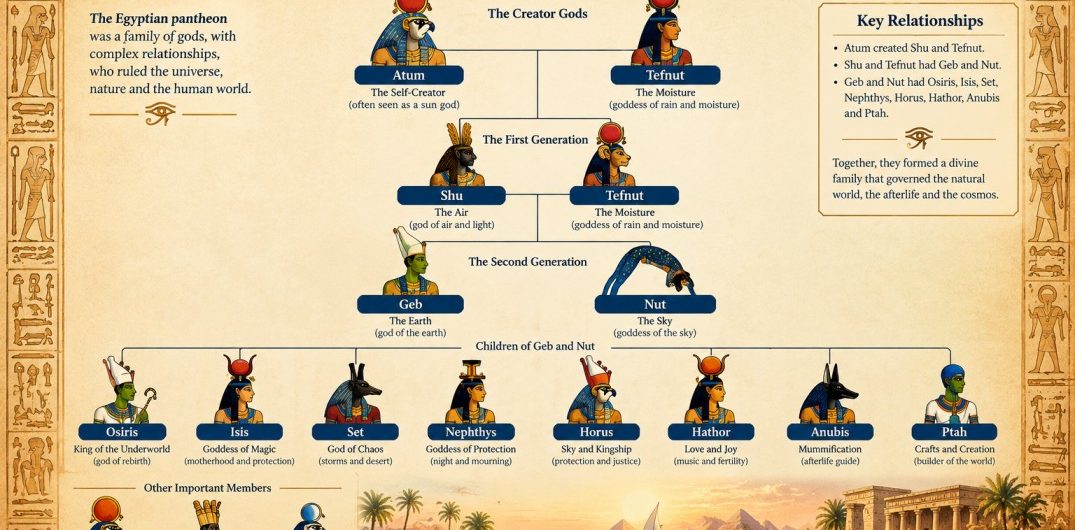
The Egyptian gods family tree is one of the most fascinating ways to understand ancient Egypt. It is not simply a list of gods. It is a web of creation myths, royal symbolism, natural forces, and moral ideas. The gods of Egypt were connected through families, battles, marriages, births, deaths, and resurrections. Through these relationships, the ancient Egyptians explained the sun, the Nile, fertility, death, kingship, chaos, justice, and the promise of eternal life.
If you are visiting Egypt, walking through Karnak Temple, entering the Valley of the Kings, or studying artifacts in the Egyptian Museum, the gods appear everywhere. Osiris stands as lord of the afterlife. Isis stretches her wings in protection. Horus watches as the rightful king. Ra travels across the sky. Thoth records the words of creation. Anubis guides the dead. To understand them is to understand Egypt itself.
However, the Egyptian gods family tree is not as simple as a modern chart. Ancient Egypt lasted for thousands of years, and different cities developed different creation myths. Heliopolis honored Ra and the Ennead. Memphis honored Ptah. Thebes honored Amun, Mut, and Khonsu. Hermopolis honored the Ogdoad of primordial forces. These traditions did not replace one another completely. They overlapped, merged, and adapted. A god could be a creator, a son, a husband, a protector, a judge, or a solar manifestation depending on the period, location, and religious text.
This guide explains the main branches of the Egyptian gods family tree, the most important divine relationships, the major gods and goddesses, where to see them in Egypt today, and how to understand their symbolism without oversimplifying. Whether you are planning a trip through Cairo, Luxor, Aswan, Saqqara, or Giza, this article will help you read Egyptian temples, tombs, statues, reliefs, and museum objects with greater clarity.
The Egyptian gods family tree is not a single chart. It is a living map of myths, cities, kingship, nature, and the ancient Egyptian search for meaning.
Quick Answer: What Is the Egyptian Gods Family Tree?
The Egyptian gods family tree is the network of relationships among ancient Egyptian deities, especially in the Heliopolitan creation myth. At the center are Atum or Ra, followed by Shu and Tefnut, then Geb and Nut, and then their children Osiris, Isis, Set, and Nephthys. Horus, son of Osiris and Isis, becomes the divine model of kingship. Other major gods, such as Thoth, Ptah, Amun, Hathor, Sekhmet, Bastet, Anubis, Ma’at, and Khonsu, connect to this tree through regional myths, solar theology, funerary belief, and royal symbolism. Because Egyptian religion changed over time, the family tree has multiple versions depending on the city, period, and myth being told.
Why the Egyptian Gods Family Tree Is Complicated
The first thing to understand is that ancient Egypt did not have one single religious system in the way modern readers might expect. Egyptian religion was local, royal, funerary, solar, magical, and temple-centered all at once. Different cities claimed different creators. Different dynasties promoted different gods. Different texts gave different versions of the same myth.
For example, Ra was the great sun god, but Atum was also a creator deity associated with the completed sun. In some traditions, Ra and Atum merge as Ra-Atum. In Thebes, Amun became supreme and merged with Ra as Amun-Ra. In Memphis, Ptah was the creator who brought the world into being through thought and speech. In Hermopolis, eight primordial gods and goddesses represented the chaotic waters before creation.
This is why the Egyptian gods family tree should be studied as a collection of overlapping mythologies, not one rigid genealogy. The most famous branch is the Heliopolitan Ennead, but it is only one path into the wider divine world.
The Heliopolitan Ennead: The Main Egyptian Gods Family Tree
The Heliopolitan Ennead is the most important family tree for understanding Egyptian mythology. Heliopolis, known in ancient Egypt as Iunu, was a major solar cult center near modern Cairo. Its creation myth describes how the world emerged from primordial waters through a sequence of divine generations.
| Generation | Deities | Meaning |
|---|---|---|
| First | Atum / Ra | The self-created god, the sun, the beginning of existence. |
| Second | Shu and Tefnut | Air and moisture, the first division of creation. |
| Third | Geb and Nut | Earth and sky, the physical world beneath the stars. |
| Fourth | Osiris, Isis, Set, Nephthys | Kingship, magic, chaos, mourning, and the central divine drama. |
| Fifth | Horus | Son of Osiris and Isis, avenger of his father, model of the living pharaoh. |
This structure is often called the Ennead because it includes nine major divine figures in some versions. The exact list can vary, but the core story is powerful: creation begins with one god, divides into opposites, produces earth and sky, and then enters a drama of murder, mourning, magic, revenge, and rightful rule.
Atum and Ra: The Creator and the Sun
Atum is one of the oldest creator gods in Egyptian religion. In the Heliopolitan myth, he appears on the primordial mound after the waters of chaos recede. He is complete in himself and brings forth the first generation of gods. Because of this, Atum is sometimes associated with the setting sun, the completed day, and the god who contains all potential.
Ra is the great solar deity, visible in the daily movement of the sun across the sky. Over time, Ra became central to Egyptian kingship, creation, and cosmic order. In many texts, Atum and Ra merge as Ra-Atum, representing the sun as both creator and ruler.
For travelers, Ra appears in temple reliefs, solar barques, obelisks, tomb paintings, and royal names. The connection between the pharaoh and Ra is essential: the king was often called the son of Ra, and his rule reflected the sun’s order, light, and victory over darkness.
Shu and Tefnut: Air and Moisture
Shu is the god of air, light, and the space between earth and sky. Tefnut is the goddess of moisture, rain, and dew. Together they represent the first differentiation within creation. The world is no longer only potential; it now has breath, separation, clarity, and life-sustaining water.
In myth, Shu is often shown holding up Nut above Geb, separating earth from sky. This image is one of the most recognizable in Egyptian art. It explains the physical structure of the cosmos: the earth below, the stars above, and the air between them.
Shu and Tefnut also appear in stories about divine return and restoration. In some myths, Tefnut wanders away and is brought back, restoring balance. These stories reflect the Egyptian concern with order, return, healing, and the stability of the world.
Geb and Nut: Earth and Sky
Geb is the earth god. Nut is the sky goddess. Their union produces the next generation of deities, including Osiris, Isis, Set, and Nephthys. In Egyptian art, Nut is often shown as a star-covered woman arching over Geb, while Shu separates them.
Nut is closely connected to daily and cosmic renewal. She swallows the sun in the evening and gives birth to him again in the morning. This makes her a powerful symbol of the cycle of death and rebirth. In funerary contexts, Nut can appear as a protective figure who receives the deceased and promises renewal.
Geb represents the fertile earth, the ground of existence, and sometimes the laughter or vibration of the world. His connection to the pharaoh is also important: the king rules over the land, and the land is divine.
Osiris: Lord of the Afterlife
Osiris is one of the most important gods in the Egyptian family tree. He is the son of Geb and Nut, the brother and husband of Isis, and the father of Horus. In myth, he becomes the first divine king, only to be murdered by his brother Set.
After his death, Isis gathers his body, performs magical rites, and restores him sufficiently for him to become lord of the underworld. Osiris is therefore not only a dead god. He is the god of resurrection, judgment, fertility, and eternal life.
In art, Osiris is often shown as a mummified king holding the crook and flail, symbols of royal authority. His green or black skin can represent regeneration, vegetation, and the fertile soil of the Nile. The myth of Osiris gave Egyptians hope that death was not the end.
You can encounter Osiris in tomb scenes, Book of the Dead papyri, temple reliefs, and funerary chapels. The Valley of the Kings is especially rich in Osirian imagery because royal burial was connected to resurrection.
Isis: Magic, Motherhood, and Divine Protection
Isis is one of the most beloved and powerful goddesses of ancient Egypt. She is the daughter of Geb and Nut, sister and wife of Osiris, mother of Horus, and sister of Set and Nephthys. Her name is connected with throne, kingship, and divine authority.
Isis is famous for her devotion to Osiris. After his murder, she searches for his body, protects her son Horus, and uses magic to restore her husband. She becomes the ideal of loyal wife, powerful mother, healer, and magician.
In art, Isis is often shown with a throne hieroglyph on her head, wings outstretched in protection, or nursing the infant Horus. Her image influenced later mother-and-child iconography across the Mediterranean world. At Philae Temple, Isis is central, worshipped as a great goddess of healing, kingship, and cosmic care.
Set: Chaos, Storm, and Necessary Conflict
Set is one of the most misunderstood gods in the Egyptian family tree. He is the brother of Osiris, Isis, and Nephthys, and the murderer of Osiris in the central myth. But Set was not simply evil. He also represented storm, desert, foreign lands, disorder, strength, and the necessary opposition that makes order meaningful.
In earlier periods, Set could be protective. He defended Ra’s solar barque against the serpent Apophis during the night journey. Later, especially after the Hyksos period and under changing political religious views, Set became more strongly associated with chaos and tyranny.
Set is often depicted with a mysterious animal head, sometimes called the Set animal. His role in the family tree is crucial: he disrupts kingship, but his conflict with Horus establishes the legitimacy of rightful rule. Without Set, the myth of Osiris and Horus would lose its dramatic tension.
Nephthys: Mourning, Protection, and Hidden Strength
Nephthys is the sister of Isis, Osiris, and Set. Her name means “Lady of the House” or “Mistress of the Temple.” She is often associated with mourning, protection, and the rituals surrounding death.
In the Osiris myth, Nephthys helps Isis mourn and protect the dead king. She is sometimes linked with Anubis, who is described in some traditions as her son, though parentage varies by text and period. Nephthys is not as prominent as Isis, but she is essential to the emotional and funerary side of the family tree.
Together, Isis and Nephthys often appear as the two kites or professional mourners, protecting Osiris and guiding the deceased through grief and transformation.
Horus: The Living King and Avenger of Osiris
Horus is the son of Isis and Osiris and one of the most important gods in Egyptian religion. He is the divine model of the pharaoh. While Osiris rules the afterlife, Horus rules the living world. Every king was understood as a manifestation of Horus during his reign.
The central myth of Horus is his struggle with Set to avenge his father and reclaim the throne. This conflict is long, complex, and full of magical contests, injuries, judgments, and restoration. Horus loses an eye in some versions, which is later healed, connecting him to the Eye of Horus symbol of protection, healing, and wholeness.
Horus appears as a falcon, a man with a falcon head, or a child suckled by Isis. The falcon form connects him to sky, kingship, vision, and power. At temples such as Luxor Temple and Edfu, Horus is central to royal ritual and divine legitimacy.
Anubis: Guide of the Dead and Master of Embalming
Anubis is the jackal-headed god of mummification, cemeteries, protection, and the afterlife journey. His parentage is complicated. In some traditions he is the son of Nephthys and Osiris, or Nephthys and Set, while in later periods he is closely associated with Osiris as a helper in the underworld.
Anubis is often shown overseeing the embalming process, protecting the corpse, and guiding the deceased. In the weighing of the heart scene, he weighs the heart of the dead against the feather of Ma’at. This makes him a crucial figure in funerary belief.
Although Osiris later becomes more prominent as lord of the underworld, Anubis remains essential as the guardian of transition, ritual purity, and the threshold between life and death.
Ma’at: Truth, Justice, and Cosmic Order
Ma’at is both a goddess and a concept. She represents truth, justice, balance, harmony, law, and the proper order of the universe. She is often shown as a woman wearing an ostrich feather, or simply as the feather itself.
In the afterlife, the heart of the deceased is weighed against the feather of Ma’at. If the heart is balanced, the person has lived rightly. If it is heavy with falsehood or wrongdoing, the soul faces destruction. This image reveals how moral Egyptian religion was: eternal life depended on truth and justice.
Ma’at is also connected to kingship. The pharaoh’s duty was to maintain Ma’at on earth, defeat chaos, uphold justice, and keep the cosmos in balance. She is sometimes described as the daughter of Ra, linking moral order to solar order.
Thoth: Wisdom, Writing, and Divine Measurement
Thoth is the ibis-headed god of wisdom, writing, knowledge, magic, science, and judgment. He is the scribe of the gods and the recorder of truth. In the weighing of the heart scene, Thoth records the outcome of the deceased’s judgment.
Thoth is also connected to the moon, measurement, time, and healing. He helps maintain cosmic balance and is sometimes associated with Ma’at as a divine advocate of order. In myth, he assists Isis and Horus, heals the wounded Eye of Horus, and serves as a mediator in disputes.
For travelers, Thoth appears in temple reliefs, funerary papyri, scribal palettes, and museum objects connected to writing and magic. He represents the Egyptian love of knowledge, precision, and the power of the spoken and written word.
Ptah: The Memphite Creator God
Ptah is one of the oldest creator gods in Egypt and the patron deity of Memphis. Unlike the Heliopolitan myth, which emphasizes physical generation, the Memphite theology presents Ptah as a creator who brings the world into being through thought and speech. His heart conceives, and his tongue commands.
Ptah is often shown as a mummified figure holding a scepter combining elements of stability, power, and dominion. He is connected with craftsmen, architects, builders, and artisans. The famous Shabaka Stone preserves important Memphite theological ideas.
If you visit the Ancient City of Memphis, Ptah becomes especially meaningful. Memphis was a political and religious center, and Ptah helped explain creation through intellect and language rather than only through physical birth.
Amun, Mut, and Khonsu: The Theban Divine Family
Thebes, modern Luxor, developed its own powerful divine family. Amun became the supreme god of the Theban pantheon, especially during the New Kingdom. His name means “the hidden one,” and he was associated with air, invisibility, kingship, and cosmic power.
Amun merged with Ra as Amun-Ra, combining hidden power with solar visibility. Mut, his consort, was a lioness goddess of motherhood, protection, and royal authority. Khonsu, their son, was a moon god connected with time, healing, and travel. The Theban triad appears prominently at Karnak Temple, one of the largest religious complexes in the ancient world.
The Theban family tree shows how Egyptian religion could be local and national at the same time. Amun was a Theban god who became a state god, while still retaining connections to older solar and creator traditions.
Hathor, Sekhmet, Bastet, and the Powerful Goddesses
Egyptian goddesses were not minor figures. They held immense power as mothers, healers, destroyers, protectors, musicians, lovers, and solar beings. Several major goddesses connect to Ra as his daughters or as manifestations of his Eye.
Hathor
Hathor is the goddess of love, beauty, music, dance, motherhood, joy, and foreign lands. She is often shown as a woman with cow horns and a sun disk, or as a full cow. She can be a nurturing mother, a joyful dancer, and a protective deity. In some myths, she becomes the Eye of Ra sent to punish humanity, then is pacified and restored as Hathor.
Sekhmet
Sekhmet is the lioness goddess of war, plague, healing, and fierce divine power. She is often described as the Eye of Ra, unleashed as a destructive force against Egypt’s enemies. Despite her violence, she was also associated with medicine and protection, showing that Egyptian divinity could heal through the same power that destroys.
Bastet
Bastet is the cat goddess of home, fertility, protection, music, and gentle care. In earlier forms she could also be lioness-like, connected to defense and power. As a domestic cat, she guards the household. As a fierce protector, she defends the sun and the king from danger.
These goddesses reveal a major theme in the Egyptian gods family tree: divine power is not only male or royal. Feminine deities create, protect, destroy, heal, and restore balance.
Sobek, Montu, Min, Bes, and Other Important Egyptian Gods
Beyond the main family tree, many other gods played essential roles in Egyptian religion. They may not always fit neatly into one genealogy, but they connect to creation, kingship, fertility, protection, and the forces of nature.
Sobek
Sobek is the crocodile god of the Nile, military power, fertility, and protective danger. He could be dangerous and creative at the same time. In some traditions, he is connected with creation and even associated with Horus or Ra. Temples such as Kom Ombo show Sobek alongside other major deities.
Montu
Montu is a falcon-headed war god associated with Thebes and royal military strength. He represents the ferocity of the king in battle and the protective violence needed to defeat chaos.
Min
Min is a god of fertility, vegetation, desert routes, and royal renewal. He appears in jubilee festivals connected with the king’s strength and the land’s productivity.
Bes and Taweret
Bes and Taweret are protective household deities. Bes, a dwarf-like god, guards homes, childbirth, and sleep. Taweret, a pregnant hippopotamus goddess, protects women in labor and children. They show that Egyptian religion was not only temple-centered. It was also domestic, magical, and personal.
The Role of the Pharaoh in the Egyptian Gods Family Tree
The pharaoh is one of the most important links between the gods and the human world. He was not merely a political ruler. He was a divine figure, the son of Ra, the living Horus, and the maintainer of Ma’at.
During life, the king was Horus. After death, he became associated with Osiris. This dual identity is central to Egyptian royal ideology. The living king protects order, builds temples, offers to the gods, and defeats chaos. The dead king joins Osiris in resurrection and continues to watch over Egypt.
This is why temples and tombs are full of royal-religious imagery. The king appears offering incense, smiting enemies, being embraced by gods, and receiving the Ankh. The Egyptian gods family tree is therefore not only myth. It is also political theology.
Where to See the Egyptian Gods Family Tree in Egypt
If you want to understand the gods in person, Egypt offers temples, tombs, museums, and sacred landscapes where divine families appear in stone and paint. The best visits combine close museum study with on-site atmosphere.
1. Karnak Temple, Luxor
Karnak is one of the best places to understand the Theban triad: Amun, Mut, and Khonsu. The temple complex also contains solar, royal, and creation imagery connected to Ra and kingship. Its columns, reliefs, sacred lakes, and processional spaces make the divine family feel present.
2. Luxor Temple
Luxor Temple is strongly connected to royal ideology and the divine birth of the king. Reliefs show Amun, Mut, Khonsu, Thoth, and other deities participating in rituals that affirm the pharaoh’s legitimacy.
3. Valley of the Kings
The Valley of the Kings is essential for funerary gods. Osiris, Anubis, Horus, Isis, Thoth, Ma’at, and solar deities appear in tomb scenes describing the journey through the underworld and the hope of resurrection.
4. Philae Temple, Aswan
Philae is one of the most important sites for Isis. The temple’s setting on the Nile, its later Ptolemaic and Roman-period reliefs, and its strong connection to Isis make it a powerful place to understand feminine divine protection and magic.
5. Abu Simbel
The Temples of Abu Simbel express Ramesses II’s divine kingship and solar connection. The Great Temple is associated with Ra-Horakhty, Amun, Ptah, and the deified king. The smaller temple honors Nefertari and Hathor.
6. Giza Plateau
The Giza Pyramids Complex is connected to solar resurrection, royal ascent, and the Great Sphinx of Giza. While not a temple of the full Ennead in the same way as Karnak, Giza embodies the theological world of Ra, kingship, and afterlife transformation.
7. Saqqara and Memphis
Saqqara, with the Step Pyramid of Zoser, and Memphis, with Ptah-related traditions, help explain the older Memphite religious landscape. These sites are especially useful for understanding creation, royal burial, and the beginnings of monumental theology.
8. Egyptian Museum and Grand Egyptian Museum
Museums allow close study of divine statues, amulets, papyri, reliefs, and ritual objects. The Egyptian Museum and Grand Egyptian Museum are ideal for identifying gods by attributes: crowns, animals, scepters, disks, feathers, and symbolic gestures.
How to Identify Egyptian Gods in Temples and Museums
Egyptian gods are often identified by visual clues rather than written names alone. Learning a few key attributes can make your visit much more rewarding.
| God | Common Form | Key Attributes |
|---|---|---|
| Ra | Man with falcon head and sun disk | Sun disk, uraeus, solar barque, falcon form |
| Osiris | Mummified king | Crook, flail, white crown, green or black skin |
| Isis | Woman with throne sign or cow horns | Throne hieroglyph, wings, nursing Horus, sun disk |
| Horus | Falcon or man with falcon head | Double crown, Eye of Horus, smiting pose, child form |
| Set | Man with Set animal head | Long ears, curved snout, storm imagery, desert power |
| Anubis | Jackal or man with jackal head | Embalming, scales, cemetery protection, guiding the dead |
| Thoth | Ibis or man with ibis head | Writing palette, moon disk, scribe role, judgment recording |
| Hathor | Woman with cow horns or cow form | Sun disk, sistrum, menat necklace, music, motherhood |
| Sekhmet | Lioness or woman with lion head | Sun disk, war power, healing, destructive Eye of Ra |
| Bastet | Cat or woman with cat head | Home protection, music, gentle and fierce forms |
| Ptah | Mummified man | Composite scepter, craftsman patron, Memphite creator |
| Amun | Man with double plumed crown | Hidden power, kingship, Theban supremacy, Amun-Ra |
Egyptian Gods Family Tree and Symbols
The gods are closely connected to the wider world of symbols of ancient Egypt. The Ankh represents life, often held by gods. The Eye of Horus represents protection and healing. The scarab represents rebirth and connects to Khepri, the morning sun. The Djed pillar represents stability and Osirian resurrection. The feather of Ma’at represents truth and judgment.
Understanding symbols helps you understand relationships. For example, when Isis holds the Ankh, she is offering life. When Horus is shown with the Eye, he is connected to restoration and kingship. When Osiris holds the crook and flail, he is both king and resurrected lord. When Ma’at’s feather appears in a tomb, the scene is about moral judgment and eternal balance.
For readers especially interested in the scarab, our guide to scarab beetle meaning explains how one small insect image became a powerful symbol of creation, transformation, and resurrection within the Egyptian divine world.
How to Include Egyptian Gods in Your Egypt Itinerary
If you want to visit Egypt with the gods family tree in mind, plan around museums, temples, and tombs rather than only famous monuments. A good religious itinerary allows you to see the gods in context: as creators, protectors, judges, parents, warriors, healers, and resurrection figures.
Cairo Religious Start
Begin in Cairo with the Egyptian Museum or Grand Egyptian Museum. Ask your guide to identify major gods by crown, animal form, and attribute. This prepares you to recognize them in temples later.
Giza and Saqqara Solar Route
Visit the Giza Plateau to understand solar kingship and resurrection. Then continue to Saqqara and Memphis to explore early pyramid theology and Memphite creation ideas. For a combined route, see our day tour to Memphis and Saqqara.
Luxor Theban Family Route
Luxor is essential for Amun, Mut, Khonsu, Horus, Osiris, and royal divine birth scenes. Karnak Temple and Luxor Temple should be visited with a guide who can explain the Theban triad and the king’s relationship to the gods.
Aswan and Philae Isis Route
Aswan offers a strong focus on Isis, especially at Philae Temple. The Nile setting also helps you understand why the river, fertility, protection, and divine femininity were spiritually connected.
For broader planning, see our Egypt itinerary guide, 7 days in Egypt itinerary, and 10 day Egypt itinerary.
Common Mistakes When Understanding the Egyptian Gods Family Tree
One common mistake is assuming there is only one version of the family tree. Egyptian mythology changed by city, period, and religious text. A god may be a son in one tradition, a husband in another, a creator in another, and a protective spirit in another.
Another mistake is judging gods by modern moral categories. Set is not simply “the devil.” He is chaos, storm, foreignness, violence, and necessary opposition. Sekhmet is not only destructive. She also heals. The Egyptian divine world contains paradox.
Travelers also sometimes confuse animal gods with literal animals. The animal form is symbolic. A falcon represents speed, vision, sky, and kingship. A jackal represents cemeteries, protection, and embalming. A crocodile represents the dangerous creative power of the Nile.
Finally, many visitors rush through temples without noticing repeated divine figures. A guide can help you slow down and recognize how the gods appear in ritual scenes, royal names, ceiling astronomy, and funerary texts.
Practical Tips for Visiting Egyptian Religious Sites
- Visit major temples early in the morning to avoid heat and crowds.
- Hire a licensed guide who can explain mythology, not only dates and names.
- Carry water, sunscreen, a hat, and comfortable shoes.
- Take photos of key reliefs, but do not touch fragile surfaces.
- Read a short overview of Osiris, Isis, Horus, Ra, and Amun before arrival.
- Combine museum visits with temple visits for better recognition.
- If you have limited time, prioritize Karnak, Luxor Temple, Valley of the Kings, Philae, and one major Cairo museum.
- For family travel, focus on stories: Osiris and Isis, Horus and Set, the weighing of the heart.
For broader preparation, see our guides to Egypt travel tips and whether it is safe to travel to Egypt.
Frequently Asked Questions About the Egyptian Gods Family Tree
Who is the most important god in the Egyptian family tree?
There is no single most important god for all periods. Ra was central as the sun god and creator. Osiris was essential for the afterlife. Horus was central to kingship. Amun became supreme in Theban and New Kingdom theology. Ptah was crucial in Memphite creation belief. The “most important” god depends on the myth, city, and historical period.
Who are the children of Geb and Nut?
In the Heliopolitan tradition, Geb and Nut are the parents of Osiris, Isis, Set, and Nephthys. These four deities form the emotional center of Egyptian myth: kingship, magic, chaos, mourning, resurrection, and rightful rule.
Who is the son of Osiris and Isis?
Horus is the son of Osiris and Isis. He avenges his father, fights Set, and becomes the divine model of the living pharaoh. His birth and rise are central to Egyptian royal ideology.
Why is Set important if he kills Osiris?
Set is important because he represents chaos, opposition, storm, desert power, and the conflict that makes order meaningful. His murder of Osiris drives the central myth, and his struggle with Horus establishes rightful kingship. Set was also protective in some contexts, especially as defender of Ra against Apophis.
Who is Anubis in the Egyptian family tree?
Anubis is the jackal-headed god of embalming, cemeteries, protection, and the afterlife journey. His parentage varies by tradition. He is often connected with Nephthys and Osiris or Set, but in funerary belief he serves as a guardian of the dead and helper in judgment scenes.
What is the difference between Ra, Amun, and Amun-Ra?
Ra is the sun god, visible in the sky. Amun is the hidden god, central to Theban theology. Amun-Ra is the merged form combining hidden power with solar visibility. This merging shows how Egyptian religion could unite different theological traditions.
Who is Ptah and why is he important?
Ptah is the Memphite creator god associated with craftsmen, architects, and intellectual creation. In Memphite theology, he creates through heart and tongue, meaning thought and speech. He is especially important for understanding the religious landscape of Memphis and early Egyptian statecraft.
Are the Egyptian gods a family?
Yes, many Egyptian gods are presented as a family, especially in the Heliopolitan Ennead. But the family tree is not fixed. Gods merge, separate, adopt new roles, and appear differently depending on region, period, and religious text.
Where can I see the Egyptian gods family tree in Egypt?
You can see major divine figures at Karnak Temple, Luxor Temple, Philae Temple, Abu Simbel, the Valley of the Kings, Saqqara, Memphis, the Egyptian Museum, and the Grand Egyptian Museum. Museums are best for close identification, while temples and tombs show the gods in ritual and funerary context.
Do I need a guide to understand the Egyptian gods?
A guide is not mandatory, but it is highly recommended. Egyptian gods appear in repeated but subtle forms. A knowledgeable guide can help you identify deities by attributes, explain regional myths, and connect temple scenes to royal and funerary belief.
Related Words and Topics Around the Egyptian Gods Family Tree
If you are researching the Egyptian gods family tree, you may also be searching for terms such as ancient Egyptian gods family tree, Egyptian god family tree, Egyptian mythology family tree, list of Egyptian gods and goddesses, Heliopolitan Ennead, Osiris Isis Horus Set, Ra Atum Shu Tefnut Geb Nut, Ptah creation myth, Amun Mut Khonsu, Egyptian gods relationships, Egyptian gods explained, Egyptian gods symbols, and where to see Egyptian gods in temples and museums. These topics all connect to the same goal: understanding how the ancient Egyptians organized the divine world.
- Egyptian Gods Family Tree for the main guide
- Symbols of Ancient Egypt for divine symbols and meanings
- Scarab Beetle Meaning for Khepri and rebirth symbolism
- Karnak Temple for the Theban gods
- Luxor Temple for royal divine imagery
- Temple of Philae for Isis worship
- Valley of the Kings for afterlife gods
- Temples of Abu Simbel for Ramesses II and divine kingship
- Egyptian Museum for close study of divine artifacts
- Grand Egyptian Museum for modern museum context
- Giza Pyramids Complex for solar and royal resurrection
- Ancient City of Memphis for Ptah and Memphite theology
- Egypt itinerary guide for planning a religious and cultural trip
- Top museums in Egypt for museum-focused visits
Final Thoughts: Why the Egyptian Gods Family Tree Still Matters
The Egyptian gods family tree matters because it is not only mythology. It is a way of explaining existence. Through the gods, ancient Egypt described the sun, the earth, the sky, the Nile, death, justice, motherhood, kingship, chaos, healing, and resurrection. The gods were not distant abstractions. They were present in temples, amulets, royal names, tomb walls, festivals, and daily prayers.
When you visit Egypt with this knowledge, the country becomes deeper. A relief is no longer just a carving. A statue is no longer just a figure. A tomb is no longer just a burial chamber. You begin to see a world where every deity has a role, every relationship has meaning, and every symbol points toward eternal order.
You do not need to memorize every god to enjoy Egypt. But understanding the main branches of the family tree can transform your visit. It helps you slow down, ask better questions, and recognize that ancient Egypt was not only a civilization of stone monuments. It was a civilization of stories, beliefs, and divine relationships that still speak across thousands of years.
The Egyptian gods family tree endures because it turns the universe into a story: creation, conflict, mourning, magic, justice, and rebirth.
Ready to Explore the Egyptian Gods in Person?
Let Egypt Via Travel help you plan a meaningful journey through Egypt’s temples, tombs, museums, and sacred landscapes, with private guides and itineraries designed to help you understand the Egyptian gods family tree in its original historical and spiritual context.