
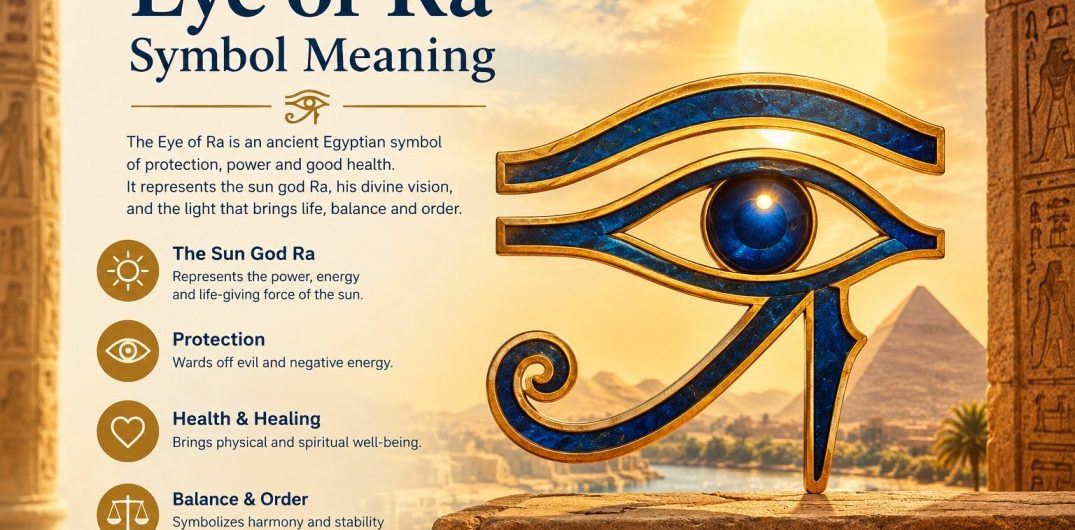
The Eye of Ra symbol meaning is one of the most powerful and misunderstood topics in ancient Egyptian religion. To modern travelers, the Eye of Ra may look like a simple eye motif repeated on jewelry, tattoos, museum objects, and souvenirs. But in ancient Egypt, it was far more than decoration. It represented the active, radiant, sometimes dangerous power of the sun god Ra. It was the eye that sees, protects, punishes, heals, and maintains cosmic order.
The Eye of Ra is often confused with the Eye of Horus, and the two symbols can appear visually similar. However, their meanings are not identical. The Eye of Horus is strongly connected to protection, healing, restoration, and royal legitimacy through the myth of Horus. The Eye of Ra is connected to solar power, divine vengeance, creative force, and the fierce energy of the sun. One is often gentle and restorative; the other is radiant, commanding, and sometimes destructive.
If you are visiting Egypt and walking through Karnak Temple, studying artifacts in the Egyptian Museum, or exploring the Grand Egyptian Museum, the Eye of Ra becomes part of a wider sacred language. It appears in solar theology, temple reliefs, royal iconography, funerary scenes, and divine myths. Understanding it helps you read ancient Egypt with more depth, especially when you encounter goddesses such as Sekhmet, Hathor, Bastet, Wadjet, and Mut.
This guide explains the Eye of Ra symbol meaning, its connection to Ra and the solar cycle, its relationship to the Eye of Horus, its role in protection and punishment, where to see authentic examples in Egypt, and how to include this symbolism in a wider Egypt itinerary. Whether you are a first-time visitor, a history lover, a traveler interested in Egyptian gods, or someone drawn to ancient symbols, this article will help you understand why the Eye of Ra remains one of Egypt’s most compelling images.
The Eye of Ra is not only a symbol of sight. It is the sun’s gaze: creative, protective, judging, and sometimes terrifying.
Quick Answer: What Does the Eye of Ra Mean?
The Eye of Ra symbol meaning is connected to the active power of the sun god Ra. It represents divine sight, solar energy, protection, punishment, healing, and cosmic order. In Egyptian mythology, the Eye of Ra could be sent out as a force of destruction against enemies of the gods, but it could also return healed, restored, and peaceful. The Eye of Ra is often associated with fierce goddesses such as Sekhmet, Hathor, Bastet, and Tefnut. It differs from the Eye of Horus, which is more closely linked to protection, healing, and royal restoration through the myth of Horus.
Why the Eye of Ra Matters in Ancient Egypt
The Eye of Ra matters because it reveals how the ancient Egyptians understood divine power. Ra was not only the sun in the sky. He was creator, king, judge, traveler, and life-giver. His eye was the extension of his will. It could see everything, reach into the world, defend the cosmos, and punish disorder.
In Egyptian religion, the sun was not a passive object. It was a living force. Each morning it was reborn, each day it crossed the sky, and each night it traveled through the underworld. The Eye of Ra helped explain this dynamic power. It was the part of Ra that acted in the world, especially when Ra needed to defend order, defeat chaos, or restore balance.
For travelers, the Eye of Ra is important because it appears across many contexts. You may encounter it in temple reliefs, royal crowns, goddess imagery, funerary texts, amulets, and museum objects. It connects to major Egyptian themes: kingship, solar worship, divine femininity, protection, vengeance, healing, and the eternal struggle between order and chaos.
What Is Ra? The Sun God Behind the Eye
Ra was one of the most important gods in ancient Egypt. He was the sun god, creator, and divine king. In many traditions, Ra was believed to travel across the sky by day in a solar barque and through the underworld by night. His journey represented the cycle of life, death, and rebirth.
Ra was also connected to kingship. The pharaoh was often called the son of Ra, and royal power was understood as an earthly reflection of solar authority. When you see Ra in temple scenes, he may appear as a man with a falcon head and a sun disk, or as a solar barque moving through celestial spaces.
The Eye of Ra belongs to this solar world. It is not separate from Ra; it is one of his powers. In myth, the eye can be personified as a goddess, sent away, angered, healed, or returned. This makes the Eye of Ra both an object and a divine being.
Eye of Ra vs. Eye of Horus: What Is the Difference?
One of the most common questions is the difference between the Eye of Ra and the Eye of Horus. Both are ancient Egyptian eye symbols, and both can represent protection. However, their mythological roots and emotional tones are different.
| Feature | Eye of Ra | Eye of Horus |
|---|---|---|
| Main deity connection | Ra, the sun god | Horus, the falcon god of kingship |
| Core meaning | Solar power, divine punishment, protection through force | Protection, healing, restoration, royal legitimacy |
| Mythological tone | Fierce, radiant, sometimes destructive | Healing, avenging, restoring order |
| Associated figures | Sekhmet, Hathor, Bastet, Tefnut, Wadjet | Horus, Isis, protective amulets, royal scenes |
| Common context | Solar theology, temple reliefs, goddess myths | Amulets, jewelry, healing, funerary protection |
The Eye of Horus is often associated with the wounded and restored eye of Horus after his conflict with Set. It became a symbol of healing, wholeness, and magical protection. The Eye of Ra, by contrast, is the eye that goes out with force. It can punish, defend, and reveal divine anger. It is not always gentle, but it is always powerful.
The Myth of the Eye of Ra
The Eye of Ra appears in several myths, but one of the most famous is the story of the distant goddess. In this myth, Ra sends his eye away, often in the form of a fierce goddess such as Hathor or Sekhmet. The eye becomes angry, destructive, or independent. She may attack humanity or enemies of the gods with terrible force.
Eventually, Ra needs to bring her back. In some versions, he tricks or soothes her, often using beer dyed red to resemble blood, calming her fury. Afterward, she is restored as a gentler form, such as Hathor. This myth explains how destructive solar power can be transformed into protective, nourishing divinity.
The story is important because it shows that the Eye of Ra is not merely a static emblem. It has will, emotion, and movement. It can leave Ra, act on its own, become dangerous, and then return to serve cosmic order. This dynamic quality makes the Eye of Ra one of the most psychologically rich symbols in Egyptian mythology.
Main Meanings of the Eye of Ra
The Eye of Ra has several layers of meaning. Its interpretation depends on context, material, placement, and the deity involved. Below are the main symbolic meanings associated with the Eye of Ra.
| Meaning | Explanation | Where It Appears |
|---|---|---|
| Solar power | The eye represents the visible force of the sun, illuminating and sustaining the world. | Temple reliefs, solar barque scenes, royal iconography |
| Divine protection | It guards Ra, the king, temples, and sacred space from chaos and enemies. | Crowns, amulets, temple entrances, goddess imagery |
| Punishment and vengeance | The Eye of Ra can be sent to destroy the enemies of the gods or punish disorder. | Sekhmet myths, royal battle scenes, solar theology |
| Healing and restoration | After acting in fury, the eye can be calmed, healed, and returned to balance. | Hathor myths, temple rituals, magical contexts |
| Cosmic order | The eye helps maintain Ma’at by defeating chaos and defending the sun’s journey. | Underworld books, royal scenes, temple ceilings |
| Divine femininity | The Eye of Ra is often personified as a goddess with fierce and nurturing powers. | Sekhmet, Hathor, Bastet, Tefnut, Wadjet |
The Eye of Ra and the Goddesses
One of the most fascinating aspects of the Eye of Ra is its connection to goddesses. In Egyptian thought, the eye could become a female divine being. This does not mean the goddess is subordinate to Ra. Rather, she is an extension of his power, capable of acting independently and with tremendous force.
Sekhmet: The Fierce Eye
Sekhmet is one of the clearest manifestations of the Eye of Ra. She is a lioness goddess of war, plague, healing, and destructive power. In myth, she is sent by Ra to punish humanity, but her fury becomes difficult to control. She is both terrifying and protective, embodying the sun’s ability to destroy and to defend.
Sekhmet also has a healing side. Because she could send disease, she could also cure it. This paradox is deeply Egyptian: the same divine force that harms can restore. If you visit temples or museums with Sekhmet statues, you are encountering the Eye of Ra in its fiercest form.
Hathor: The Restored Eye
Hathor is often connected to the pacified form of the Eye of Ra. After the destructive phase of the myth, the eye may return as Hathor, goddess of love, music, motherhood, joy, and nourishment. This transformation shows that the Eye of Ra is not only wrathful. It can also become gentle, pleasurable, and life-giving.
Hathor appears at sites such as Dendera and in many temple reliefs. Her imagery often includes cow horns, a sun disk, sistrum, and menat necklace. She represents the restored balance of solar power after fury has been calmed.
Bastet: The Protective Eye
Bastet, the cat goddess, can also be linked to the Eye of Ra. In her domestic form, she protects the home, childbirth, and daily life. In older or fiercer forms, she can be lioness-like and connected to solar defense. Bastet shows how the Eye of Ra can be both gentle and dangerous depending on context.
Tefnut and Wadjet
Tefnut, goddess of moisture, is sometimes associated with the Eye of Ra in Heliopolitan traditions. Wadjet, the cobra goddess of Lower Egypt and royal protection, also connects to solar and royal defense. These links show that the Eye of Ra is not limited to one goddess. It can appear through multiple divine feminine forms.
Eye of Ra in Kingship and Royal Power
The Eye of Ra is closely connected to the pharaoh. Because the king was associated with Ra, the eye became part of royal ideology. It protected the king, validated his rule, and symbolized his ability to defeat chaos.
On royal crowns, the uraeus cobra often appears as a protective eye-like force. In battle scenes, the king may be shown striking enemies while divine power watches over him. The Eye of Ra helps explain why royal violence could be sacred: the king was not acting alone. He was an instrument of solar order.
When visiting Luxor Temple or Karnak Temple, you may see scenes where the king offers to the gods, receives life from Ra, or is protected by divine figures. These scenes are part of the same solar and royal language as the Eye of Ra.
Eye of Ra in the Afterlife
The Eye of Ra also appears in funerary belief. The deceased hoped to join the solar cycle, travel with Ra through the day and night, and be restored like the sun each morning. In this context, the Eye of Ra could protect the soul during its journey through dangerous regions.
Tomb walls, coffins, papyri, and underworld books often show solar barques, gods, demons, and protective symbols. The Eye of Ra helps defend the sun against chaos, especially the serpent Apophis. For the deceased, this protection was spiritually significant: if Ra could be guarded, the soul could also be guided.
The Valley of the Kings is one of the best places to understand this solar-afterlife connection. Royal tombs contain scenes of the sun’s journey, judgment, resurrection, and divine protection. The Eye of Ra fits naturally into this world of eternal renewal.
Where to See the Eye of Ra in Egypt
If you want to understand the Eye of Ra in person, Egypt offers museums, temples, tombs, and royal monuments where solar symbolism is deeply present. The best approach is to combine museum study with on-site viewing.
1. Egyptian Museum in Cairo
The Egyptian Museum is an excellent place to study eye symbols, amulets, royal crowns, goddess statues, and funerary objects. A guide can help you distinguish the Eye of Ra from the Eye of Horus and explain the context of each object.
2. Grand Egyptian Museum
The Grand Egyptian Museum near Giza offers modern galleries and monumental artifacts connected to royal and solar power. It is especially useful before or after visiting the pyramids, because it helps you understand the theological world behind the monuments.
3. Karnak Temple
At Karnak Temple, solar theology is everywhere. Amun-Ra, royal ritual, divine birth scenes, and temple reliefs all connect to the broader world of the Eye of Ra. The temple’s scale makes the solar and royal symbolism feel immense.
4. Luxor Temple
Luxor Temple is strongly connected to kingship and divine legitimacy. Scenes of the king’s relationship with the gods help explain how the Eye of Ra supported royal authority. Evening visits can be especially atmospheric, with illumination highlighting reliefs and symbolic details.
5. Valley of the Kings
The Valley of the Kings is ideal for afterlife solar imagery. Tomb walls show Ra’s journey, protective deities, underworld gates, and resurrection scenes. The Eye of Ra becomes meaningful here as part of the soul’s protection and the sun’s victory over chaos.
6. Abu Simbel
The Temples of Abu Simbel are deeply connected to solar kingship. The famous sun alignment phenomenon links Ramesses II with Ra-Horakhty and solar renewal. This is one of the most dramatic ways to experience Egyptian solar symbolism in person.
7. Philae Temple
The Temple of Philae is dedicated to Isis, but it also helps visitors understand the wider world of Egyptian goddesses. Isis, Hathor, and other feminine deities connect to themes of protection, healing, and divine power that overlap with the Eye of Ra tradition.
8. Giza Plateau
The Giza Pyramids Complex and Great Sphinx of Giza are connected to solar resurrection, royal ascent, and guardian symbolism. While the Eye of Ra may not always be the most visible motif at Giza, the entire plateau belongs to the same solar-religious world.
How to Identify the Eye of Ra in Art and Temples
Identifying the Eye of Ra can be difficult because Egyptian eye symbols often overlap visually. The best method is to look at context rather than shape alone.
- Look for Ra: falcon head, sun disk, solar barque, or royal solar scenes.
- Look for fierce goddesses: Sekhmet, lioness forms, war imagery, or punishment scenes.
- Look for restoration scenes: Hathor, calming rituals, music, or nurturing imagery.
- Look for royal protection: crowns, uraeus cobras, battle scenes, or divine endorsement.
- Look for afterlife contexts: solar barques, underworld journeys, and judgment scenes.
A guide can be especially helpful because many symbols are small, repeated, or worn by time. In museums, labels and object context can clarify whether an eye motif belongs to Ra, Horus, or a protective amulet tradition.
Eye of Ra and Other Egyptian Symbols
The Eye of Ra does not exist in isolation. It is part of the wider system of symbols of ancient Egypt. It connects to the sun disk, the uraeus cobra, the scarab, the Ankh, the feather of Ma’at, and royal crowns.
For example, the scarab represents rebirth and connects to Khepri, the morning sun. The Eye of Ra represents the sun’s active power. Together, they form part of the solar cycle: creation, renewal, protection, and judgment. The Ankh represents life, while the Eye of Ra can defend the order that makes life possible.
If you are interested in how symbols interact, our guide to scarab beetle meaning and our guide to the Egyptian gods family tree can help you place the Eye of Ra within the larger Egyptian symbolic world.
Modern Meaning of the Eye of Ra
Today, the Eye of Ra is often used in jewelry, tattoos, spiritual design, and popular culture. Many people see it as a symbol of strength, awareness, protection, or feminine power. These modern interpretations can be meaningful, but they should not be confused with the full ancient context.
In ancient Egypt, the Eye of Ra was not simply a personal empowerment symbol. It belonged to a complex religious system involving the sun, kingship, chaos, judgment, and divine order. It could be fierce, dangerous, and judicial. Understanding this depth makes the modern symbol more interesting, not less.
If you are traveling to Egypt and see Eye of Ra souvenirs, you can appreciate them as modern echoes of an ancient idea. But remember that the original meaning was tied to temples, myths, royal ritual, and the eternal journey of the sun.
Buying Eye of Ra Souvenirs Responsibly
Many travelers want to bring home an Eye of Ra pendant, ring, statue, or print. This can be a beautiful souvenir, but it should be purchased responsibly. Authentic ancient artifacts should never be bought or exported illegally.
- Buy legal replicas, not authentic antiquities.
- Ask about materials: silver, brass, copper, faience, stone, resin, or glass.
- Compare prices before purchasing in tourist markets.
- Negotiate politely and avoid insulting sellers with unrealistic offers.
- Check jewelry quality, clasps, and stone settings.
- Remember that the Eye of Ra is a sacred symbol, not only a decorative motif.
A replica can be a meaningful reminder of your journey if bought ethically. It allows you to carry the symbolism home without harming Egypt’s archaeological heritage.
Common Mistakes When Understanding the Eye of Ra
One common mistake is assuming the Eye of Ra and Eye of Horus are the same. They are related in visual language, but their myths and meanings differ. The Eye of Ra is solar and often fierce; the Eye of Horus is royal, healing, and protective through the Horus myth.
Another mistake is thinking the Eye of Ra is always negative because of its destructive myths. In Egyptian religion, destruction can be sacred when it protects order. Sekhmet’s violence is not mindless cruelty; it is divine force used against chaos.
Some modern interpretations also exaggerate mystical meanings without historical support. The Eye of Ra is genuinely powerful in Egyptian religion, but it does not need fantasy to be fascinating. Its documented myths, goddess connections, and solar theology are already profound.
Finally, visitors sometimes rush through temples without noticing repeated eye motifs, solar disks, uraeus cobras, and goddess figures. Slowing down and asking a guide to explain context can make the difference between seeing decoration and reading sacred language.
How to Include the Eye of Ra in Your Egypt Itinerary
If you are planning a trip to Egypt and want to focus on symbols, the Eye of Ra is an excellent theme. It connects museums, temples, tombs, goddesses, kingship, and solar theology. You do not need to be an Egyptologist to enjoy it. You only need curiosity, a good guide, and enough time to look closely.
Cairo Symbol Day
Begin in Cairo with the Egyptian Museum or Grand Egyptian Museum. Ask your guide to point out eye motifs, solar imagery, goddess statues, and royal crowns. This gives you a visual vocabulary before visiting temples.
Giza Solar Route
Visit the Giza Plateau to understand solar resurrection and royal ascent. Then continue to Saqqara and Memphis to explore early pyramid theology and Memphite religious traditions. For a combined route, see our day tour to Memphis and Saqqara.
Luxor Temple and Karnak
In Luxor, focus on Karnak Temple and Luxor Temple. Look for solar barques, Amun-Ra imagery, royal ritual scenes, and goddess figures. A guide can help you connect these scenes to the Eye of Ra and the wider solar theology of the New Kingdom.
Valley of the Kings Afterlife Theme
The Valley of the Kings is ideal for understanding how the Eye of Ra protected the sun and the deceased in the underworld. Tomb walls show solar journeys, judgment imagery, and divine guardians. Plan early, use a guide, and respect access rules.
For broader planning, see our Egypt itinerary guide, 7 days in Egypt itinerary, and 10 day Egypt itinerary.
Frequently Asked Questions About the Eye of Ra
What does the Eye of Ra mean?
The Eye of Ra represents the active power of the sun god Ra. It symbolizes divine sight, protection, punishment, healing, and cosmic order. In myth, the Eye of Ra could be sent out as a fierce goddess to defend Ra or punish enemies, then return restored and peaceful.
What is the difference between the Eye of Ra and the Eye of Horus?
The Eye of Ra is connected to solar power, divine vengeance, and the fierce energy of the sun. The Eye of Horus is connected to protection, healing, restoration, and royal legitimacy through the myth of Horus and Set. They can look similar, but their meanings are not identical.
Is the Eye of Ra a protection symbol?
Yes, the Eye of Ra can be a protection symbol, but its protection is often forceful. It defends Ra, the king, temples, and cosmic order against chaos. It can also punish enemies, which makes it more complex than a simple good-luck amulet.
Which goddess is associated with the Eye of Ra?
Several goddesses are associated with the Eye of Ra, especially Sekhmet, Hathor, Bastet, Tefnut, and Wadjet. Sekhmet often represents the fierce destructive aspect, while Hathor can represent the restored, gentle, and nurturing aspect.
Where can I see the Eye of Ra in Egypt?
You can see Eye of Ra-related imagery in the Egyptian Museum, Grand Egyptian Museum, Karnak Temple, Luxor Temple, Valley of the Kings, Abu Simbel, Philae Temple, and other solar or royal contexts. Museums are best for close study, while temples and tombs show the symbol in ritual and mythological settings.
Is the Eye of Ra evil?
No. The Eye of Ra is not evil in the modern sense. It can be destructive, but its destruction serves cosmic order. In Egyptian religion, forceful divine action can protect truth, defeat chaos, and restore balance.
Can I wear Eye of Ra jewelry?
Yes, many people wear modern Eye of Ra jewelry as a symbol of strength, awareness, or protection. However, it is important to remember that in ancient Egypt the symbol had religious and royal meanings. Buy legal replicas and respect the cultural origin of the design.
Do I need a guide to understand the Eye of Ra?
A guide is not mandatory, but it is highly recommended. Egyptian eye symbols can be subtle and context-dependent. A knowledgeable guide can help you distinguish the Eye of Ra from the Eye of Horus, identify goddesses, and understand solar theology in temples and museums.
Related Words and Topics Around the Eye of Ra
If you are researching the Eye of Ra symbol meaning, you may also be searching for terms such as Eye of Ra vs Eye of Horus, ancient Egyptian eye symbols, solar eye of Ra, Sekhmet Eye of Ra, Hathor Eye of Ra, Eye of Ra protection meaning, Eye of Ra tattoo meaning, Eye of Ra jewelry, Egyptian sun symbols, and where to see Eye of Ra in Egypt. These topics all connect to the same idea: the Eye of Ra was one of ancient Egypt’s most powerful images of divine sight, solar force, and cosmic order.
- Eye of Ra Symbol Meaning for the main guide
- Symbols of Ancient Egypt for wider symbolic context
- Egyptian Gods Family Tree for Ra, Horus, Isis, Osiris, and other deities
- Scarab Beetle Meaning for Khepri and solar rebirth symbolism
- Egyptian Museum for close study of artifacts
- Grand Egyptian Museum for modern museum context
- Karnak Temple for solar and royal temple imagery
- Luxor Temple for divine kingship scenes
- Valley of the Kings for afterlife solar symbolism
- Temples of Abu Simbel for solar alignment and royal divinity
- Temple of Philae for goddess-centered worship
- Giza Pyramids Complex for solar resurrection and royal ascent
- Egypt itinerary guide for planning a symbol-focused trip
- Egypt travel tips for practical preparation
Final Thoughts: Why the Eye of Ra Still Speaks to Us
The Eye of Ra endures because it expresses something deeply human: the need to be seen, protected, judged, and restored. In ancient Egypt, the sun was not only a source of light. It was a divine force that could create, defend, punish, heal, and renew. The Eye of Ra gave that force a face, a gaze, and a myth.
When you travel through Egypt and learn to recognize this symbol, temples become more than stone walls. Museums become more than display cases. Tombs become more than burial chambers. You begin to see a civilization that believed the universe was watched over by powerful eyes, guided by solar order, and sustained by the endless return of light.
The Eye of Ra is not always gentle. It is not always simple. But it is profoundly Egyptian. It reminds us that ancient Egypt did not separate beauty from danger, protection from punishment, or healing from power. In the Eye of Ra, all of these forces meet in a single image that still commands attention thousands of years later.
The Eye of Ra is ancient Egypt’s reminder that the sun does not merely shine. It watches, protects, judges, and renews.
Ready to Explore Egyptian Symbols in Person?
Let Egypt Via Travel help you plan a meaningful journey through Egypt’s museums, temples, tombs, and sacred landscapes, with private guides and itineraries designed to help you understand symbols like the Eye of Ra in their original historical and spiritual context.
Contact Egypt Via Travel to Plan Your Symbol-Focused Egypt Trip