
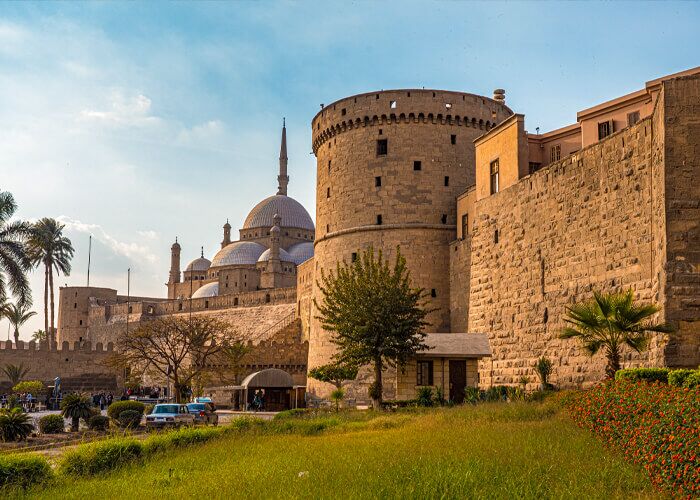
The Citadel of Saladin is one of the most powerful and atmospheric landmarks in Cairo. It is not simply an old fort on a hill. It is a symbol of the city’s medieval strength, its Islamic heritage, and its long relationship with power, protection, and architecture. For nearly eight centuries, the Citadel has watched over Cairo from its high limestone ridge, offering visitors a rare combination of history, panoramic views, mosques, museums, and the feeling of standing inside one of the most important defensive complexes ever built in the region.
Founded by Salah El-Din, also known as Saladin, in the twelfth century, the Citadel was created to protect Cairo from outside threats and to serve as a seat of government for centuries to come. Over time, it became much more than a military fortress. It became a royal residence, a political center, a religious complex, and a monumental stage where some of Egypt’s most important rulers left their mark. Ayyubid, Mamluk, and Ottoman influences can still be felt in its walls, gates, courtyards, mosques, and terraces.
Today, the Citadel is one of Cairo’s most rewarding stops for travelers who want to understand the city beyond the pyramids. While the Giza Pyramids Complex shows the ancient world at its most monumental, the Citadel reveals medieval Cairo at its most dramatic. From its terraces, you can look across the city and see how layers of history overlap: minarets, domes, old neighborhoods, modern streets, and distant desert edges all appear in one sweeping view.
This guide is written for first-time visitors, returning travelers, families, couples, solo explorers, history lovers, and anyone who wants to plan a smooth and meaningful visit to the Citadel of Saladin. We will explore its history, what you can see inside, the best time to visit, how much time you need, practical ticket and transport tips, safety advice, photography suggestions, and how to combine the Citadel with nearby Islamic and Coptic attractions. You will also find links to related guides on this website so you can place the Citadel within a wider Cairo itinerary and a broader Egypt journey.
Whether you are spending one day in Cairo or building a longer route through Egypt, the Citadel deserves attention. It is one of those places that gives you more than a photo opportunity. It gives you perspective, literally and historically. From above the city, Cairo becomes easier to understand: not as a single modern capital, but as a layered civilization that has been defended, ruled, rebuilt, and admired for centuries.
The Citadel of Saladin is more than a fortress. It is a balcony over history, a place where Cairo reveals itself through minarets, stone walls, and the long memory of power.
Quick Answer: What Is the Citadel of Saladin?
The Citadel of Saladin is a historic fortified complex in Cairo, Egypt, founded by Salah El-Din in the twelfth century to defend the city and serve as a seat of government. It is one of the most important medieval landmarks in Cairo and includes mosques, courtyards, museums, gates, terraces, and panoramic viewpoints. Its most famous structure is the Mosque of Muhammad Ali, with its tall minarets and Ottoman-style dome. Visitors usually spend one to three hours exploring the Citadel, especially when combining it with nearby Islamic Cairo attractions such as the Al-Azhar Mosque, the Sultan Hassan Mosque, the Al-Refai Mosque, and the Ibn Tulun Mosque. The Citadel is best visited early in the morning or late in the afternoon, when the light is softer and the views over Cairo are most beautiful.
Why the Citadel of Saladin Matters
The Citadel matters because it changed the way Cairo was defended, governed, and imagined. Before its construction, Cairo was already a major city, but the fortress gave it a new strategic center on high ground. From this elevated position, rulers could monitor the city, protect it from attack, and project authority over the surrounding landscape. The Citadel was not built only for war. It was built for control, visibility, and permanence.
Salah El-Din, the Kurdish Muslim leader who founded the Ayyubid dynasty, is remembered across the Islamic world for his role in the Crusader period and for recapturing Jerusalem in 1187. But in Cairo, his legacy is also architectural and political. The Citadel represents his ambition to strengthen Egypt as a center of power. It became a symbol of a unified defense system and of a city that needed both spiritual and military protection.
Over the centuries, the Citadel became the residence of rulers and the stage for important historical events. Mamluk sultans expanded it, Ottoman governors used it, and Muhammad Ali Pasha later made it the center of his modernizing state. This means the Citadel is not frozen in one period. It is a layered monument where Ayyubid foundations, Mamluk architecture, Ottoman influence, and later restorations all meet.
For travelers, the Citadel matters because it offers a different side of Egypt. Many visitors come expecting pharaonic temples and pyramids. Cairo delivers those wonders through the Giza Plateau and museums, but the Citadel shows the medieval Islamic city at its most dramatic. It helps you understand how Egypt continued to evolve after antiquity, how religion and politics shaped architecture, and how rulers used monumental building to communicate power.
The Citadel also matters because of its view. Standing on its terraces, you can see Cairo spread below you in all its complexity. The city feels vast, ancient, noisy, and alive at the same time. That perspective is difficult to find elsewhere. It makes the Citadel not only a historical site but also one of the best places in Cairo to understand the city’s scale and character.
To understand Cairo, you must see it from above. The Citadel gives you that height, and with it comes a deeper sense of the city’s history.
The History of the Citadel: From Saladin to Muhammad Ali
The story of the Citadel begins in the late twelfth century, when Salah El-Din decided that Cairo needed a stronger defensive center. The city had grown in importance, but it was vulnerable. A fortress on the Mokattam Hills would allow rulers to protect Cairo, control movement, and create a secure administrative heart above the urban sprawl.
Construction began around 1176 CE. The site was chosen carefully. The ridge offered natural elevation, visibility, and protection. The fortress was intended to be both a military stronghold and a royal residence. Over time, it became one of the largest citadels in the Islamic world, a walled city within a city.
During the Ayyubid period, the Citadel established itself as a center of power. But it was under the Mamluks that it reached its architectural and political peak. The Mamluk sultans, who ruled Egypt from the thirteenth to the sixteenth century, expanded the complex, built palaces, mosques, courtyards, and ceremonial spaces. They used the Citadel not only as defense but as a statement of legitimacy and glory.
One of the most important Mamluk structures inside the Citadel is the Mosque of al-Nasir Muhammad. Though smaller and less visually dominant than the Mosque of Muhammad Ali, it is architecturally significant and reflects the refined taste of Mamluk building. Its columns, arches, courtyard, and prayer hall show how Egyptian Islamic architecture developed through reuse, innovation, and spiritual symbolism.
The Ottoman period brought another layer. After the Ottoman conquest of Egypt in the sixteenth century, the Citadel remained important as an administrative and military center. Ottoman style influence can be seen in later constructions, especially in the great mosque that now defines the Cairo skyline: the Mosque of Muhammad Ali.
Muhammad Ali Pasha, the Albanian Ottoman governor who became the founder of modern Egypt, ruled in the early nineteenth century and used the Citadel as his seat of power. He demolished earlier structures and built the Mosque of Muhammad Ali as a monumental statement of his dynasty. The mosque, with its cascading dome and slender minarets, remains the most visible symbol of the Citadel today.
This layered history is what makes the Citadel so rewarding. It is not one building from one century. It is a complex where Saladin’s strategic vision, Mamluk artistic achievement, Ottoman imperial style, and Muhammad Ali’s modernizing ambition all converge.
The Citadel is a history book written in stone. Each gate, mosque, terrace, and wall belongs to a different chapter of Cairo’s long story.
Where the Citadel Is Located in Cairo
The Citadel is located on a ridge of the Mokattam Hills in eastern Cairo, overlooking the historic city center. Its position is not accidental. It was built to dominate the landscape and protect the city below. Today, that same elevation makes it one of the best viewpoints in Cairo.
From the Citadel, visitors can look across Islamic Cairo, see minarets and domes clustered together, and in clear weather catch distant views toward the Nile and the city’s modern districts. The contrast between old and new Cairo is visible from the terraces, making the site especially powerful for first-time visitors.
The Citadel is also close to some of Cairo’s most important Islamic and Coptic attractions. Below its walls lies the area around Saladin Street, where the Sultan Hassan Mosque and the Al-Refai Mosque stand near one another. A short distance away is the Al-Azhar Mosque, one of the most important religious institutions in the Islamic world. Farther along, the Ibn Tulun Mosque offers another masterpiece of early Islamic architecture.
This location makes the Citadel an ideal anchor for a wider Cairo cultural day. You can combine it with Islamic Cairo, Coptic Cairo, the Hanging Church, the Ben Ezra Synagogue, and the Mosque of Amr Ibn Al-As. For a broader overview, see our guide to tourist places in Egypt and our article on things to do in Egypt.
The Citadel is not just in Cairo. It is above Cairo, and from that height it becomes the city’s best observer.
What You Can See Inside the Citadel of Saladin
The Citadel is a large complex, and what you see depends on your time, interests, and energy. Some visitors come mainly for the view and the Mosque of Muhammad Ali. Others explore the museums, older mosques, gates, and terraces in more detail. The best approach is to decide before arrival whether you want a quick highlight visit or a slower historical exploration.
1. The Mosque of Muhammad Ali
The Mosque of Muhammad Ali is the most famous structure inside the Citadel and one of the most recognizable landmarks in Cairo. Built in the nineteenth century in an Ottoman style, it dominates the skyline with its large central dome and tall pencil-shaped minarets. From many points in the city, the mosque appears as a white silhouette against the sky.
Inside, the mosque is spacious, bright, and serene. The prayer hall is decorated with marble, chandeliers, calligraphy, and a large carpet. The dome rises above the central space, creating a sense of vertical calm. Visitors often describe the interior as unexpectedly peaceful, especially after the noise and movement of Cairo below.
The mosque is not only beautiful but symbolic. Muhammad Ali used it to express the power and modernity of his dynasty. Its Ottoman style connects Egypt to a wider imperial world, while its location inside the Citadel ties it to centuries of Egyptian rulership. For many travelers, the Mosque of Muhammad Ali is the emotional center of the visit.
2. The Mosque of al-Nasir Muhammad
The Mosque of al-Nasir Muhammad is one of the oldest and most architecturally interesting parts of the Citadel. It reflects the Mamluk period at its refined best. Though less dramatic than the Mosque of Muhammad Ali, it is deeply rewarding for travelers who enjoy historical detail.
The mosque has a courtyard, arcades, and a prayer hall with columns and arches that show influences from earlier periods. Some materials were reused from older buildings, a common practice in medieval Islamic architecture. This reuse was not a sign of weakness. It was a way of connecting new construction to the memory of the past.
Visiting this mosque helps you understand that the Citadel is not dominated by one style or one century. It is a place where Mamluk craftsmanship, Ayyubid foundations, and Ottoman monumentalism coexist. If you enjoy architecture, spend time here. The details are quieter but often more historically revealing.
3. The Mosque of Suleiman Pasha
The Mosque of Suleiman Pasha is another important structure within the Citadel complex. It is named after Suleiman Pasha, a son of Muhammad Ali, and it reflects the Ottoman architectural tradition in a more intimate setting. The mosque is smaller than the Mosque of Muhammad Ali but still worth noticing.
Its dome, courtyard, and prayer space offer a calmer experience. For visitors who want to understand the nineteenth-century Ottoman presence in Egypt, this mosque adds useful context. It also provides a quieter corner within a site that can become busy around the main attractions.
4. The Gawhara Terrace and Viewpoints
One of the most rewarding parts of the Citadel is the view from its terraces. The Gawhara Terrace is especially popular because it offers a sweeping panorama over Cairo. On clear days, you can see minarets, rooftops, historic districts, and the distant horizon where city meets desert.
This is the place where many visitors pause longest. Not because there is a famous object to photograph, but because the city itself becomes the exhibit. Cairo looks vast, layered, and alive. The view helps you understand why the Citadel was built here: whoever controlled this height could watch over the city below.
If you are visiting for photography, the terrace is one of the best stops. Early morning light is soft and clear, while late afternoon gives warmer tones and longer shadows. Sunset can be dramatic, but it may also be crowded.
5. Museums Inside the Citadel
The Citadel also contains museums that add depth to the visit. Depending on current openings, you may find displays related to Egyptian military history, police history, royal documents, costumes, and artifacts connected to the site’s long administrative role. These museums are not always the main reason people visit, but they can enrich the experience.
For travelers who enjoy context, the museums help explain how the Citadel functioned as a seat of power. It was not only a fortress or a mosque complex. It was a governing space where state ceremonies, military organization, and royal authority were performed.
If you are interested in museums across Cairo, you may also want to visit the Egyptian Museum or the Grand Egyptian Museum. For a broader museum overview, see our guide to top museums in Egypt.
6. Gates, Walls, and Defensive Architecture
The Citadel’s walls and gates are easy to overlook when visitors rush toward the mosques and viewpoints, but they are essential to the site’s identity. The fortress was built to be defended, and its architecture reflects that purpose. Thick walls, controlled entrances, elevated positions, and layered courtyards all served strategic functions.
Walking through the gates helps you imagine the Citadel in its military prime. It was not an open tourist site. It was a protected world, with controlled access and internal spaces designed for ruling, residence, worship, and defense.
Pay attention to stone textures, arch shapes, and the way paths rise and turn. The Citadel’s design is not only beautiful. It is intelligent. Every element served a purpose.
The Citadel teaches you that power in medieval Cairo was built into the landscape: walls to protect, mosques to sanctify, terraces to watch, and gates to control.
Best Time to Visit the Citadel of Saladin
The best time to visit the Citadel is early in the morning, shortly after opening. This is when the light is soft, the temperature is more comfortable, and the site feels calmer. Early visits are especially useful if you want to enjoy the view without large crowds blocking the terraces.
Late afternoon can also be excellent, particularly if you want golden light over Cairo. The city takes on warmer tones, and the white stone of the Mosque of Muhammad Ali glows beautifully. However, popular viewpoints may be busier near sunset, so arrive with enough time and patience.
In terms of season, the most comfortable months to visit Cairo and the Citadel are generally from October to April. During this period, daytime temperatures are milder, making outdoor walking and sightseeing much more pleasant. If you are planning a wider trip, our guides to Egypt in October and Egypt in November can help you choose the right window.
Summer visits are possible, but the heat can be intense. Cairo is a large city, and the Citadel involves walking on stone paths, stairs, and open terraces. If you travel in summer, start early, carry water, wear sun protection, and avoid staying too long during the hottest part of the day. For broader seasonal advice, see our article on climate and weather in Egypt.
If you are visiting during Ramadan, the atmosphere in Cairo changes. Days can feel quieter, evenings more lively, and some schedules may shift. Our guide to Ramadan in Egypt can help you plan respectfully around local rhythms.
The Citadel is best seen when Cairo is calm: early morning for clarity, late afternoon for gold, and sunset for memory.
How Much Time Do You Need at the Citadel?
For most visitors, one to two hours is enough to see the main highlights of the Citadel. This allows time to visit the Mosque of Muhammad Ali, walk the terraces, see the viewpoint, and explore one or two additional structures without rushing.
If you are interested in architecture, museums, and Mamluk history, you may want two to three hours. The site is large, and some areas reward slow attention. You may find yourself lingering over columns, arches, inscriptions, and the changing light on stone.
For families with children, keep the visit shorter and focused. The main mosque and the view are usually enough. Younger travelers may lose interest if the visit becomes too long or too historical, especially in the heat.
If you are combining the Citadel with Islamic Cairo and Coptic Cairo, plan for a half-day or full-day route. A strong morning might include the Citadel, Sultan Hassan Mosque, Al-Refai Mosque, and Al-Azhar Mosque. A full day can add Ibn Tulun Mosque, Bayt Al-Suhaymi, the Hanging Church, Ben Ezra Synagogue, and the Mosque of Amr Ibn Al-As.
For structured itineraries, see our private Islamic and Coptic Cairo day tour and our private day tour Cairo sightseeing options.
One hour gives you the view. Two hours gives you the mosques. Three hours gives you the Citadel’s layered soul.
Tickets, Entry, and Practical Visitor Information
Entry to the Citadel usually requires a ticket, and prices can vary for international visitors, Egyptian residents, and Arab residents. Some areas inside the complex may have separate access rules, especially museums or specific mosques. Before visiting, check current opening hours, ticket prices, and whether any sections are closed for maintenance.
Security checks are normal at major sites in Cairo. Bags may be inspected, and large luggage is usually not permitted inside. If you are visiting as part of a tour, your guide or driver can advise you on the best entrance and timing.
When visiting mosques inside the Citadel, dress modestly. Shoulders and knees should be covered, and women may need to cover their hair in certain prayer areas. Shoes are usually removed before entering prayer halls. Carry socks or slip-on shoes for convenience.
Photography rules may vary by area. Some spaces allow photos without flash, while others restrict photography during prayer times or in sensitive zones. Always look for signs and ask staff if you are unsure.
Because the Citadel is on elevated ground, expect stairs, slopes, and uneven stone paths. Visitors with mobility concerns should plan carefully and consider private transport close to the entrance. A guided visit can make navigation easier and more comfortable.
A smooth Citadel visit depends on small preparations: modest dress, comfortable shoes, current ticket information, and enough time to move calmly.
How to Get to the Citadel of Saladin
The Citadel is located in eastern Cairo, and most visitors reach it from hotels in downtown Cairo, Giza, Heliopolis, or the airport. Travel time can vary significantly depending on traffic. Cairo traffic is one of the most important planning factors for any visit.
Private transport is usually the most comfortable option. A hired car or driver can take you directly to the Citadel entrance and then continue to nearby Islamic Cairo sites. This is especially useful if you are combining the Citadel with other attractions in one day.
Taxis and ride-hailing apps can also be used, but you should confirm the destination carefully. Because the Citadel has multiple access roads and entrances, unclear instructions can lead to confusion. If you use an app, check the drop-off point and be ready to communicate with the driver.
Public transport is possible but not always the easiest option for first-time visitors. The Cairo Metro can get you close to central areas, but the final route to the Citadel may still require a taxi. For a smooth day, a guided tour or private driver is usually better.
For broader Cairo planning, see our Cairo destination guide and our practical Egypt travel tips.
In Cairo, transport is not just logistics. It is part of the art of planning, and the Citadel is a place where good timing matters as much as good eyesight.
Is the Citadel Safe for Tourists?
The Citadel is generally safe for tourists. Security is visible around major sites in Cairo, and the Citadel is a well-established cultural destination. Millions of visitors explore the area each year without serious issues.
As with any busy urban attraction, normal awareness is recommended. Keep your belongings secure, stay on official routes, and avoid isolated areas outside designated visiting zones. Be cautious with phones, cameras, and bags, especially near entrances, parking areas, and crowded viewpoints.
The most common issues travelers encounter are not violent crimes but minor hassles: persistent vendors, unofficial guides, inflated prices, or pressure to buy services. These situations can be managed with politeness, firmness, and preparation. A simple “no thank you” is usually enough.
If you are visiting independently, use reputable transport and confirm ticket information at official entrances. If you are traveling with a guide, choose a licensed and experienced professional. This reduces stress and helps you move smoothly between sites.
For broader safety advice, read our guide on whether it is safe to travel to Egypt. For practical guidance on common tourist pressures, see our article on tourist scams in Egypt.
The Citadel has protected Cairo for centuries. Today, your job is simply to protect your peace of mind with awareness, respect, and good planning.
What to Wear and What to Pack for the Citadel
The Citadel is an outdoor and semi-outdoor historical site with mosques, stone paths, terraces, and stairs. Comfortable walking shoes are essential. The ground can be uneven, and you may walk more than you expect, especially if you combine the visit with nearby Islamic Cairo attractions.
Dress modestly, especially because you will be visiting active or historically significant mosques. Shoulders and knees should be covered. Women may need to carry a scarf for hair coverage in certain prayer areas. Lightweight breathable clothing is practical, especially in warmer months.
Bring a sun hat, sunglasses, sunscreen, a reusable water bottle, tissues, hand sanitizer, and a small backpack. A power bank is useful if you plan to take many photos or use your phone for maps and tickets.
If you are visiting in the early morning or late afternoon, a light layer can be helpful. Evenings in Cairo can feel cooler, and shaded stone areas inside the Citadel may feel breezy.
For a complete checklist, see our guide to what to pack when traveling to Egypt.
At the Citadel, your best accessories are modest clothing, comfortable shoes, water, and the willingness to look closely.
Photography Tips for the Citadel of Saladin
Photographing the Citadel is one of the highlights of a Cairo visit. The site offers dramatic architecture, sweeping city views, and iconic images of the Mosque of Muhammad Ali. The best light is usually early morning or late afternoon, when shadows are softer and the stone glows warmly.
Wide-angle shots work well for the mosque exterior, courtyards, and panoramic views. Closer details can reveal arches, calligraphy, marble patterns, dome shapes, and the texture of ancient walls. Do not focus only on the main mosque. Some of the best images come from quieter corners, gateways, and columns.
When photographing inside mosques, be respectful. Avoid shooting during prayer, do not disturb worshippers, and follow signage. If you are unsure whether photography is allowed, ask staff or your guide.
The terraces are excellent for cityscape photography. On clear days, Cairo stretches below you in layers of minarets, rooftops, and haze. If you want cleaner shots, arrive early before crowds gather at the viewpoints.
The best Citadel photograph is not always the widest view. Sometimes it is the shadow of an arch, the line of a minaret, or the quiet face of a city seen from above.
Visiting the Citadel with Kids
The Citadel can be a good stop for families, especially for children who enjoy castles, walls, high views, and large mosques. The idea of a fortress above the city is easy for younger travelers to understand, and the view often creates a sense of wonder.
To make the visit engaging, keep it short and interactive. Let children look for minarets, count domes, imagine soldiers on the walls, or spot landmarks from the terrace. You do not need to explain every dynasty. A few vivid images are enough.
The heat, stairs, and crowds can become tiring, so bring water, hats, sunscreen, and snacks if needed. If your family wants a smoother experience, consider a private guide who knows how to make Cairo history accessible for children.
For broader family advice, see our guide to Egypt with kids and our family tours Egypt page.
Children do not need a full lecture on the Ayyubids. They need to stand above Cairo, see the minarets, and feel that history can be enormous.
Solo Travel and Romantic Travel at the Citadel
Solo travelers often find the Citadel deeply rewarding. The site invites reflection, and the view over Cairo can feel surprisingly personal. Standing above the city, watching the call to prayer echo across minarets, or simply observing the urban sprawl can create a memorable moment of solitude.
If you are traveling alone, plan transport carefully and use trusted drivers or tours. The area is generally safe, but as in any busy city, awareness is important. For broader solo advice, see our guides to tips when traveling to Egypt alone and the solo female travel Egypt guide.
For couples, the Citadel can be romantic in a quiet, historic way. The view at sunset, the white mosque against the sky, and the sense of standing above a city with centuries of stories can create an intimate atmosphere. Pair the visit with a calm dinner or a walk through Islamic Cairo for a balanced evening.
If you are planning a romantic route through Egypt, our Egypt honeymoon itinerary guide can help you combine culture with comfort.
There is something romantic about high places. The Citadel gives you distance from the noise and closeness to the memory of Cairo.
Budget Tips for Visiting the Citadel
The Citadel can be visited on different budgets. Independent travel with public or app-based transport is usually cheaper, but it requires more planning and confidence. Guided tours cost more but can save time, reduce confusion, and provide historical context.
If you are budget-conscious, consider combining the Citadel with nearby Islamic Cairo sites in one route. Booking separate short trips can become inefficient. Also, bring your own water and snacks to avoid paying inflated prices near tourist areas.
If you prefer comfort, private tours with air-conditioned vehicles are often the best value for time and energy. This is especially true if you are traveling in warmer months or with family. For broader pricing guidance, see our article on Egypt travel costs.
For value-focused options, visit our Egypt budget tours page. For higher-end comfort, see our guides to luxury hotels in Egypt and 5-star hotels in Cairo Egypt.
The best budget tip for the Citadel is not to skip it. It is to combine it wisely with nearby sites so your time and money work together.
Common Mistakes to Avoid at the Citadel
One of the most common mistakes is arriving too late in the day. By mid-afternoon, the site can be hotter and more crowded. If you want a peaceful experience, early morning is one of the simplest and most effective strategies.
Another mistake is focusing only on the Mosque of Muhammad Ali. The mosque is magnificent, but the Citadel is larger than one building. The older mosques, terraces, gates, museums, and views all add depth to the visit.
Travelers also sometimes underestimate the amount of walking involved. The Citadel is not a flat, compact stop. It includes slopes, stairs, stone paths, and multiple levels. Comfortable shoes and pacing matter.
Finally, many visitors rush through without pausing at the viewpoint. That is a missed opportunity. The view is not just a photo background. It is part of the historical meaning of the place.
The biggest mistake at the Citadel is treating it as a quick mosque visit. It is a fortress, a viewpoint, a museum, and a piece of Cairo’s soul.
Cultural Etiquette and Respectful Travel at the Citadel
The Citadel contains active and historically significant mosques, so respectful behavior is important. Dress modestly, speak softly, and avoid disruptive photography. If prayer is taking place, keep your distance and do not walk in front of worshippers.
Remove shoes when required and follow signs at mosque entrances. Women may need to cover their hair in certain areas, so carrying a light scarf is useful. Men and women should both avoid overly revealing clothing.
When photographing people, ask permission. Local workers, guards, vendors, and visitors are not part of the scenery. A friendly gesture and a smile can lead to better interactions than a hidden shot.
Tipping may come up for guides, drivers, restroom attendants, or helpers. For clear advice, read our guide to tipping in Egypt.
Respect at the Citadel is simple: dress modestly, move quietly, ask before photographing people, and remember that this is a sacred and historical space.
Combining the Citadel with Islamic Cairo
The Citadel is most rewarding when combined with the surrounding area of Islamic Cairo. Just below its walls, you can visit some of the most important mosques and historical sites in the city. This creates a powerful half-day or full-day route through medieval Cairo.
A short walk from the Citadel brings you to the Sultan Hassan Mosque, one of the largest and most impressive Mamluk monuments in Cairo. Its towering façade, madrasa layout, and monumental scale make it a essential stop. Nearby is the Al-Refai Mosque, known for its elegant interior and royal connections.
The Al-Azhar Mosque is also close by and is one of the most important religious institutions in the Islamic world. Founded in the Fatimid period, Al-Azhar has served as a mosque, university, and center of scholarly tradition for over a thousand years.
Farther along, the Ibn Tulun Mosque offers one of the oldest and most spacious mosque complexes in Cairo. Its spiral minaret, courtyard, and brick architecture create a very different atmosphere from the Ottoman elegance of the Mosque of Muhammad Ali.
If you want to explore historic houses and domestic architecture, the Bayt Al-Suhaymi is a wonderful addition. It gives you a sense of how wealthy families lived in old Cairo and adds a human layer to the city’s monumental history.
For a structured route, consider our private Islamic and Coptic Cairo day tour.
The Citadel is the crown of Islamic Cairo, but the city below it is the jewel box. Together, they reveal centuries of faith, power, and art.
Combining the Citadel with Coptic Cairo
Cairo’s religious history is not limited to Islam. Coptic Cairo, not far from the Citadel area, preserves some of the most important early Christian sites in Egypt. Combining the Citadel with Coptic Cairo creates a powerful day of interfaith and historical exploration.
The Hanging Church is one of the most famous Coptic sites in Cairo. Its name comes from the fact that it was built above a Roman gatehouse. The church is small but deeply atmospheric, with wooden ceilings, icons, and a sense of ancient devotion.
Nearby, the Church of St. George offers another quiet glimpse into Coptic tradition. Its dome and interior decoration reflect centuries of Christian worship in Egypt.
The Ben Ezra Synagogue adds yet another layer to the spiritual landscape of Old Cairo. According to tradition, it is connected to the story of Moses and has long been an important Jewish site in Egypt.
The Mosque of Amr Ibn Al-As is also located in this area and is traditionally considered the first mosque built in Africa. Together, these sites show how Cairo has been a city of coexistence, succession, and layered sacred memory.
For a combined visit, see our private day tour to the Egyptian Museum and Old Cairo.
Cairo is not one religion, one century, or one story. The Citadel and Coptic Cairo together show how many sacred voices echo in the same city.
Combining the Citadel with Giza and the Museums
If you have more time in Cairo, the Citadel can be combined with the Giza Pyramids Complex, the Great Sphinx of Giza, the Egyptian Museum, or the Grand Egyptian Museum. This creates a fuller picture of Egypt, from ancient monarchy to medieval Islamic power.
A strong full-day route might begin with the Giza Pyramids early in the morning, continue to the Grand Egyptian Museum for context and comfort, and finish with the Citadel at late afternoon for views over Cairo. Alternatively, you can start with the Citadel and Islamic Cairo in the morning, then move to Giza later in the day.
If you are interested in the evolution of Egyptian monumental architecture, you can also add the Ancient City of Memphis and the Step Pyramid of Zoser at Saqqara. These sites help connect the Old Kingdom roots of Egyptian statecraft with later medieval centers of power.
For structured combinations, see our private day tour to the Egyptian Museum and Pyramids of Giza and our private day tour to the Grand Egyptian Museum and Pyramids of Giza.
Giza shows Egypt’s ancient eternity. The Citadel shows its medieval strength. Together, they reveal two great chapters of the same civilization.
Suggested Citadel Itineraries
Short Half-Day Route: Citadel and Islamic Cairo
This is the most practical route for travelers with limited time. Start early at the Citadel, visit the Mosque of Muhammad Ali, walk the terraces, and enjoy the view. Then descend to the nearby Sultan Hassan Mosque and Al-Refai Mosque. If time allows, continue to the Al-Azhar Mosque.
Full-Day Route: Citadel, Islamic Cairo, and Coptic Cairo
For a deeper Cairo experience, combine the Citadel with Islamic Cairo in the morning and Coptic Cairo in the afternoon. Add the Ibn Tulun Mosque, the Hanging Church, the Ben Ezra Synagogue, and the Mosque of Amr Ibn Al-As. This route shows Cairo as a city of many faiths and centuries.
Sunset Route: Citadel and Cairo Views
If you want a more romantic or photographic visit, arrive at the Citadel in the late afternoon. Explore the Mosque of Muhammad Ali, then move to the terrace for sunset. The city below turns golden, and the minarets create one of the most memorable views in Cairo. Finish the evening with dinner or a quiet walk nearby.
Museum-Focused Route: Citadel and Grand Egyptian Museum
For a balanced cultural day, combine the Citadel with the Grand Egyptian Museum. Visit the Citadel in the morning for medieval history and views, then spend the afternoon in the museum for ancient artifacts and air-conditioned comfort. This route works well for families and first-time visitors.
The best Citadel itinerary is not the one with the most stops. It is the one that gives you time to look up, look out, and understand why the fortress was built.
Guided Tours vs Independent Visits to the Citadel
You can visit the Citadel independently or with a guide. Independent travel gives flexibility and lower cost. Guided visits provide historical context, transport support, and help with logistics. For first-time visitors, a guide is often worth it, especially if you are combining the Citadel with Islamic Cairo and Coptic Cairo.
The Citadel is easy to navigate, but its meaning is deeper than its visible stones. A good guide can explain Saladin’s strategy, Mamluk architecture, Ottoman influence, and the political role of the fortress over centuries. Without interpretation, some visitors may see only a mosque and a view. With guidance, they see a civilization’s defensive and spiritual heart.
If you prefer independence, read a short overview before arrival, plan your transport, and allow enough time for traffic. Also, be prepared for vendor approaches near tourist sites. A polite but firm attitude helps.
For structured options, see our Egypt guided tours and Egypt sightseeing tours pages.
A guide cannot give you wonder, but it can remove confusion so wonder has room to arrive.
What the Citadel Feels Like: Atmosphere, Height, and Memory
The Citadel has a distinctive atmosphere. It feels elevated in every sense. The air is often clearer above the city, the stone is warm underfoot, and the view makes Cairo feel both enormous and intimate. You hear the city below, but you are slightly removed from it.
Inside the mosques, the mood changes. The Mosque of Muhammad Ali feels bright, spacious, and ceremonial. The older Mamluk spaces feel more textured and historical. The terraces feel open and reflective. Each area gives a different emotional experience.
What makes the Citadel memorable is not only its architecture but its sense of continuity. Rulers built here to protect power. Prayers were offered here to sanctify authority. Visitors now come here to understand both. The site carries the weight of centuries without feeling dead.
If you allow yourself to slow down, the Citadel becomes more than a tourist stop. It becomes a place of perspective. You see Cairo, but you also see time.
The Citadel does not only overlook Cairo. It remembers it.
Frequently Asked Questions About the Citadel of Saladin
Is the Citadel of Saladin worth visiting?
Yes. The Citadel of Saladin is one of the most important historical sites in Cairo and one of the best places to understand the city’s medieval Islamic heritage. It offers mosques, museums, fortress architecture, and panoramic views over Cairo. Even if you only have limited time, a visit to the Citadel can add depth and perspective to your Cairo itinerary.
How much time do you need at the Citadel?
Most visitors need one to two hours to see the main highlights, including the Mosque of Muhammad Ali, the terraces, and the viewpoint. If you want to explore older mosques, museums, and architectural details, plan for two to three hours. Families with children may prefer a shorter visit.
What is the most famous part of the Citadel?
The most famous part is the Mosque of Muhammad Ali, with its large dome and tall minarets. It is one of the most recognizable landmarks in Cairo and dominates the skyline from many parts of the city. However, the Citadel also contains older Mamluk structures, museums, gates, and terraces that are worth exploring.
Can you visit the Citadel and Islamic Cairo in one day?
Yes, this is one of the best day-trip combinations in Cairo. You can start at the Citadel, then visit the Sultan Hassan Mosque, Al-Refai Mosque, Al-Azhar Mosque, and Ibn Tulun Mosque. If you have more time, add Bayt Al-Suhaymi and Coptic Cairo for a fuller historical day.
Is the Citadel safe for tourists?
Yes, the Citadel is generally safe for tourists. Security is visible at major sites, and the area is well known to guides and drivers. As always, keep your belongings secure, use reputable transport, and stay aware of your surroundings. Most issues visitors encounter are minor hassles rather than serious safety concerns.
Do I need a guide at the Citadel?
A guide is not mandatory, but it is highly recommended for first-time visitors. The Citadel is historically rich, and a good guide can explain Saladin’s fortress, Mamluk architecture, Ottoman influence, and the site’s role in Cairo’s governance. If you prefer independence, read a short overview before arrival.
What should I wear to the Citadel?
Wear modest, comfortable clothing and walking shoes. Shoulders and knees should be covered, especially when entering mosques. Women may need a scarf for hair coverage in certain prayer areas. A hat, sunglasses, and sunscreen are useful because the site is partly open-air.
Can you take photos inside the Citadel?
Photography is often allowed in many areas, but rules can vary by mosque and exhibition space. Flash may be restricted, and some areas may prohibit photos during prayer. Always follow signage and ask staff if you are unsure.
Is the Citadel suitable for children?
Yes, the Citadel can be suitable for children, especially if you keep the visit short and focus on the view, the large mosque, and the fortress atmosphere. However, stairs, heat, and crowds can become tiring. Bring water, hats, and plan breaks.
What is the best time of day to visit the Citadel?
Early morning is usually best because the light is soft, the temperature is cooler, and crowds are smaller. Late afternoon is also excellent for golden views over Cairo. Avoid the hottest part of the day, especially in summer.
Can you visit the Citadel and the Pyramids of Giza in one day?
Yes, but timing and traffic matter. A common route is to visit the Pyramids of Giza early, then spend the afternoon at the Citadel or combine the Citadel with the Grand Egyptian Museum. Because Cairo traffic can be unpredictable, private transport or a guided tour is usually the smoothest option.
What is the difference between the Citadel and the Mosque of Muhammad Ali?
The Citadel is the entire fortified complex founded by Saladin, including walls, gates, mosques, museums, terraces, and historical structures. The Mosque of Muhammad Ali is one famous mosque inside the Citadel. Many visitors use the names interchangeably, but the mosque is only one part of the larger fortress complex.
Is the Citadel open every day?
The Citadel is generally open daily, but hours can change due to season, holidays, maintenance, or special circumstances. Before visiting, check current opening times and ticket information. If you are combining it with a tour, your guide or operator can confirm the best schedule.
Can you see the whole city from the Citadel?
On clear days, the Citadel offers excellent panoramic views over Cairo, including Islamic Cairo, minarets, rooftops, and distant parts of the city. Visibility can be affected by haze, traffic pollution, and weather, but the view remains one of the most rewarding experiences at the site.
Should I visit the Citadel before or after Coptic Cairo?
Either order can work. Many travelers visit the Citadel and Islamic Cairo in the morning, then continue to Coptic Cairo in the afternoon. This route flows geographically and historically, allowing you to move from medieval Islamic power to early Christian heritage in one day.
Related Words and Topics Around the Citadel of Saladin
If you are researching the Citadel of Saladin, you may also be searching for terms such as Cairo Citadel, Saladin Citadel Egypt, Mosque of Muhammad Ali, Islamic Cairo tour, Citadel of Cairo history, best viewpoint in Cairo, Cairo fortress, Al-Azhar Mosque near Citadel, Sultan Hassan Mosque, Coptic Cairo day trip, Cairo Islamic landmarks, and Citadel tickets. These topics all connect to the same experience: standing above Cairo in a place where military power, religious architecture, and city history meet.
- Citadel of Saladin for the main site guide
- Cairo for city context and attractions
- Al-Azhar Mosque for nearby Islamic heritage
- Sultan Hassan Mosque for Mamluk architecture
- Al-Refai Mosque for royal and religious history
- Ibn Tulun Mosque for early Islamic Cairo
- Hanging Church for Coptic Cairo context
- Giza Pyramids Complex for ancient Cairo comparisons
- Egypt travel tips for practical preparation
Final Thoughts: Why the Citadel Stays With You
The Citadel of Saladin is not the most famous monument in Egypt, but it may be one of the most revealing. It shows how Cairo was defended, how power was centered, how religion was built into stone, and how a city can be understood from above. It gives travelers more than a view. It gives them context.
Many visitors arrive expecting a single mosque and leave with a deeper impression of Cairo’s layered identity. The Citadel is Ayyubid strategy, Mamluk artistry, Ottoman grandeur, and modern memory all in one place. It is a fortress, a sanctuary, a viewpoint, and a historical mirror.
If you plan your visit well, dress respectfully, arrive early, and allow time to pause at the terrace, the Citadel can become one of the highlights of your Cairo trip. It is not a place to rush. It is a place to stand still and let the city unfold below you.
The Citadel does not simply show you Cairo. It helps you feel the weight of centuries that built it, protected it, prayed in it, and watched from it.
Ready to Explore the Citadel and Islamic Cairo Without Stress?
Let Egypt Via Travel help you plan a smooth Cairo journey that combines the Citadel of Saladin, Islamic Cairo, Coptic Cairo, museums, and private transport with comfort, clarity, and expert guidance.